











 Secure payments
Standard refund policy
Trade Assurance
Secure payments
Standard refund policy
Trade Assurance
| Product Type | Memory Module |
|---|---|
| Memory Capacity | 32 GB |
| Memory Technology | DDR5 |
| RAM Speed | 6400 MHz |
| RAM Standard | DDR5-6400/PC5-51200 |
| Error Identifying | ECC |
| Signal Type | Registered |
| Column Access Strobe (CAS) | CL52 |
| Rank | Dual Rank x8 |
| Quantity of Pins | 288-pin |
| RAM Genre | RDIMM |
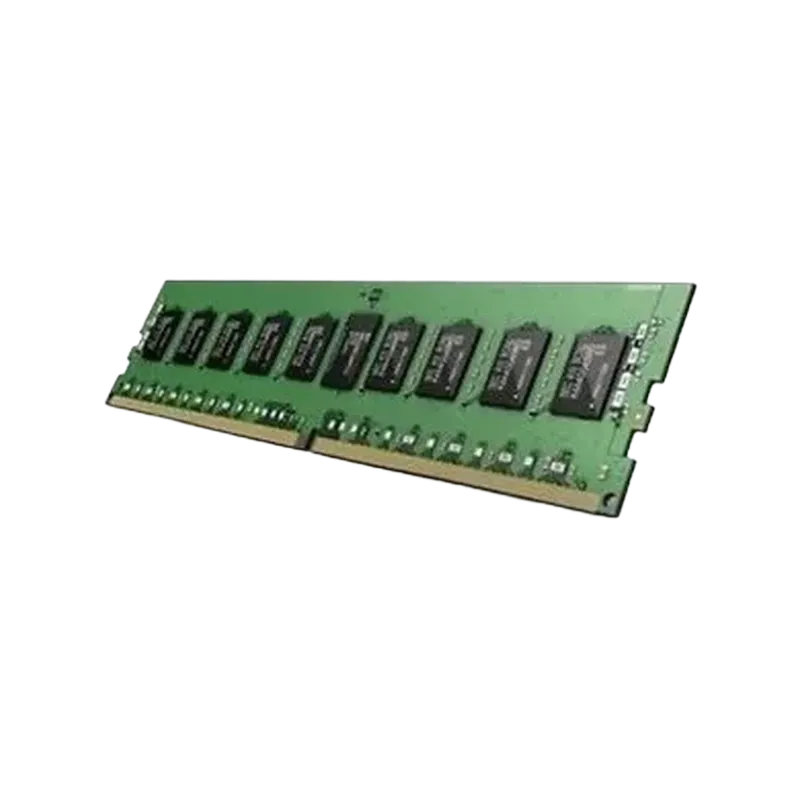
This 32GB DDR5-6400 Registered ECC RDIMM is engineered for enterprise servers and high-reliability workstations, making it ideal for virtualization farms, in-memory databases, and latency‑sensitive workloads where data integrity is paramount. Its registered signal type stabilizes multi‑DIMM channels and ECC corrects single‑bit errors in real time, while the dual‑rank x8 organization leverages rank interleaving to boost effective bandwidth under sustained heavy loads.
1. ECC error correction silently detects and repairs single-bit memory faults in real time, preserving data integrity for financial transactions and virtualization hypervisors that cannot tolerate silent corruption.
2. Registered clock driver buffering sharply reduces electrical loading on the memory bus, enabling fully populated server boards to maintain rock‑solid signal integrity across all channels under sustained 24/7 operation.
3. 32GB module density raises the per‑server memory ceiling, letting IT consolidate more virtual machines and in‑memory databases onto a single node and directly lowering software licensing costs.
4. 6400MT/s DDR5 bandwidth delivers up to 51.2 GB/s of throughput, which accelerates real‑time analytics, AI inference, and large in‑memory datasets that starve on slower DRAM.
5. Dual‑rank x8 organization interleaves accesses across internal banks, keeping memory channels fully saturated and delivering consistent, low‑jitter performance during peak multi‑tenant workloads.
The M321R4GA3EB2-CCP is a 32GB DDR5-6400 registered ECC RDIMM engineered for next-generation servers. Its four defining characteristics address the most critical pain points in enterprise data centers. In a dense virtualization cluster hosting dozens of VMs, the ECC capability silently corrects single-bit errors caused by background radiation, preventing silent data corruption that could crash financial ledgers or corrupt customer records. Meanwhile, the registered buffer allows a server to populate all memory channels without overloading the CPU’s memory controller, delivering the terabyte-scale capacity needed to avoid swapping to slower storage. For in-memory databases like SAP HANA, the combination of 6400MT/s bandwidth and dual-rank architecture proves transformative. The dual-rank design interleaves accesses across two internal rank groups, driving near-maximum data throughput even with large datasets, while the raw 51.2 GB/s bandwidth per module slashes query response times. This is more than speed—it ensures reliability and uncompromised throughput in virtualized, mission-critical workloads.
General Virtualization
For a balanced virtualized environment running multiple VMs, populate six or eight identical 32 GB RDIMMs per server for 192–256 GB total capacity. Distribute modules evenly across all memory channels to maintain uniform latency and peak throughput. This configuration maximizes VM density while preserving responsive performance under mixed workloads.
In-Memory Database
In-memory databases demand both capacity and data integrity. Deploy twelve 32 GB RDIMMs per dual-socket node to reach 384 GB, ensuring the dataset fits entirely in RAM. The registered ECC design corrects single-bit errors and detects multi-bit faults, reducing the risk of silent data corruption in transactional systems.
High-Performance Computing (HPC)
HPC clusters benefit from bandwidth saturation. Fully populate all eight channels per CPU with one 32 GB RDIMM per channel (1DPC) to achieve the highest possible memory bandwidth at DDR5-6400 speeds. This minimal-population-per-channel approach avoids speed downclocking, keeping dual-rank x8 modules operating at their rated CAS 52 latency for floating-point-intensive simulations.
Rigorously tested, compatible with Dell PowerEdge R760, HPE ProLiant DL380 Gen11, Lenovo ThinkSystem SR650 V3, and more.
Q: Can I mix this M321R4GA3EB2-CCP with other memory modules of different brands or speeds?
A: Mixing different RDIMMs is not recommended. This module runs at DDR5-6400 CL52. Combining it with slower or differently ranked DIMMs may force the entire channel to the lowest common speed or cause stability issues. Always use identical modules.
Q: Is this memory compatible with my system?
A: This 32GB DDR5-6400 ECC RDIMM is designed for servers using Intel Xeon Scalable (4th Gen+) or AMD EPYC 9004/7003 series. Verify that your server board officially supports DDR5-6400 registered DIMMs and has 288-pin slots.
Q: What is the recommended DIMM population order for optimal performance?
A: For optimal performance, populate identical DIMMs in sets matching the platform's memory channels. Typically, start with slot A1, B1, C1, etc. Refer to your server's motherboard manual for the exact balanced configuration to avoid reduced bandwidth.
Q: Does this module support overclocking or XMP profiles?
A: No. This is an enterprise-class ECC registered module running at JEDEC standard DDR5-6400. It does not support XMP profiles or overclocking, as server environments prioritize data integrity and stability over manual frequency tuning.
Q: What warranty and typical failure rate can I expect?
A: This module includes a 1-year warranty. As a server-grade RDIMM built to JEDEC standards and featuring ECC, the typical annualized failure rate (AFR) is very low, ensuring reliable 24/7 operation in enterprise environments.