











 Secure payments
Standard refund policy
Trade Assurance
Secure payments
Standard refund policy
Trade Assurance
| Model | M393B4G70BM0-YH9Q9 |
|---|---|
| Product Type | Memory Module |
| Compliance Standards | EU RoHS,FCC |
| Memory Capacity | 32 GB |
| Memory Technology | DDR3 |
| Product Voltage | 1.35V |
| RAM Speed | 1333MHz |
| RAM Standard | DDR3-1333/PC3-10600 |
| Error Identifying | ECC |
| Signal Type | Registered |
| Column Access Strobe (CAS) | CL9 |
| Rank | Quad Rank x4 |
| Quantity of Pins | 240-pin |
| RAM Genre | RDIMM |
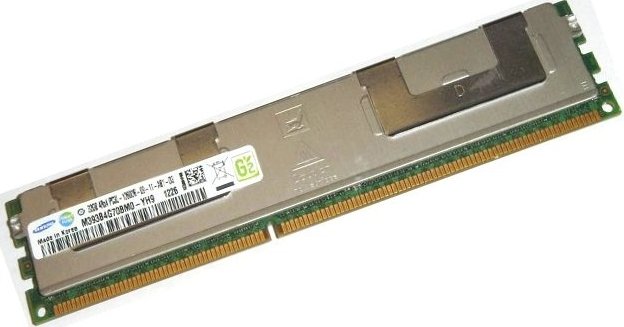
Designed for server platforms, this Samsung M393B4G70BM0-YH9Q9 32GB DDR3-1333 RDIMM leverages a quad-rank x4 configuration and ECC to maximize memory density and data integrity in virtualized environments and in-memory databases. Its 1.35V low-voltage operation and registered signal architecture ensure stable, power-efficient performance under heavy multi-DIMM loads while maintaining CL9 latency.
1. ECC protection detects and corrects single-bit errors on the fly, safeguarding transactional data integrity for critical financial and database workloads.
2. Registered signal buffering stabilizes command and address lines, allowing fully populated memory channels to sustain performance under dense virtualization clusters.
3. A 32GB per-module density maximizes the memory footprint per server node, enabling expansive in-memory analytics and larger guest fleets without horizontal scaling.
4. Operating at 1.35V instead of standard DDR3 voltage trims overall power draw across large-scale deployments, directly reducing cooling costs in multi-rack server rooms.
5. Quad Rank x4 organization delivers elevated capacity in a single slot, essential for heavy caching scenarios, while controlled command rates preserve signal quality under sustained access pressure.
The Samsung M393B4G70BM0-YH9Q9 is a 32GB DDR3 Registered DIMM engineered for server environments where uptime and data fidelity are non-negotiable. Its ECC technology actively detects and corrects single-bit memory errors, a critical safeguard when you are running an in-memory database like SAP HANA. A silent bit flip in financial transaction processing can mean data corruption, but with ECC the system corrects the error on the fly, preserving the integrity of every record. The Registered signal buffer manages the electrical load of high-density deployments, so you can populate all memory channels without sacrificing signal quality—essential in a dense virtualization cluster hosting dozens of virtual machines. This module’s Quad Rank x4 organization provides massive capacity on a single DIMM, allowing hypervisors to allocate more memory per socket and reducing the need for additional physical servers. Operating at a low 1.35V, it cuts power consumption and heat output across a rack of servers, directly lowering your cooling costs and extending component lifespan in always-on data center operations.
Memory Type: Server (DDR3 Registered ECC RDIMM)
This 32GB DDR3-1333 RDIMM is designed for legacy server platforms requiring high capacity and data integrity. Its quad-rank x4 organization and 1.35V low-voltage operation suit densely populated systems where power and thermal constraints matter. Below are capacity planning guidelines for typical server workloads.
General Virtualization
Virtualized hosts are sensitive to memory overcommit and benefit from ample headroom. For a dual-socket server with 24 DIMM slots, populate at least 16 identical modules (512GB total) to comfortably run 40–60 average VMs. Keep memory speed uniform across all channels to avoid throttling, and leave slots open for future scaling.
In-Memory Database
In-memory databases like Redis or SAP HANA demand low latency and absolute stability. Maximize per-channel capacity by installing one quad-rank DIMM per channel first (e.g., 8 modules for 256GB on an 8-channel board), as quad-rank loading limits speed. Prioritize balanced memory population and ensure BIOS settings lock to 1.35V for thermal consistency.
High Performance Computing (HPC)
HPC workloads need consistent bandwidth and minimal NUMA penalties. Populate all memory channels symmetrically with identical modules to sustain peak throughput—for example, 16 DIMMs (512GB) in a dual-socket cluster node. Stick to the vendor’s recommended rank-per-channel limit; if a channel accepts three DIMMs, populate just two quad-rank DIMMs to maintain 1333 MHz without downclocking.
Tested with Dell PowerEdge R720, HP DL380p G8, Cisco UCS C240 M3; designed for DDR3 registered server platforms.
Q: Can I mix this M393B4G70BM0-YH9Q9 with other memory modules of different brands or speeds?
A: Mixing is not recommended for registered server memory. Different brands, speeds, or ranks may cause signal integrity issues and system instability. For guaranteed reliability, populate all channels with identical Samsung RDIMMs.
Q: Is this memory compatible with my Intel Xeon or AMD Opteron server platform?
A: This DDR3 RDIMM is compatible with servers using Intel Xeon E5-2600 v1/v2 (Sandy/Ivy Bridge-EP) or AMD Opteron 6300 series processors. Please verify your board supports 32GB quad-rank registered DIMMs and 1.35V operation.
Q: What is the recommended DIMM population order for optimal performance with this quad-rank module?
A: Install identical modules starting with the memory slot farthest from the CPU per channel. For dual-processor systems, balance capacity evenly. Populate slots with the same color/position first to maximize interleaving and memory bandwidth.
Q: Does this module support overclocking or XMP profiles?
A: No. This JEDEC-compliant ECC RDIMM operates strictly at 1333MHz with no XMP or overclocking support. Stability and data integrity are prioritized over speed; altering timings outside specification will compromise server reliability.
Q: What warranty and typical failure rate can I expect from this Samsung memory?
A: This module includes a 1-year warranty. Samsung server memory exhibits an extremely low annualized failure rate (typically under 0.2%), backed by rigorous 100% testing and enterprise-grade Samsung B-die DRAM for 24/7 mission-critical workloads.