











 Secure payments
Standard refund policy
Trade Assurance
Secure payments
Standard refund policy
Trade Assurance
| Model | M386B4G70BM0-CMA |
|---|---|
| Product Type | Memory Module |
| Compliance Standards | EU RoHS,FCC |
| Memory Capacity | 32 GB |
| Memory Technology | DDR3 |
| Product Voltage | 1.5V |
| RAM Speed | 1866MHz |
| RAM Standard | DDR3-1866/PC3-14900 |
| Error Identifying | ECC |
| Signal Type | Registered |
| Column Access Strobe (CAS) | CL13 |
| Rank | Quad Rank x4 |
| Quantity of Pins | 240-pin |
| RAM Genre | RDIMM |
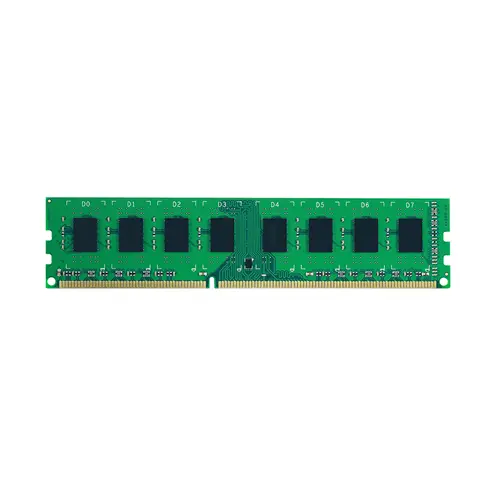
Designed for server environments, this 32GB DDR3-1866 Registered ECC RDIMM is ideally suited for virtualization, in-memory databases, and mission-critical workloads where data integrity is paramount. Its Quad Rank x4 organization maximizes module capacity per channel while the registered signal architecture enhances signal stability, and the ECC with CL13 latency delivers robust error correction with responsive access times.
1. High-density module design significantly expands memory capacity per server, empowering massive virtual desktop infrastructure and in-memory database deployments without straining limited DIMM slots.
2. Fast DDR3 clock speed supplies ample throughput to feed multi-core CPUs, accelerating simultaneous data streams in content delivery and web-scale applications.
3. Integrated ECC automatically corrects memory errors, ensuring rock-solid data integrity for financial ledgers and scientific computations that cannot tolerate silent corruption.
4. Registered signal architecture allows the memory controller to drive heavily populated channels reliably, enabling storage arrays and virtualization hosts to scale memory seamlessly.
5. Quad Rank x4 organization keeps all banks active and interleaved, maximizing bandwidth utilization and smooth performance under sustained enterprise workloads.
The M386B4G70BM0-CMA is a server-grade 32GB DDR3-1866 RDIMM purpose-built for enterprise workloads, and its four defining characteristics—ECC error correction, registered signal buffering, quad-rank architecture, and dense 32GB capacity—directly confront the reliability and scalability challenges server administrators face daily. ECC continuously scans and corrects single-bit errors, preventing silent data corruption that could crash a virtual machine or taint a financial database; when a VMware ESXi host runs dozens of VMs, that protection translates directly to uninterrupted uptime and transactional accuracy. The registered buffer re-drives address and command signals, stabilizing fully populated memory channels so you can fill all slots without signal degradation—critical when consolidating heavy loads onto a single virtualization node. The quad-rank x4 design packs immense capacity per module, making it ideal for in-memory analytics platforms like SAP HANA or Redis where entire datasets must reside in RAM to meet sub-millisecond query demands. At 1866MHz with CL13 latency, the module balances throughput and command response, ensuring memory bandwidth never becomes a bottleneck under sustained load. In practice, these features give infrastructure teams the confidence to deploy dense, reliable memory pools that keep mission-critical services running without compromise.
Memory Type: Server — 32GB DDR3-1866 RDIMM (M386B4G70BM0-CMA)
General Virtualization
For typical server consolidation, install six DIMMs (192 GB) across three memory channels per processor. This config comfortably hosts 40–50 moderate virtual machines. When populating two quad‑rank DIMMs per channel, verify whether the platform can sustain 1866 MT/s; many systems will derate to 1333 MT/s, which is acceptable for most virtualized workloads.
In-Memory Database
Maximize capacity by fully populating all DIMM slots—in a dual‑socket server with 24 slots, that delivers 768 GB. Quad‑rank 32 GB RDIMMs are dense enough for large in‑memory datasets, but review BIOS release notes to confirm support for high‑capacity RDIMM mappings. Enable interleaving and memory sparing to improve data resilience and latency consistency.
High Performance Computing
To sustain peak bandwidth, deploy only one DIMM per channel (1DPC). An eight‑channel node fitted with eight modules provides 256 GB at full 1866 MT/s, ideal for memory‑bandwidth‑bound simulations. When capacity demands grow, scale to one DIMM per channel across two sockets (512 GB) and accept a minor frequency drop if quad‑rank loading requires it.
Rigorously tested for compatibility with Dell PowerEdge R720/R620, HP DL380p Gen8, and Lenovo System x3650 M4 servers.
Q: Can I mix this M386B4G70BM0-CMA with other memory modules of different brands or speeds?
A: Mixing modules of different brands, speeds, or ranks in a server is strongly discouraged. It can cause POST failures, instability, and reduced throughput due to mismatched timings and electrical characteristics. Always use identical part numbers per channel.
Q: Is this memory compatible with my system?
A: This 32GB DDR3-1866 ECC RDIMM suits Intel Xeon E5-2600 v2/v3 and AMD Opteron 6300 platforms with 240-pin slots. Verify your board accepts quad-rank x4 registered DIMMs and supports 1.5V operation before purchase.
Q: What is the recommended DIMM population order for optimal performance?
A: Follow your server’s population guide: install identical quad-rank DIMMs first in the primary slots (often white or blue), then secondary slots. Balance channels evenly to avoid bandwidth degradation and ensure interleaved memory access.
Q: Does this module support overclocking or XMP profiles?
A: No. This is a JEDEC-compliant ECC Registered DIMM engineered for stability, not overclocking. It lacks XMP support and runs at fixed 1866MHz, CL13, 1.5V; any manual timing changes may risk data integrity in server environments.
Q: What warranty and typical failure rate can I expect?
A: The module includes a 1-year warranty. While exact AFR figures are proprietary, this Samsung server DIMM meets strict enterprise reliability standards, with an expected annual failure rate well below 1% under normal operational conditions.