











 Secure payments
Standard refund policy
Trade Assurance
Secure payments
Standard refund policy
Trade Assurance
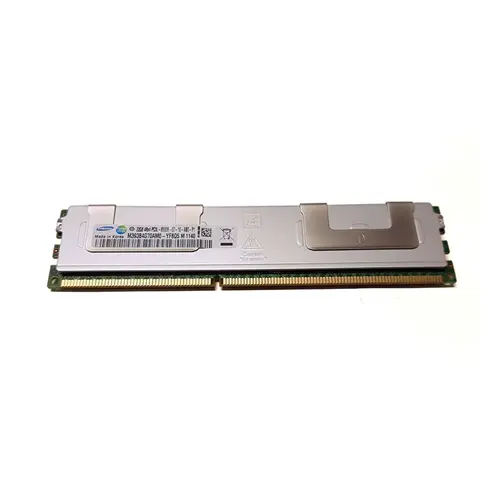
| Model | M393B4G70AM0-YF8Q5 |
|---|---|
| Product Type | Memory Module |
| Compliance Standards | EU RoHS,FCC |
| Memory Capacity | 32 GB |
| Memory Technology | DDR3 |
| Product Voltage | 1.35V |
| RAM Speed | 1066MHz |
| RAM Standard | DDR3-1066/PC3-8500 |
| Error Identifying | ECC |
| Signal Type | Registered |
| Column Access Strobe (CAS) | CL7 |
| Rank | Quad Rank x4 |
| Quantity of Pins | 240-pin |
| RAM Genre | RDIMM |
This registered DDR3-1066 RDIMM is engineered for legacy server platforms, delivering exceptional data integrity for virtualization and in-memory database workloads through its ECC and quad-rank x4 configuration. The low 1.35V operating voltage combined with tight CL7 latency optimizes power efficiency without compromising signal stability in dense, memory-constrained deployments.
1. Large module capacity enables higher VM density per server, maximizing consolidation ratios and reducing infrastructure sprawl in virtualized data centers.
2. End-to-end error correction safeguards data integrity in mission-critical database transactions, preventing silent data corruption in always-on environments.
3. Register buffering stabilizes signal integrity across fully populated memory channels, essential for scaling memory configurations in large-scale enterprise deployments.
4. Quad rank organization maximizes bank interleaving, sustaining peak memory throughput and consistent latency under heavy concurrent analytical workloads.
5. Low voltage operation significantly cuts cooling costs and improves energy efficiency in dense rack environments, directly lowering total cost of ownership.
The Samsung M393B4G70AM0-YF8Q5 is an RDIMM engineered specifically for enterprise servers and data centers, where stability and data integrity are non-negotiable. Its four defining characteristics directly address the critical pain points of modern infrastructure.
First, ECC error correction actively detects and corrects single-bit memory errors caused by background radiation, preventing silent data corruption. In a financial database or an in-memory caching system like Redis, a single undetected flipped bit could mean a transactional discrepancy or a logic error that cascades across an entire application—ECC eliminates that risk. Second, the registered buffer architecture stabilizes the electrical loads, allowing a single server to populate all memory channels with high-capacity modules without signal degradation. For a virtualization cluster running dozens of VMware VMs, this means you can maximize density to 768GB or more per host without sacrificing boot reliability or causing memory training failures. Third, the quad-rank x4 configuration delivers a dense 32GB per stick while intelligently interleaving access across internal banks, providing the sustained bandwidth that memory-analytics platforms like SAP HANA demand during intense columnar scans. Finally, the 1.35V low-voltage operation meaningfully reduces power consumption and cooling overhead. Across a fleet of 500 servers, that lower thermal profile translates into thousands of dollars in annual energy savings and extended fan lifespan. This memory turns generic hardware into a trusted platform for workloads where every bit and every millisecond matters.
General Virtualization
For dense virtualization hosts, populate a dual-socket platform with at least eight of these 32 GB DDR3L RDIMMs to deliver 256 GB of low-voltage, registered memory. This configuration balances cost per gigabyte and per-slot capacity, allowing plenty of headroom for dozens of moderate VMs while keeping power and cooling loads in check. Spread modules evenly across all memory channels to maintain uniform access latency under mixed-workload pressure.
In-Memory Database
Maximize capacity by installing the full supported set of quad-rank 32 GB DIMMs—often 24 modules across both CPU sockets for 768 GB—to keep entire datasets resident in RAM. The ECC protection and registered signaling on these DDR3-1066 sticks ensure data integrity during sustained, write-intensive operations. Although 1066 MT/s is modest, the sheer capacity per channel avoids swapping and delivers predictable low-latency lookups for large key-value stores or in-memory caches.
High-Performance Computing (HPC)
In bandwidth-sensitive HPC clusters, populate one DIMM per channel to reach peak memory throughput without trading speed for high rank loading. A common foundation is twelve 32 GB modules (384 GB total) in a dual-socket node, giving each core enough local capacity for scratch arrays and checkpoint buffers. The registered, 1.35 V design helps stabilize large node counts by reducing thermal variance during long-running parallel simulations.
Rigorously tested server memory. Verified compatible with Dell PowerEdge R710/R720, HP ProLiant DL380 G7/G8, Lenovo ThinkServer RD630.
Q: Can I mix this M393B4G70AM0-YF8Q5 with other memory modules of different brands or speeds?
A: Mixing with different brands or speeds is not recommended. All installed RDIMMs should have identical specifications (speed, rank, timing) to ensure signal integrity and stable server operation.
Q: Is this memory compatible with my system?
A: This DDR3-1066 Registered ECC RDIMM is designed for server platforms supporting Intel Xeon E5-2600 v1/v2 or AMD Opteron 6300 series processors. Verify your motherboard’s qualified vendor list for DDR3 RDIMM support.
Q: What is the recommended DIMM population order for optimal performance?
A: Follow your server board's manual; typically populate blue or white slots first. For quad-rank modules like this, fill one DIMM per channel initially and balance across memory controllers for best throughput.
Q: Does this module support overclocking or XMP profiles?
A: No. This is a JEDEC-compliant DDR3-1066 Registered ECC server memory module. Overclocking and XMP profiles are not supported, as server-class memory prioritizes data integrity and stability.
Q: What warranty and typical failure rate can I expect?
A: This module includes a one-year warranty. Typical annualized failure rate (AFR) is below 0.5% under standard operating conditions, ensuring reliable long-term deployment in enterprise environments.