











 Secure payments
Standard refund policy
Trade Assurance
Secure payments
Standard refund policy
Trade Assurance
| Model | M393B4G70BM0-YF809 |
|---|---|
| Product Type | Memory Module |
| Compliance Standards | EU RoHS,FCC |
| Memory Capacity | 32 GB |
| Memory Technology | DDR3 |
| Product Voltage | 1.35V |
| RAM Speed | 1066MHz |
| RAM Standard | DDR3-1066/PC3-8500 |
| Error Identifying | ECC |
| Signal Type | Registered |
| Column Access Strobe (CAS) | CL7 |
| Rank | Quad Rank x4 |
| Quantity of Pins | 240-pin |
| RAM Genre | RDIMM |
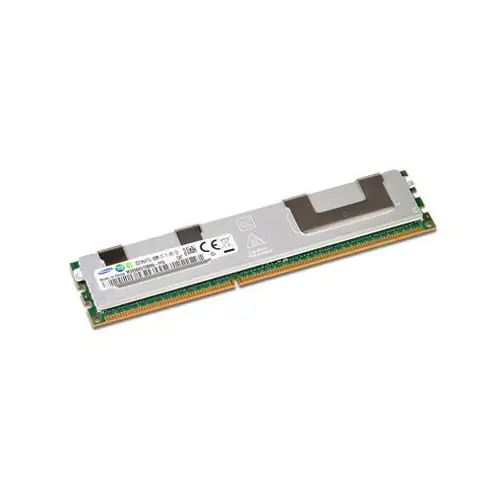
Designed for legacy server platforms, this Samsung 32GB DDR3-1066 RDIMM (M393B4G70BM0-YF809) leverages a Quad Rank x4 configuration and registered signaling to deliver high-density memory scalability essential for virtualization clusters and in-memory databases. Its ECC protection combined with a tight CL7 latency and low 1.35V operation ensures critical data integrity while improving thermal efficiency in heavily loaded 24/7 environments.
1. High-density module capacity supports extensive virtual machine consolidation, ensuring smooth operation of demanding enterprise applications under heavy load.
2. ECC protection actively detects and corrects memory errors, safeguarding data integrity in mission-critical server environments where accuracy is non-negotiable.
3. Registered signal buffering stabilizes command and address buses, enabling reliable operation in large-scale memory configurations commonly found in rack servers.
4. Quad Rank x4 organization drives greater memory channel utilization, delivering the capacity density required for memory-constrained workloads like in-memory databases.
5. Low operating voltage reduces overall power draw and thermal output, contributing to greener and more cost-efficient data center deployments around the clock.
The Samsung M393B4G70BM0-YF809 is a DDR3 server RDIMM engineered for enterprise reliability. In virtualized clusters hosting critical applications or in-memory databases such as Redis and SAP HANA, its four defining features deliver measurable advantages. ECC corrects single-bit errors continuously, eliminating silent data corruption that could crash VMs or corrupt database records—a must for enterprise data integrity. The registered buffer stabilizes signals across fully populated channels, enabling 32GB per slot and massive total capacity; this is crucial for hypervisors running hundreds of VMs. The 1.35V low-voltage design cuts power and cooling costs in dense server farms, reducing both operational expenditure and environmental impact. Its 32GB quad-rank density maximizes slots, letting in-memory databases hold entire datasets in RAM. Combined with a CAS latency of 7, you get faster cache response and transaction speeds. These attributes translate directly to higher uptime, better VM density, and accelerated insight for mission-critical infrastructure.
General Virtualization
For a hypervisor hosting moderate-density VMs, populate at least eight modules (256GB) across dual-socket platforms to balance cost and density. Distribute DIMMs evenly across all memory channels—typically four modules per CPU—to maintain full interleaving and avoid bandwidth bottlenecks under multi-tenant workloads.
In-Memory Database
Achieve maximum capacity by installing three quad-rank RDIMMs per memory channel (e.g., 24 modules for 768GB on a dual-CPU board), as the 1.35V low-power design helps control thermals at high density. Always match ranks per channel strictly and use the lowest CAS latency (CL7) to reduce access times for large result sets.
High-Performance Computing (HPC)
Prioritize balanced channel population over raw capacity: install one module per channel (e.g., 8 × 32GB for 256GB on a dual-socket node) to sustain peak bandwidth of 8500 MB/s. The registered ECC feature is critical for long-running simulations, preventing silent data corruption without throttling 1066MHz throughput.
Rigorously tested for compatibility with Dell PowerEdge R720, HP ProLiant DL380p Gen8, and IBM System x3650 M4.
Q: Can I mix this M393B4G70BM0-YF809 with other memory modules of different brands or speeds?
A: Mixing is not recommended. This registered ECC RDIMM requires strict matching of part numbers, ranks, and timings. Mismatched modules may cause instability, boot failures, or silent data corruption in server environments.
Q: Is this memory compatible with my server platform, specifically Intel Xeon E5 or AMD Opteron systems?
A: It is compatible with platforms supporting DDR3 Registered ECC RDIMMs, such as Intel Xeon E5-2400/2600 v1/v2 series and AMD Opteron 6300 series. Verify your server board's Quad Rank x4 support for 32GB modules.
Q: What is the recommended DIMM population order for optimal performance with this quad-rank module?
A: Populate one DIMM per channel first, starting with the farthest slot from the CPU. For this quad-rank module, refer to your server manual; typically, use blue slots first to balance channels and avoid excessive rank loading.
Q: Does this module support overclocking or XMP profiles?
A: No. As enterprise server memory, it operates exclusively at JEDEC standard DDR3-1066 with CL7 timings and 1.35V. It prioritizes stability and ECC integrity over performance tuning, so overclocking is unsupported.
Q: What warranty and typical failure rate can I expect with this Samsung server memory?
A: This module includes a one-year warranty. It is built to stringent enterprise standards, resulting in a very low annualized failure rate (AFR), typically under 0.5% under normal operating conditions with adequate cooling.