











 Secure payments
Standard refund policy
Trade Assurance
Secure payments
Standard refund policy
Trade Assurance
| Product Type | Memory Module |
|---|---|
| Memory Capacity | 32 GB |
| Memory Technology | DDR4 |
| Product Voltage | 1.2 V |
| RAM Speed | 2133 MHz |
| RAM Standard | DDR4-2133/PC4-17000 |
| Error Identifying | ECC |
| Signal Type | Registered |
| Column Access Strobe (CAS) | CL15 |
| Rank | Quad Rank x4 |
| Quantity of Pins | 288-pin |
| RAM Genre | RDIMM |
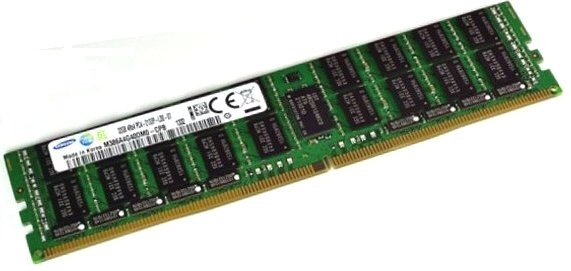
Built for server environments, this 32GB DDR4-2133 RDIMM with ECC and registered signal technology ensures data integrity and system stability under heavy virtualization and in-memory database workloads. Its quad-rank x4 organization maximizes capacity density per channel while the CL15 latency and 1.2V low-power operation deliver a balanced blend of reliability and energy efficiency for enterprise platforms.
1. ECC error correction proactively detects and corrects single-bit memory faults, safeguarding transactional data integrity that financial and healthcare servers depend on around the clock.
2. Registered buffering re-drives address and command signals, preserving clean communication across fully loaded server boards for rock-solid stability under 24/7 operation.
3. Quad Rank x4 layout doubles the chip density per module, letting virtualization hosts pack more RAM into fewer slots to support higher VM consolidation ratios without expanding hardware.
4. The substantial per-module capacity enables enterprise systems to reach multi-terabyte memory footprints, accelerating large in-memory databases and real-time analytics platforms.
5. DDR4-2133 base frequency provides ample sustainable throughput for balanced workload processing while keeping per-node power budgets under strict control in dense data center racks.
When you deploy mission-critical workloads like a dense virtualization cluster or an in-memory database, the M386A4G40DM0-CPB0Q server memory module transforms your infrastructure with four vital design choices. First, integrated Error-Correcting Code (ECC) constantly detects and fixes single-bit flips caused by background radiation—an absolute necessity for financial trading systems or SAP HANA instances where even one silent bit error can corrupt transactions. Second, the Registered signal buffer stabilizes command and address lines across heavy DIMM populations, so you can populate all channels with 32 GB modules without sacrificing signal integrity, keeping your hypervisor clusters running reliably under load. Third, its proprietary Quad Rank x4 organization leverages bank interleaving to unlock higher effective bandwidth, reducing latency spikes when dozens of virtual machines compete for memory access. Fourth, DDR4’s 1.2 V operation slashes per-DIMM power draw compared to 1.5 V DDR3, cutting cooling costs across a server farm. Together, these attributes deliver the unwavering data integrity, massive scalability, and energy efficiency your enterprise depends on.
General Virtualization
For general virtualization hosts, maximize total capacity while preserving multi-channel bandwidth. Install one 32GB quad-rank RDIMM per memory channel (e.g., 8 DIMMs per socket on an 8-channel platform) to populate all channels symmetrically. This typically yields 256GB per CPU, balancing dense VM consolidation with consistent memory latency, and avoids the speed penalties of running two quad-ranked DIMMs per channel.
In-Memory Database
In-memory databases demand the largest possible addressable capacity with predictable low latency. Fill every available DIMM slot on the platform, accepting a possible speed downshift when using two quad-rank DIMMs per channel—the capacity gain outweighs the modest frequency reduction. A dual-socket system can host 512GB to 1TB of memory, keeping entire datasets resident and eliminating disk I/O bottlenecks.
High-Performance Computing (HPC)
HPC workloads benefit most from balanced memory bandwidth and per-core efficiency. Use a uniform configuration with exactly one quad-rank RDIMM per channel to sustain the rated 2133 MT/s without rank-switching overhead. A per-node capacity of 128GB–256GB is often optimal, providing ample headroom for large simulation meshes or parallel MPI tasks while ensuring every core sees full memory throughput.
Server-grade compatibility verified. Rigorously tested for Dell PowerEdge R760, HPE ProLiant DL380 Gen10, Lenovo ThinkSystem SR650, etc.
Q: Can I mix this M386A4G40DM0-CPB0Q with other memory modules of different brands or speeds?
A: Mixing is not recommended. For ECC Registered memory, mismatched specifications risk instability or boot failure. Always use identical Samsung modules with the same part number to ensure signal integrity and system reliability.
Q: Is this memory compatible with my system?
A: This DDR4-2133 ECC RDIMM is compatible with server platforms such as Intel Xeon E5-2600 v3/v4 or AMD EPYC 7001/7002 series. Always verify your motherboard’s qualified vendor list before purchase.
Q: What is the recommended DIMM population order for optimal performance?
A: Follow your server board manual. Typically, populate identical DIMMs in corresponding slots across memory channels, starting farthest from the CPU. For quad-rank modules, balance channels evenly to maximize interleaving.
Q: Does this module support overclocking or XMP profiles?
A: No. This is a JEDEC-compliant enterprise server module. ECC Registered memory does not support XMP or overclocking; it operates at fixed 2133MT/s with CL15 timings for maximum stability in 24/7 environments.
Q: What warranty and typical failure rate can I expect?
A: This Samsung module includes a 1-year warranty. Enterprise-class RDIMMs exhibit very low annualized failure rates, typically under 0.4%, ensuring mission-critical reliability within specified voltage and temperature ranges.