











 Secure payments
Standard refund policy
Trade Assurance
Secure payments
Standard refund policy
Trade Assurance
| Product Type | Memory Module |
|---|---|
| Memory Capacity | 32 GB |
| Memory Technology | DDR4 |
| Product Voltage | 1.2V |
| RAM Speed | 2400MHz |
| RAM Standard | DDR4-2400/PC4-19200 |
| Error Identifying | ECC |
| Signal Type | Registered |
| Column Access Strobe (CAS) | CL17 |
| Rank | Quad Rank x4 |
| Quantity of Pins | 288-pin |
| RAM Genre | RDIMM |
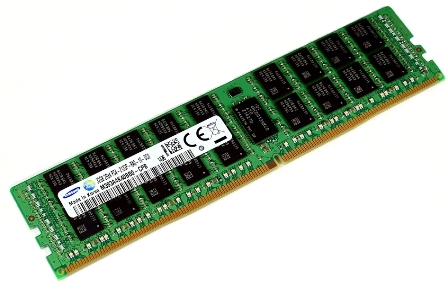
Designed for server platforms, this 32GB DDR4-2400 Registered ECC module is ideal for memory-intensive workloads such as virtualization, in-memory databases, and enterprise data processing where data integrity is critical. Its quad-rank x4 organization maximizes capacity per channel while the registered signal architecture stabilizes heavily loaded memory buses, and ECC protection corrects single-bit errors to prevent silent data corruption in 24/7 mission-critical environments.
1. The high-density module size allows for greater memory capacity per server node, directly increasing virtual machine density and improving consolidation ratios in virtualized environments.
2. DDR4 technology delivers improved power efficiency and higher data rates, enabling data centers to scale performance while reducing energy consumption per gigabyte.
3. ECC protection automatically corrects single-bit errors and detects multi-bit faults, ensuring transactional integrity and minimizing silent data corruption in financial and database applications.
4. Registered signal buffering stabilizes heavy memory configurations, allowing the server to support numerous DIMMs per channel without compromising signal quality for reliable large-scale deployment.
5. Quad Rank x4 organization packs more DRAM chips into a single module, maximizing memory capacity within limited server slots to accelerate in-memory databases and large-scale analytics.
The M386A4G40EM2-CRC4Y is a server-grade 32 GB DDR4-2400 RDIMM purpose-built for always-on enterprise workloads, and its four defining characteristics solve critical real-world challenges. ECC error correction silently intercepts single-bit memory faults that would otherwise corrupt data in financial transaction ledgers or virtual machine states—in a virtualized cluster hosting dozens of business-critical VMs, this translates to continuous uptime and uncompromised data integrity. The Registered buffer stabilizes signal integrity across densely populated memory channels, letting you confidently scale to terabytes of RAM per host and pack in more virtual machines without speed degradation. The Quad Rank x4 organization delivers deep bank-level parallelism, which for in-memory databases like SAP HANA or Redis sustains high bandwidth and consistent low latency under intense concurrent queries, powering real-time analytics at scale. Finally, the 1.2 V operating voltage and CL17 latency keep power and cooling costs tightly controlled in a full rack deployment, ensuring every watt you consume drives measurable performance, not overhead.
General Virtualization
For consolidated virtual machine hosting, deploy this 32GB quad-rank RDIMM with one DIMM per channel in a dual-socket server. Populating all six channels per CPU (12 modules total) yields 384GB of ECC-protected capacity, striking an optimal balance between memory footprint and full 2400 MT/s speed. This setup ensures stable virtualization overhead, enables live migration, and leaves room for moderate VM density without triggering multi-DIMM rank-induced clock drops.
In-Memory Database
To minimize latency for in-memory workloads, limit each memory channel to a single quad-rank 32GB module; this preserves the rated CL17 timing and avoids down-clocking to 1866 MT/s. For a typical dual-socket platform, install 12 identical modules to achieve 384GB per node, then scale out with additional nodes. If extreme capacity is required per instance, you may carefully place two DIMMs per channel, but performance-sensitive transactions will benefit from the low-jitter, single-DIMM-per-channel design.
High-Performance Computing
HPC applications demand maximum memory bandwidth, so configure one quad-rank 32GB DIMM per channel to run at the full 2400 MHz. With dual-socket systems supporting 12 channels, 384GB of total memory can be sustained at peak throughput for large-scale simulations. Avoid populating a second DIMM per channel, as the speed penalty can degrade tightly coupled parallel I/O. Distribute identical modules symmetrically across all channels to guarantee interleaved access and prevent unbalanced thermal or electrical load on the memory controller.
Certified for server use: rigorously tested, compatible with Dell PowerEdge R740, HPE ProLiant DL380 Gen10, Lenovo ThinkSystem SR650, and more.
Q: Can I mix this M386A4G40EM2-CRC4Y with other memory modules of different brands or speeds?
A: Not recommended. Mixing registered ECC modules of different brands, speeds, or rank configurations can cause stability issues. For server environments, always use identical modules validated per the system’s qualified vendor list.
Q: Is this memory compatible with my Intel Xeon or AMD EPYC server platform?
A: It is compatible with platforms supporting DDR4-2400 Registered ECC RDIMMs, such as Intel Xeon E5-2600 v4 or AMD EPYC 7001 series. Verify your motherboard’s QVL to confirm compatibility with quad-rank x4 modules.
Q: What is the recommended DIMM population order for optimal performance?
A: Follow your server’s technical manual. Typically, populate identical quad-rank modules per channel starting with the farthest slots from the CPU. Balanced channels and matched ranks maintain optimal memory bandwidth and interleaving efficiency.
Q: Does this module support overclocking or XMP profiles?
A: No. As a JEDEC-compliant DDR4-2400 registered ECC server module, it does not support XMP or overclocking. It is engineered for maximum data integrity and 24/7 stability at the specified frequency and timings.
Q: What warranty and typical failure rate can I expect?
A: This module includes a one-year warranty. Built with enterprise-grade components and strict burn-in testing, it delivers a typical annualized failure rate (AFR) well below 0.5%, ensuring exceptional long-term reliability in mission-critical deployments.