











 Secure payments
Standard refund policy
Trade Assurance
Secure payments
Standard refund policy
Trade Assurance
| Product Type | Memory Module |
|---|---|
| Memory Capacity | 32 GB |
| Memory Technology | DDR4 |
| Product Voltage | 1.2 V |
| RAM Speed | 2400 MHz |
| RAM Standard | DDR4-2400/PC4-19200 |
| Error Identifying | ECC |
| Signal Type | Registered |
| Column Access Strobe (CAS) | CL17 |
| Rank | Dual Rank x4 |
| Quantity of Pins | 288-pin |
| RAM Genre | RDIMM |
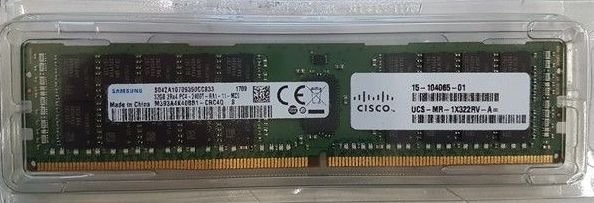
This Samsung M393A4K40BB1-CRC40 is a 32GB DDR4-2400 Registered ECC memory module purpose-built for server platforms, where its dual-rank x4 organization maximizes memory bandwidth and the CL17 latency ensures responsive data access under heavy multi-threaded loads. With error-correcting code and registered signal buffering, it delivers the rock-solid data integrity and scalability required for virtualization clusters, in-memory databases, and mission-critical enterprise workloads.
1. ECC memory detects and corrects single-bit errors on the fly, safeguarding transactional databases and in-memory caches against silent data corruption that could crash financial or virtualization workloads.
2. Registered signal buffering stabilizes the command and address bus under fully populated server boards, enabling massive memory configurations without sacrificing signal integrity during concurrent multi-tenancy operations.
3. Dual Rank x4 organization interleaves access across internal banks to maximize channel bandwidth utilization, crucial for sustaining throughput when multiple virtual machines hammer memory simultaneously.
4. A 32 gigabyte module density provides headroom for running more instances per physical host, directly lowering cost-per-VM and deferring hardware refresh cycles in scale-out data centers.
5. DDR4-2400 speed class strikes a deliberate balance between transfer rates and power efficiency, delivering consistent performance per watt for always-on enterprise services that cannot tolerate thermal throttling under sustained load.
Based on its Registered DIMM form factor and 288-pin ECC architecture, the Samsung M393A4K40BB1-CRC40 is unequivocally server memory. For IT managers overseeing virtualized clusters or in-memory databases, its four defining characteristics are not just specifications, they are operational safeguards. The integrated ECC directly prevents silent data corruption, a critical defense when a single bit-flip in a financial transaction log or a live virtual machine snapshot could cascade into service outages and compliance violations. Its Registered design buffers command signals, allowing you to populate this full 32GB capacity across dense dual-socket servers without signal instability, which is essential for memory-hungry databases like SAP HANA where scale-up capacity determines real-time analytics scope. The Dual Rank x4 organization then leverages interleaving to parallelize memory accesses, reducing latency and sustaining high throughput when dozens of virtual machines contend for resources simultaneously. Finally, the 1.2V DDR4 voltage significantly lowers power and cooling expenditure per node across a hyperscale deployment, turning efficiency gains into direct operational cost savings while maintaining 2400MT/s consistency. These features ensure that your business logic, not your hardware, remains the limiting factor.
General Virtualization
For moderate-density virtualization hosts, a balanced population of eight 32GB RDIMMs (256GB total) across dual sockets provides ample headroom for dozens of VMs. Populate all memory channels symmetrically (one DIMM per channel) to preserve bandwidth and ensure consistent latency, enabling live migration and resource overcommit without thrashing.
In-Memory Database
In-memory databases like SAP HANA demand large, contiguous memory blocks and high availability. Equip both sockets with twelve 32GB RDIMMs (384GB per node) using 2 DIMMs per channel on supported platforms; dual-rank x4 modules optimize rank interleaving for maximum throughput. Configure spare ranks or mirroring if uptime is critical, and validate the memory speed stays at 2400 MT/s under full load to avoid clock downgrades.
High-Performance Computing
HPC workloads thrive on bandwidth and low latency. Populate all eight channels per socket with a single 32GB RDIMM initially (256GB total) to hit peak theoretical bandwidth; avoid mixing capacities. For capacity-bound CFD or weather modeling, scale to 512GB by installing a second DIMM per channel, accepting a slight speed trade-off if the platform’s BIOS automatically relaxes to 2 DPC, but prioritize balanced NUMA affinity to keep compute threads fed.
Strictly validated server memory. Compatible with Dell PowerEdge R760, HPE ProLiant DL380 Gen10, Lenovo ThinkSystem SR650, and more.
Q: Can I mix this M393A4K40BB1-CRC40 with other memory modules of different brands or speeds?
A: Mixing is not recommended for server environments. All modules should operate at the lowest common speed, and mismatched ranks or brands may compromise signal integrity and system stability under registered ECC operation.
Q: Is this memory compatible with my Intel Xeon Scalable or AMD EPYC server platform?
A: This DDR4-2400 ECC RDIMM is compatible with most Intel Xeon E5-2600 v4 and scalable platforms, as well as select AMD EPYC systems that support 2400MT/s registered DIMMs. Verify motherboard POP (Population) guidelines.
Q: What is the recommended DIMM population order for optimal performance?
A: Follow your server board’s memory population guide. Typically, populate identical DIMMs per channel starting with the farthest slots from the CPU. Balance across memory controllers to maximize interleaving and avoid performance penalties.
Q: Does this module support overclocking or XMP profiles?
A: No. This is a JEDEC-compliant registered server DIMM operating at fixed 2400MT/s with CL17 latency. It does not support XMP or overclocking, as stability and signal integrity are paramount in enterprise environments.
Q: What warranty and typical failure rate can I expect?
A: This Samsung module includes a one-year warranty. Enterprise DRAM typically exhibits an annualized failure rate (AFR) below 0.5%, assuming proper cooling and ECC-protected operation within specified voltage and temperature ranges.