











 Secure payments
Standard refund policy
Trade Assurance
Secure payments
Standard refund policy
Trade Assurance
| Product Type | Memory Module |
|---|---|
| Memory Capacity | 32 GB |
| Memory Technology | DDR5 |
| RAM Speed | 6400 MHz |
| RAM Standard | DDR5-6400/PC5-51200 |
| Error Identifying | ECC |
| Signal Type | Registered |
| Column Access Strobe (CAS) | CL52 |
| Rank | Dual Rank x8 |
| Quantity of Pins | 288-pin |
| RAM Genre | RDIMM |
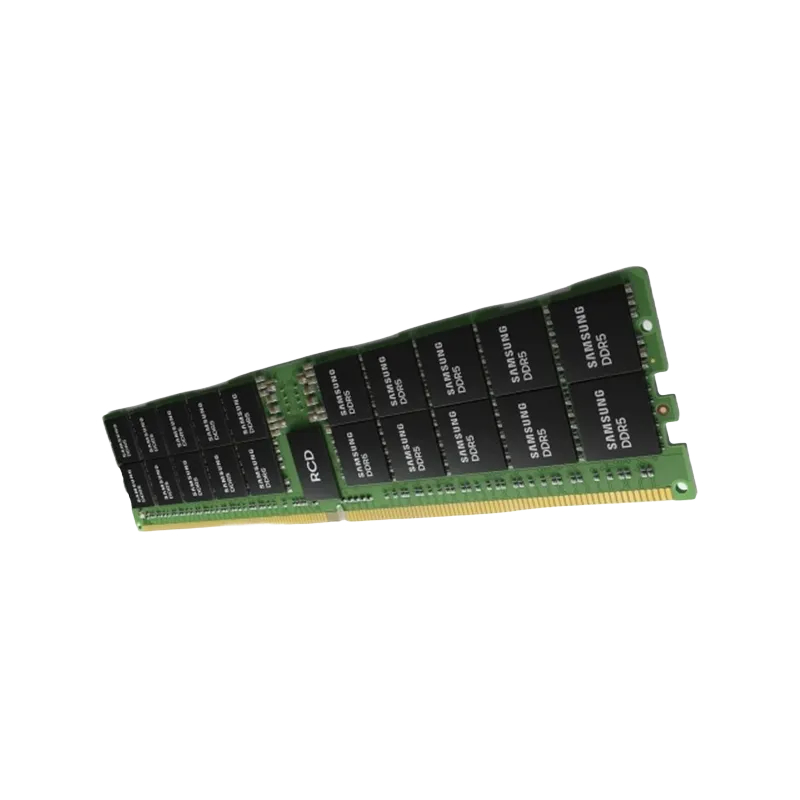
This DDR5-6400 Registered ECC RDIMM, configured as a Dual Rank x8 module, delivers exceptional data integrity and signal stability for demanding server environments such as virtualization hosts and in-memory databases. Its Registered architecture and ECC engine minimize transmission errors under high-capacity loads, while the dual-rank interleaving boosts memory bandwidth efficiency for sustained heavy workloads.
1. Registered clock drivers stabilize signal integrity across densely populated server boards, allowing IT to scale memory without risking data errors or system crashes.
2. On-the-fly ECC correction silently detects and fixes single-bit errors, safeguarding transactional databases and long-running virtualization hosts from silent data corruption.
3. A generous 32-gigabyte capacity per module raises the memory ceiling in rack servers, directly boosting virtual machine density and container consolidation ratios.
4. DDR5-6400 throughput feeds high-frequency trading and real-time analytics engines, slashing the latency between massive datasets and actionable insights.
5. Dual-rank x8 interleaving saturates the memory bus with parallel accesses, keeping response times predictable under heavy multi-tenant workloads.
Based on the RDIMM form factor, registered signal type, and ECC support, the Samsung M321R4GA3EB2-CCPKC is unequivocally a server-grade memory module, engineered for mission-critical enterprise workloads where downtime is not an option. Its four defining characteristics directly address acute pain points in modern data centers.
Consider a dense virtualization cluster running dozens of VMs per node. Here, the DDR5-6400 frequency and Dual Rank x8 organization work in tandem to deliver massive interleaved bandwidth, preventing the memory bus from becoming a bottleneck as hypervisors juggle simultaneous memory requests. More critically, the ECC functionality acts as a silent guardian, detecting and correcting single-bit flips caused by background cosmic radiation. Without it, silent data corruption could cascade into VM crashes or undetected database errors. The true unsung hero is the registered buffer. In a high-capacity in-memory database like Redis or SAP HANA, populating all channels with these RDIMMs imposes a heavy electrical load. The register isolates the command and address signals from the DRAM chips, stabilizing the entire memory interface. This allows you to scale to terabyte-level capacities without sacrificing signal integrity, ensuring your real-time analytics platform remains both lightning-fast and rock-solid under constant, punishing load.
Memory Type Identification: Server (RDIMM DDR5 ECC Registered)
This 32GB DDR5-6400 CL52 ECC Registered DIMM is built for enterprise servers and workstations that require data integrity and large memory populations. Below are capacity planning guidelines for common server workloads.
General Virtualization
Virtualized hosts thrive on total capacity and memory bandwidth. Deploy these RDIMMs in balanced configurations across all memory channels—typically eight or sixteen modules per dual-socket server—to maximize interleaving. A starting point of 256GB (8x32GB) supports moderate VM density, while scaling to 512GB or 1TB accommodates heavier consolidation without overcommitting RAM.
In-Memory Database
In-memory databases demand capacity, low latency, and absolute data integrity. Populate all memory channels identically with dual-rank x8 RDIMMs to maintain peak bandwidth while leveraging ECC protection. For large datasets, configure 512GB to 1TB using 32GB modules; the dual-rank design at DDR5-6400 ensures high throughput for real-time analytics under sustained loads.
High-Performance Computing
HPC workloads benefit from maximum memory bandwidth per core. A fully populated, balanced memory layout (e.g., one DIMM per channel across all CPU memory controllers) is essential. Using 32GB dual-rank RDIMMs gives a strong capacity-per-node sweet spot; for capacity-hungry simulations, scale to 1TB per node while maintaining uniform configurations to avoid NUMA imbalances and bandwidth cliffs.
Proven compatibility with Dell PowerEdge R760, HPE ProLiant DL380 Gen11, and Lenovo ThinkSystem SR650 V3 after rigorous testing.
Q: Can I mix this M321R4GA3EB2-CCPKC with other memory modules of different brands or speeds?
A: Mixing RDIMMs of different brands or speeds is not recommended. The memory controller will default to the slowest common speed and may cause stability issues in server environments. Identical modules ensure validated RAS.
Q: Is this memory compatible with my system?
A: This DDR5-6400 registered ECC RDIMM is designed for server platforms supporting the standard, such as AMD EPYC 9004/8004 Series and Intel Xeon Scalable 4th/5th Gen. Verify your motherboard’s qualified vendor list.
Q: What is the recommended DIMM population order for optimal performance?
A: Follow your server board’s manual for balanced memory configuration. Typically, populate identical dual-rank DIMMs starting from the farthest slot per channel, filling all channels symmetrically to maximize interleaving and bandwidth.
Q: Does this module support overclocking or XMP profiles?
A: No. As a server-grade registered DIMM, this module adheres to strict JEDEC DDR5-6400 specifications for reliability. It does not support overclocking or consumer XMP profiles. Operation is defined at standard latency CL52.
Q: What warranty and typical failure rate can I expect?
A: This module includes a one-year warranty. Enterprise-class RDIMMs undergo rigorous screening and deliver an extremely low annualized failure rate (AFR), typically under 0.5%, ensuring mission-critical server uptime.