











 Secure payments
Standard refund policy
Trade Assurance
Secure payments
Standard refund policy
Trade Assurance
| Model | M393B5270DH0-YH9 |
|---|---|
| Product Type | Memory Module |
| Compliance Standards | EU RoHS,FCC |
| Memory Capacity | 4 GB |
| Memory Technology | DDR3 |
| Product Voltage | 1.35V |
| RAM Speed | 1333MHz |
| RAM Standard | DDR3-1333/PC3-10600 |
| Error Identifying | ECC |
| Signal Type | Registered |
| Column Access Strobe (CAS) | CL9 |
| Rank | Single Rank x4 |
| Quantity of Pins | 240-pin |
| RAM Genre | RDIMM |
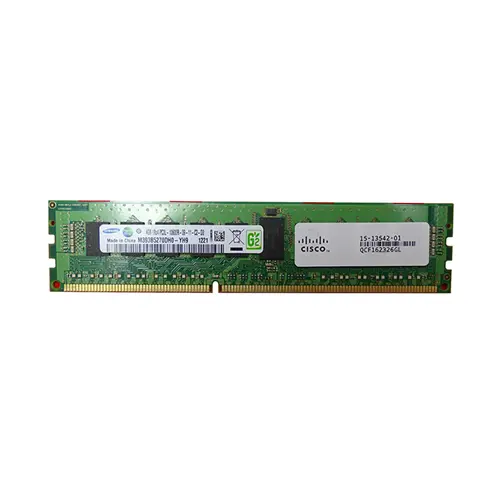
Designed as a server-grade RDIMM with registered signaling and ECC, this Samsung M393B5270DH0-YH9 DDR3-1333 module ensures reliable data integrity in virtualized environments and memory-intensive workloads like in-memory databases. Its low 1.35V operating voltage and single-rank x4 organization provide excellent power efficiency and consistent signal integrity in dense server deployments.
1. ECC protection silently corrects single-bit errors in real time, preserving transactional integrity for financial databases and preventing silent data corruption in always-on server environments.
2. Registered signal buffering amplifies command and address lines across heavily populated memory channels, maintaining rock-solid stability in multi-rack virtualization clusters.
3. Low 1.35V operation cuts energy draw and waste heat per DIMM, directly reducing cooling demands and power costs in high-density data center deployments.
4. Single Rank x4 organization minimizes electrical loading per channel, delivering consistent access latency for latency-sensitive enterprise applications even when all slots are fully populated.
5. A 4 GB module capacity provides finely grained scalability, allowing operators to optimize total memory footprint for containerized microservices without over-provisioning expensive resources.
The M393B5270DH0-YH9 is a server-class Registered DIMM purpose-built for data centers where downtime is measured in lost revenue. Its defining characteristic, ECC error correction, means silent data corruption is not an option. In a dense virtualization cluster running dozens of VMs, a single cosmic-ray-induced bit flip in system memory can crash hypervisors or silently poison financial transactions. This module catches and corrects single-bit errors in real time, preserving workload integrity without your team even noticing. The registered buffer acts as a signal amplifier, allowing the memory controller to drive far more modules per channel than unbuffered alternatives. For an in-memory database like Redis or SAP HANA that demands terabytes of reliable footprint, that scalability keeps large datasets instantly accessible, eliminating swap latency that would kill query performance. Operating at 1.35V instead of the standard 1.5V, it reduces thermal load in a fully populated 2U rack server, lowering energy costs and delaying thermal throttling. Its single-rank x4 organization optimizes command and data bus loading, sustaining the low CAS latency of CL9 even when multiple DIMMs populate the same channel. For your virtualized infrastructure or real-time analytics engine, this selection translates directly into fewer application errors, higher VM density, and consistent sub-100-nanosecond response.
General Virtualization
This Samsung M393B5270DH0-YH9 is a server-grade DDR3-1333 Registered ECC RDIMM with 4GB capacity and 1.35V low-voltage operation. For general virtualization hosts, populate at least six to eight identical modules per CPU socket to enable balanced memory channels. A typical dual-socket server with 12 modules provides 48GB of reliable ECC memory, comfortably supporting 20–30 light to medium virtual machines while maintaining headroom for hypervisor overhead.
In-Memory Database
In-memory databases such as Redis or SAP HANA demand both capacity and data integrity. Using this 4GB single-rank RDIMM, maximize the server’s DIMM slots — for example, 24 modules in a dual-socket platform yielding 96GB — to keep active datasets entirely in RAM. Always install modules in matched sets per memory channel and leverage the ECC and registered features to prevent silent data corruption under sustained write-intensive workloads.
High-Performance Computing
HPC clusters often require a large number of nodes with moderate capacity and rock-solid stability. Deploy these low-voltage (1.35V) RDIMMs across all available memory channels per node, typically 8 or 16 modules for a total of 32GB or 64GB, which balances cost and memory bandwidth in scale-out designs. The registered ECC architecture ensures resilience during long-running parallel computations, while the reduced power draw lowers thermal loads in dense rack environments.
Rigorously tested server memory for Dell PowerEdge R720, HP ProLiant DL380p Gen8, Lenovo ThinkServer RD530, Cisco UCS C220 M3.
Q: Can I mix this M393B5270DH0-YH9 with other memory modules of different brands or speeds?
A: Mixing is not recommended for server environments. Different speeds or brands may cause instability. For reliable ECC operation, use identical modules with the same M393B5270DH0-YH9 part number.
Q: Is this memory compatible with my system?
A: This is a DDR3 Registered ECC RDIMM for servers. Verify your server or motherboard supports 1.35V DDR3-1333 RDIMMs. Compatible with select Intel Xeon E5 series and AMD Opteron platforms. Check your vendor's qualified list.
Q: What is the recommended DIMM population order for optimal performance?
A: Populate identical DIMMs in matching channels per your server manual. Typically, install 4 identical RDIMMs in channel-aligned slots (e.g., A1, B1, C1, D1) first to enable balanced memory interleaving and maximize bandwidth.
Q: Does this module support overclocking or XMP profiles?
A: No. This is a server-grade Registered ECC module designed for stability, not overclocking. It adheres to JEDEC DDR3-1333 specifications and does not support XMP profiles.
Q: What warranty and typical failure rate can I expect?
A: This module includes a one-year warranty. As a rigorously tested Samsung server component, it offers very low failure rates under proper usage, ensuring high reliability for enterprise workloads.