











 Secure payments
Standard refund policy
Trade Assurance
Secure payments
Standard refund policy
Trade Assurance
| Product Type | Memory Module |
|---|---|
| Compliance Standards | EU RoHS,FCC |
| Memory Capacity | 4 GB |
| Memory Technology | DDR2 |
| RAM Speed | 800 |
| RAM Standard | DDR2-800/PC2-6400 |
| Error Identifying | Non-ECC |
| Signal Type | Unbuffered |
| Column Access Strobe (CAS) | CL6 |
| Rank | Dual Rank x8 |
| Quantity of Pins | 200-pin |
| RAM Genre | SoDIMM |
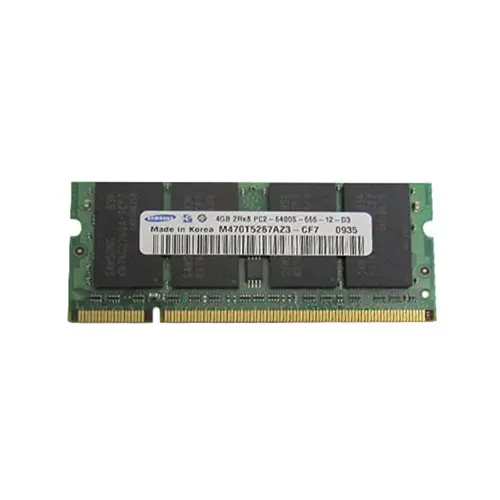
This 4GB DDR2-800 SoDIMM targets memory upgrades in older notebooks and mobile workstations that need higher capacity for modernized workflows. Its dual-rank x8 organization enables bank-interleaved access to improve effective bandwidth, while the low CL6 latency and unbuffered signal path deliver responsive, energy-efficient operation in legacy compact platforms.
1. SoDIMM form factor fits seamlessly into compact laptop chassis, allowing instant plug-and-play upgrades without complex installation.
2. 4 GB capacity breathes new life into aging notebooks, enabling smoother multitasking across browser tabs and office applications without constant disk swapping.
3. DDR2 technology provides a cost-effective path for extending legacy laptop usability, avoiding premature hardware replacement with affordable, compatible modules.
4. 800 MT/s data rate supplies sufficient bandwidth for everyday productivity workloads, ensuring responsive application launches and stable media playback on older mobile platforms.
5. Non-ECC operation strips away error-correction overhead, minimizing energy consumption and heat generation to help preserve battery runtime during mobile use.
Targeted at mobile users, this 4GB DDR2-800 SoDIMM breathes new life into older notebooks. Its 200-pin small outline form factor clips easily into compact laptop chassis, making upgrades a tool-free, quick task. The unbuffered, non-ECC design guarantees drop-in compatibility with consumer chipsets, and the dual-rank x8 configuration packs maximum density per module for its platform. What does this mean for you? A business traveler with an aging ThinkPad upgrades from 1GB to 4GB, running Windows 7, Office, and video calls concurrently without the disk thrashing that kills battery life. A student with a hand-me-down laptop turns it into a responsive machine for online learning, avoiding the cost and waste of a new purchase. The DDR2-800 speed with CL6 latency delivers quick application launches while staying within the thermal limits of slim enclosures, conserving battery during long lectures and flights. RoHS compliance adds peace of mind of sustainable sourcing.
Laptop Upgrade
For ageing notebooks still using DDR2, this 4GB SoDIMM represents the maximum viable density per module. If your system currently runs with 1GB or 2GB sticks, replacing one or both with this 4GB part delivers an immediate responsiveness boost, allowing modern lightweight OS versions and browsers to run without constant swapping. Check your chipset’s limit—many DDR2-era laptops support up to 8GB total across two slots, so a matched pair of these modules would be the ideal doubling or quadrupling of current capacity.
Mobile Workstation
While DDR2 platforms are now legacy, users clinging to a workstation-class laptop for field data collection or niche industrial software can still benefit from populating both SoDIMM slots with a dual-channel 8GB kit built from these 4GB modules. The unbuffered, non-ECC nature is typical, but ensure your application does not require error correction. Running demanding suites like older CAD or virtual instrumentation tools will be constrained primarily by CPU, yet maximizing memory eliminates paging bottlenecks.
Ultrabook Power Saving
Although this is standard 1.8V DDR2-800 rather than a low-voltage variant, installing a single high-capacity 4GB module reduces the need for a second stick and can marginally lower overall power draw compared to running multiple smaller-capacity DIMMs. More importantly, sufficient RAM prevents excessive hard-disk spin-ups and virtual memory thrashing on legacy ultraportables, resulting in noticeably longer battery runtimes during typical productivity tasks.
Rigorously tested for laptops, this DDR2 SODIMM is compatible with Dell Latitude D630, Lenovo ThinkPad T61, and more.
Q: Can I mix this M470T5267AZ3-CF7 with other memory modules of different brands or speeds?
A: Mixing is not recommended for laptop SODIMMs. Different brands or speeds often cause instability. For best compatibility, use identical modules with the same part number, capacity, rank, and timings.
Q: Is this memory compatible with my system?
A: It fits notebooks supporting DDR2-800 SODIMM. Please verify your laptop model’s chipset and maximum capacity. Many Intel GM965/PM965 or AMD platforms accept 4GB dual-rank modules, but check your manufacturer’s specifications first.
Q: What is the recommended DIMM population order for optimal performance?
A: Laptops typically have two SODIMM slots. For dual-channel operation, install a matched pair of identical modules. If using a single module, populate slot 0 first, though performance is reduced without symmetric configuration.
Q: Does this module support overclocking or XMP profiles?
A: No. This is a standard JEDEC-compliant DDR2-800 SODIMM. It does not include XMP or EEPROM overclocking profiles. Operation is limited to the programmed CL6 and 800 MT/s specifications.
Q: What warranty and typical failure rate can I expect?
A: It includes a one-year warranty. The typical annualized failure rate for this mature DDR2 technology is less than 0.5%, ensuring reliable long-term performance under normal operating conditions.