











 Secure payments
Standard refund policy
Trade Assurance
Secure payments
Standard refund policy
Trade Assurance
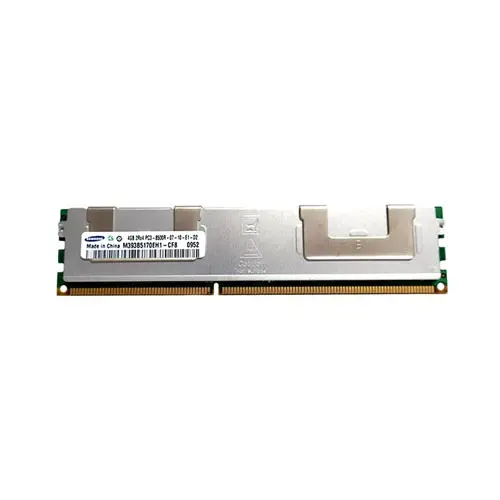
| Model | M393B5170EH1-CF8 |
|---|---|
| Product Type | Memory Module |
| Compliance Standards | EU RoHS,FCC |
| Memory Capacity | 4 GB |
| Memory Technology | DDR3 |
| Product Voltage | 1.5V |
| RAM Speed | 1066MHz |
| RAM Standard | DDR3-1066/PC3-8500 |
| Error Identifying | ECC |
| Signal Type | Registered |
| Column Access Strobe (CAS) | CL7 |
| Rank | Dual Rank x4 |
| Quantity of Pins | 240-pin |
| RAM Genre | RDIMM |
This DDR3-1066 Registered ECC module (M393B5170EH1-CF8) is a server-grade RDIMM ideal for virtualization hosts and in-memory databases where data integrity and system stability under high-capacity workloads are critical. Its dual-rank x4 organization and CL7 latency deliver reliable, low-latency access, while the registered signal buffering ensures clean command/address signaling in dense multi-DIMM configurations.
1. ECC protection corrects single-bit errors in real time, preserving data integrity for mission-critical enterprise databases and financial transactions.
2. Registered DIMM architecture stabilizes signal integrity across fully loaded server boards, enabling higher memory capacities without compromising uptime.
3. Dual-rank x4 organization maximizes channel utilization, sustaining high throughput under heavily consolidated virtual machine workloads.
4. A CAS latency of just seven cycles accelerates cache line fills, reducing memory access delays in latency-sensitive applications like in-memory caching.
5. Operating at 1066MHz delivers a balanced 8.5 GB/s per channel, ensuring steady bandwidth for multi-threaded enterprise workloads without excessive power draw.
The Samsung M393B5170EH1-CF8 is a server-grade DDR3 RDIMM engineered for mission-critical workloads, where downtime is unacceptable and data integrity is non-negotiable. Its four defining characteristics directly address the real pain points of data center operators. ECC (Error‑Correcting Code) memory automatically detects and corrects single‑bit errors caused by cosmic radiation or electrical noise; in a virtualized cluster hosting dozens of VMs, a single undetected bit‑flip can crash a hypervisor and take down every guest—ECC eliminates that risk. The registered buffer stabilizes command and address signals when you populate multiple DIMMs per channel, so you can saturate all 18 slots of a dual‑socket server without signal degradation, a must for memory‑intensive databases that demand upward of 144 GB of RAM. Dual Rank x4 organization leverages rank interleaving to keep the data bus saturated, significantly boosting bandwidth for in‑memory analytics platforms like Apache Spark. Finally, the CL7 latency guarantees rapid column access, reducing response times in latency‑bound caching layers such as Redis or Memcached. This module may be a modest 4 GB stick, but for small‑to‑mid‑sized deployments running hyper‑converged storage or light virtualization, it delivers the reliability and consistent performance that generic unbuffered DIMMs simply cannot match.
General Virtualization
Deploy this 4GB DDR3-1066 RDIMM in balanced-density virtualization hosts. For light to moderate workloads, populate at least six identical modules per CPU to enable triple-channel memory interleaving, yielding 24GB total. This configuration reduces memory contention among virtual machines while keeping costs low, although you should limit overcommitment due to the modest 1066MHz speed and ECC overhead.
In-Memory Database
For in-memory datasets, maximize channel bandwidth by installing one DIMM per memory channel across both processor sockets—typically twelve modules for a dual-socket server, delivering 48GB of fault-tolerant memory. The registered ECC design ensures data integrity under constant write pressure, but the 1066MHz transfer rate becomes a bottleneck for large real-time analytics; consider this capacity only for small-scale Redis or Memcached instances.
High-Performance Computing
In HPC clusters where memory capacity per node is secondary to core counts, use eight to sixteen of these modules to supply between 32GB and 64GB per node. Dual-rank x4 DIMMs offer a slight latency advantage for repetitive, tightly-coupled parallel tasks. However, for memory-bandwidth-bound simulations, the low 1066MHz clock limits sustained throughput, so reserve this RAM for lightly threaded preprocessing nodes rather than primary compute nodes.
Rigorously tested server memory. Works with Dell R710, HP DL380 G7, IBM x3650 M3.
Q: Can I mix this M393B5170EH1-CF8 with other memory modules of different brands or speeds?
A: Mixing different brands or speeds in a server RDIMM configuration is strongly discouraged. It may cause instability, force the memory to the lowest common speed, or prevent booting altogether. Use identical modules for guaranteed compatibility.
Q: Is this memory compatible with my system?
A: This DDR3-1066 registered ECC module is designed for server platforms supporting 1.5V DDR3 RDIMMs, such as Intel Xeon 5500/5600 series or AMD Opteron 4100/4200 series. Verify your motherboard's QVL to confirm compatibility.
Q: What is the recommended DIMM population order for optimal performance?
A: Follow your server motherboard manual. Typically, populate one DIMM per channel first (e.g., slots A1, B1) to enable dual-channel mode and maximize bandwidth. Balanced configurations across memory channels ensure optimal performance.
Q: Does this module support overclocking or XMP profiles?
A: No. This registered ECC DIMM adheres to JEDEC DDR3-1066 standards and does not support overclocking or XMP profiles. It is engineered for maximum stability and data integrity in mission-critical server environments.
Q: What warranty and typical failure rate can I expect?
A: This module comes with a one-year warranty. Server-grade DRAM exhibits extremely low failure rates, and the integrated ECC functionality actively detects and corrects single-bit errors, further enhancing long-term reliability.