











 Secure payments
Standard refund policy
Trade Assurance
Secure payments
Standard refund policy
Trade Assurance
| Model | M393B5170GB0-CF8 |
|---|---|
| Product Type | Memory Module |
| Compliance Standards | EU RoHS,FCC |
| Memory Capacity | 4 GB |
| Memory Technology | DDR3 |
| Product Voltage | 1.5V |
| RAM Speed | 1066MHz |
| RAM Standard | DDR3-1066/PC3-8500 |
| Error Identifying | ECC |
| Signal Type | Registered |
| Column Access Strobe (CAS) | CL7 |
| Rank | Dual Rank x4 |
| Quantity of Pins | 240-pin |
| RAM Genre | RDIMM |
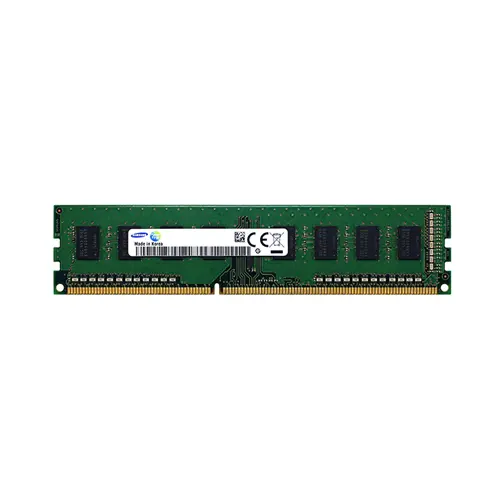
The M393B5170GB0-CF8 is a DDR3-1066 registered ECC DIMM designed for server platforms, making it an optimal choice for memory-intensive workloads such as virtualization and in-memory databases where data integrity is critical. Its dual-rank x4 organization and CL7 latency balance density with interleaving efficiency, while the registered signal type and ECC ensure robust data transmission and single-bit error correction in multi-socket systems.
1. ECC error correction actively detects and corrects single-bit memory faults, preventing silent data corruption that could jeopardize financial transactions or patient records in always-on server environments.
2. Registered signal buffering stabilizes electrical loads across fully populated DIMM slots, allowing dense server platforms to scale memory channels without risking signal degradation or system crashes.
3. Dual Rank x4 interleaving keeps bank groups busy on every clock cycle, delivering higher effective throughput necessary for virtual machine density and real-time database response.
4. The 1066 MHz data rate supplies a balanced 8.5 GB/s per channel bandwidth, smoothly accommodating concurrent workloads like web serving, caching, and light containerized applications.
5. A 4 GB footprint efficiently covers single-purpose server roles such as DNS, firewall appliances, or remote branch office controllers where predictable, lean memory provisioning ensures stable fixed-function operation.
When you are managing a virtualized cluster or an in-memory database, the M393B5170GB0-CF8 guarantees that your data remains intact and your services stay responsive. This Samsung DDR3 4GB RDIMM is engineered with ECC, which actively detects and corrects single-bit errors caused by background radiation, preventing silent data corruption that could crash a hypervisor hosting dozens of virtual machines. Its registered architecture buffers command and address signals, so you can confidently populate all 24 DIMM slots in a 2U server without worrying about signal degradation or system instability as you scale memory capacity for larger VM footprints. The dual-rank x4 design leverages rank interleaving, allowing the memory controller to initiate a read to one rank while the other rank completes a prior access; for a Redis instance holding millions of session records, this overlapping concurrency directly translates into higher throughput and lower tail latency. Moreover, the CL7 latency works hand in hand with rank interleaving to reduce access delays, accelerating real-time fraud detection queries that repeatedly traverse hash tables in main memory. In every layer of your infrastructure—from keeping the hypervisor stable to delivering microsecond query responses—this RDIMM turns electrical specifications into tangible business continuity and performance.
General Virtualization
For modest virtualization hosts using DDR3-era platforms, populate all memory channels symmetrically to maximize bandwidth. Deploy six or eight of these 4GB RDIMMs (24–32GB total) to run a dozen light VMs, ensuring ECC protection for multi-tenant stability. Avoid mixing ranks per channel—stick to identical dual-rank DIMMs to maintain signal integrity.
In-Memory Database
In-memory databases demand capacity and error resilience, making registered ECC essential. Equip the server with 12 or 18 modules (48–72GB) across all channels, keeping DIMMs uniform for consistent latency. This configuration holds medium-sized datasets fully in RAM while Registered logic sustains signal quality under heavy load.
High-Performance Computing
HPC clusters prioritize memory bandwidth per node. Install one DIMM per channel—typically 8 or 12 modules (32–48GB total)—to enable balanced, wide-stripe access. Although 1066MHz is modest, dual-rank x4 DIMMs deliver steady throughput for parallel MPI tasks, and ECC prevents silent data corruption during multi-day compute runs.
Rigorously tested for compatibility with Dell PowerEdge R710/R720, HP DL380 G7, IBM x3650 M3, and Lenovo RD630.
Q: Can I mix this M393B5170GB0-CF8 with other memory modules of different brands or speeds?
A: Mixing different brands or speeds is strongly discouraged for server RDIMMs. Unmatched modules may cause instability, ECC errors, or system POST failure. Use identical part numbers across all channels to guarantee validated performance and uptime.
Q: Is this memory compatible with my system?
A: This DDR3-1066 Registered ECC module targets servers based on Intel Xeon E5-2600 v1/v2 (C602 chipset) or AMD Opteron 6300 series. Compatibility depends on BIOS and board wiring. Please consult your server’s qualified vendor list.
Q: What is the recommended DIMM population order for optimal performance?
A: Populate channels symmetrically, starting with blue or first-slot positions per memory controller (e.g., slots A1, B1, C1, D1). This enables interleaving and balances load across all memory controllers. Refer to your system manual for exact slot numbering.
Q: Does this module support overclocking or XMP profiles?
A: No. This is a JEDEC-compliant server RDIMM operating at fixed 1066MHz with CL7 latency. It does not support overclocking or XMP, as stability and ECC data integrity take priority over speed flexibility in enterprise environments.
Q: What warranty and typical failure rate can I expect?
A: We provide a one-year warranty. Enterprise DDR3 RDIMMs like this typically exhibit an annualized failure rate under 0.5% under normal operating conditions, backed by full manufacturing screening for early-life defects.