











 Secure payments
Standard refund policy
Trade Assurance
Secure payments
Standard refund policy
Trade Assurance
| Product Type | Memory Module |
|---|---|
| Compliance Standards | EU RoHS,FCC |
| Memory Capacity | 4 GB |
| Memory Technology | DDR3 |
| RAM Speed | 1066 |
| RAM Standard | DDR3-1066/PC3-8500 |
| Error Identifying | Non-ECC |
| Signal Type | Unbuffered |
| Column Access Strobe (CAS) | CL7 |
| Rank | Dual Rank x8 |
| Quantity of Pins | 204-pin |
| RAM Genre | SoDIMM |
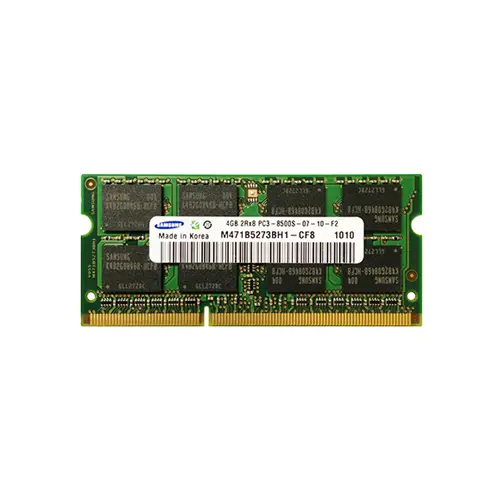
This DDR3-1066 SoDIMM is a notebook memory module designed for upgrading aging laptops and entry-level mobile workstations, delivering a low-latency CL7 timing and reliable dual-rank x8 organization to boost system responsiveness. Its unbuffered, non-ECC architecture and 204-pin form factor ensure broad plug-and-play compatibility with older dual-core and quad-core Intel platforms, offering an efficient, low-power memory refresh that extends the usable life of portable systems.
1. Modest capacity handles everyday browsing, document editing, and media playback without bottlenecking an older system’s potential.
2. DDR3 technology guarantees broad compatibility with a vast range of existing notebooks, making it a cost-efficient revival for aging machines.
3. Balanced operating frequency delivers stable data throughput while minimizing battery drain and heat generation in confined laptop chassis.
4. Low-latency response accelerates fetching of frequently used data, translating to snappier program launches and smoother desktop feel.
5. The SoDIMM form factor ensures straightforward, tool-free upgrades in most laptops, meeting exact physical and electrical specs out of the box.
When upgrading a notebook, the Samsung M471B5273BH1-CF8 SODIMM delivers four practical advantages that directly address the frustrations of mobile users. The 204-pin form factor guarantees effortless physical installation across countless laptops, from aging ultrabooks to entry-level mobile workstations, eliminating compatibility guesswork. Once fitted, its DDR3-1066 speed paired with a CL7 latency makes everyday multitasking tangibly snappier—whether toggling between large spreadsheets and a video call or running a lightweight virtual machine for software demonstrations while traveling. The dual-rank x8 architecture further enhances this experience by enabling interleaving, which elevates memory bandwidth just enough to smooth out integrated graphics performance during client presentations or HD streaming without a dedicated GPU. Finally, the 4GB capacity hits the sweet spot for cost-conscious upgrades: it doubles the memory in many thin-and-light systems originally equipped with only 2GB, reviving Windows 10 responsiveness for office applications and web browsing while drawing minimal additional power. This keeps battery drain in check, so you stay productive unplugged through a full meeting or a long commute.
Capacity Planning for DDR3-1066 SoDIMM (Non-ECC, Unbuffered)
This module is a laptop memory (204-pin SoDIMM, DDR3, non-ECC). Given its speed and capacity, planning should target older notebooks or compact systems where power and physical constraints limit options.
Laptop Upgrade
For typical multitasking on older dual-slot laptops, replacing a single 4 GB module with a matching pair (2 × 4 GB) enables dual-channel operation and doubles total capacity to 8 GB. This provides a cost-effective responsiveness boost for web browsing, office suites, and light media consumption without overinvesting in a legacy platform.
Mobile Workstation
When upgrading a mobile workstation for professional tools (e.g., CAD, data analysis), populate both slots with the largest supported modules, often 8 GB each, to reach 16 GB total. Although this DDR3-1066 kit is only 4 GB per stick, it can serve as a stepping stone if the system’s chipset and BIOS impose a 8 GB per slot ceiling, prioritizing capacity over raw speed for stable large-dataset handling.
Ultrabook Power Saving
In ultrabooks where battery life is critical, use a single 4 GB module or a low-voltage variant if the platform requires 1.35 V DDR3L. Because this unbuffered non-ECC memory is already power-frugal, populating only one slot leaves room for future expansion while minimizing idle power draw, extending runtime during light productivity tasks.
Rigorously tested, compatible with laptops like Lenovo ThinkPad X230, Dell Latitude E6430, HP EliteBook 8570p.
Q: Can I mix this M471B5273BH1-CF8 with other memory modules of different brands or speeds?
A: Mixing is not recommended. Notebooks often impose strict timing and voltage requirements. Pairing mismatched modules may cause instability, POST failures, or forced downclocking. Align exact specifications for reliable dual-channel operation.
Q: Is this memory compatible with my system?
A: This is a 204-pin DDR3-1066 SODIMM. It fits notebooks with the Intel GM45/PM45 chipset or similar DDR3 platforms. Verify your laptop supports dual-rank x8 SODIMMs and 1.5V operation before purchase for guaranteed compatibility.
Q: What is the recommended DIMM population order for optimal performance?
A: Most notebooks have two slots. Install identical modules in matched pairs to enable dual-channel interleaving. If only one slot is available, a single module works; no specific population sequence is required beyond using the same capacity and rank.
Q: Does this module support overclocking or XMP profiles?
A: No. This is a JEDEC-compliant DDR3-1066 CL7 module with fixed timings. Notebook BIOS typically lock memory speed and exclude XMP support. The module operates strictly at its intended 1066MHz profile.
Q: What warranty and typical failure rate can I expect?
A: This Samsung module carries a 1-year warranty. Mean failure rate is well under 0.5%, aligning with enterprise-grade specifications. Proper handling and ESD precautions ensure long-term reliability in typical operating conditions.