











 Secure payments
Standard refund policy
Trade Assurance
Secure payments
Standard refund policy
Trade Assurance
| Model | M393B5170EHB-CH9 |
|---|---|
| Product Type | Memory Module |
| Compliance Standards | EU RoHS,FCC |
| Memory Capacity | 4 GB |
| Memory Technology | DDR3 |
| Product Voltage | 1.5V |
| RAM Speed | 1333MHz |
| RAM Standard | DDR3-1333/PC3-10600 |
| Error Identifying | ECC |
| Signal Type | Registered |
| Column Access Strobe (CAS) | CL9 |
| Rank | Dual Rank x4 |
| Quantity of Pins | 240-pin |
| RAM Genre | RDIMM |
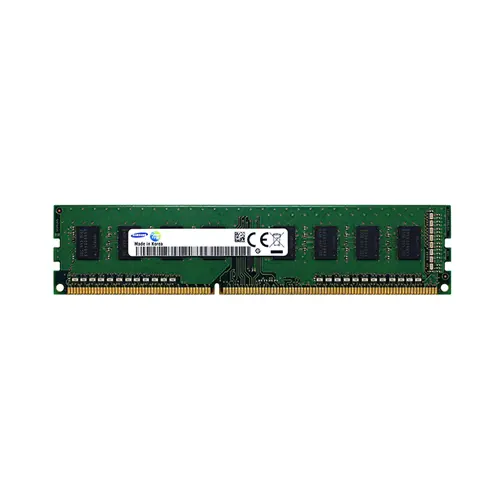
The Samsung M393B5170EHB-CH9 is a 4 GB DDR3-1333 registered ECC RDIMM built for legacy server platforms, leveraging its dual-rank x4 organization and CAS 9 latency to enhance memory interleaving and access efficiency. It is ideal for workloads that require uncompromising data integrity, such as virtualization clusters and in-memory databases, thanks to its registered signal stability and hardware error correction.
1. ECC protection detects and corrects single-bit memory errors in real time, preventing silent data corruption in long-running database or virtualization workloads.
2. Registered signal buffering stabilizes command and address lines across fully populated server boards, enabling reliable operation at scale with dozens of DIMMs per node.
3. Dual Rank x4 organization balances capacity with interleaved access, maintaining consistent memory bandwidth when multiple virtual machines contend for shared resources.
4. DDR3-1333 throughput delivers up to 10.6 GB/s per channel, offering predictable I/O performance for web serving and light containerized environments where cost-per-bit matters.
5. CL9 latency provides deterministic read response times, helping keep buffer caches fed and reducing CPU wait states during memory-intensive batch processing.
The Samsung M393B5170EHB-CH9 is a server-grade DDR3 RDIMM, engineered for environments where downtime is not an option. For a virtualization cluster running dozens of VMs, the Registered signal buffer is the first line of defense, enabling the system to support high-density memory configurations without signal degradation, so you can scale capacity without sacrificing stability. Its ECC technology continuously detects and corrects single-bit errors—a silent, cosmic-ray-induced bit flip in a financial database or hypervisor could otherwise cascade into transaction corruption or system crash, meaning your data integrity remains absolute under 24/7 operation. The Dual Rank x4 organization increases bank-level parallelism, allowing overlapping memory accesses that boost throughput during peak loads, such as an in-memory database processing millions of queries per second, reducing latency spikes. Operating at DDR3-1333 with CL9, it delivers a proven balance of responsive timing and bandwidth, ensuring consistent performance in legacy server refresh cycles. Together, these attributes mean fewer application stutters, predictable virtual machine response, and a trustworthy foundation for mission-critical workloads—translating directly into reduced operational risk and a lower total cost of ownership for your data center.
General Virtualization
For balanced virtualization hosts, populate memory channels symmetrically with these 4GB ECC Registered DIMMs. Installing at least one DIMM per channel (e.g., six identical modules per CPU in a triple-channel server) ensures uniform memory access and stable VM performance. A total of 48–96 GB using these modules can support a modest number of light- to medium-weight virtual machines.
In-Memory Database
In-memory databases demand maximum capacity and data integrity. Fill all available DIMM slots with these RDIMMs to maximize overall memory while preserving error-correcting protection. Configuring dual-rank modules, such as this x4 organized RDIMM, in every channel boosts effective bandwidth and aids database caching under heavy transactional loads.
High Performance Computing
HPC clusters require consistent memory bandwidth and low latency. Use identical 4GB RDIMMs, populating all memory channels equally (ideally two DIMMs per channel) to enable rank interleaving and maximize throughput. On dual-socket nodes, mirror the DIMM population across both processors to reduce NUMA penalties and maintain peak floating-point performance during parallel simulations.
Rigorously tested for server compatibility: fits Dell PowerEdge R710, R510, HP ProLiant DL380 G7, and similar DDR3 systems.
Q: Can I mix this M393B5170EHB-CH9 with other memory modules of different brands or speeds?
A: Mixing registered ECC modules of different brands or speeds is not recommended. It may compromise signal integrity and cause server instability. For reliable operation, use identical matched kits throughout the system.
Q: Is this memory compatible with my system?
A: This DDR3-1333 Registered ECC RDIMM is compatible with servers using Intel Xeon 5500/5600 series or AMD Opteron 6100/6200 platforms. Confirm your motherboard supports registered DIMMs and 1333MHz ECC memory.
Q: What is the recommended DIMM population order for optimal performance?
A: Populate identical DIMMs per channel, starting with the first slot of each memory channel as specified in your server's manual. Balanced interleaving across channels ensures optimal memory bandwidth and performance.
Q: Does this module support overclocking or XMP profiles?
A: No. This server-grade RDIMM complies strictly with JEDEC DDR3-1333 CL9 standards. It does not support overclocking or XMP profiles, prioritizing data integrity and rock-solid stability for enterprise workloads.
Q: What warranty and typical failure rate can I expect?
A: This module includes a 1-year warranty. As enterprise-class memory, it offers an annualized failure rate (AFR) well below 1%, delivering the high reliability required for mission-critical server environments.