











 Secure payments
Standard refund policy
Trade Assurance
Secure payments
Standard refund policy
Trade Assurance
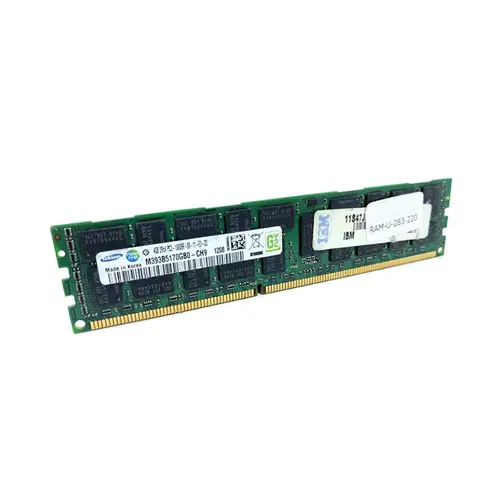
| Model | M393B5170GB0-CH9Q8 |
|---|---|
| Product Type | Memory Module |
| Compliance Standards | EU RoHS,FCC |
| Memory Capacity | 4 GB |
| Memory Technology | DDR3 |
| Product Voltage | 1.5V |
| RAM Speed | 1333MHz |
| RAM Standard | DDR3-1333/PC3-10600 |
| Error Identifying | ECC |
| Signal Type | Registered |
| Column Access Strobe (CAS) | CL9 |
| Rank | Dual Rank x4 |
| Quantity of Pins | 240-pin |
| RAM Genre | RDIMM |
This Samsung M393B5170GB0-CH9Q8 is a 4GB DDR3-1333 Registered ECC RDIMM designed for legacy server platforms requiring moderate memory density, and its dual-rank x4 organization with CL9 latency optimally supports virtualized environments and memory-intensive applications like in-memory databases by enabling efficient bank-level parallelism and low access latency. The ECC and registered architecture ensure end-to-end data integrity and signal stability in multi-DIMM configurations, making it a reliable upgrade for aging 1.5V dual-socket servers that demand consistent uptime and error resilience.
1. A 4-gigabyte capacity per module supplies the essential memory footprint for entry-level server virtualisation, letting multiple lightweight VMs run concurrently without excessive paging to disk.
2. The 1333-megahertz clock rate provides steady memory bandwidth that sustains responsive database queries and reliable web-serving under constant enterprise workloads.
3. On-the-fly ECC correction prevents single-bit errors from corrupting transactional data, delivering the end-to-end integrity that financial and healthcare computing demand.
4. Registered signal buffering preserves command and address integrity, enabling fully populated memory channels in dense rack servers without sacrificing stability.
5. Dual Rank x4 organisation heightens bank-level parallelism, allowing consolidated enterprise applications to sustain peak throughput while scaling to large memory capacities.
As a server-class DDR3 Registered DIMM, the Samsung M393B5170GB0-CH9Q8 is purpose-built to eliminate the risks that keep IT managers awake at night. Its ECC engine actively scans every bit of data, instantly correcting single-bit errors before they cascade into silent corruption. In a dense VMware cluster, that means a flipped bit in a virtualized database won’t trigger a host crash or, worse still, write corrupted financial records—your data integrity remains absolute. The registered signal buffer isolates the memory controller from electrical load spikes, letting you fully populate all channels with dual-rank modules without sacrificing frequency or stability. When you’re running an in-memory analytics platform like SAP HANA, this reliability under full slot utilization translates directly into uninterrupted real-time insights. That dual-rank x4 architecture further amplifies performance through rank interleaving: while one rank processes a refresh cycle, the other immediately services pending reads, aggressively reducing latency for simultaneous OLTP transactions. Finally, stringent qualification to the 240-pin, 1.5V, RoHS, and FCC standards guarantees drop-in compatibility across mixed-fleet server nodes, slashing deployment uncertainty and ensuring consistent, 24/7 operational uptime across your datacenter.
General Virtualization
For a hypervisor hosting multiple VMs, populate at least six identical M393B5170GB0 modules per CPU to leverage triple-channel memory and reduce NUMA penalties. Start with 24 GB (6 × 4 GB) per socket for light workloads, scaling to 48 GB for moderate consolidation, and always balance DIMMs across memory channels evenly.
In-Memory Database
Low latency and data integrity are critical, so deploy the maximum supported RDIMM count—often 12 or 24 per server. Use 4 GB sticks to reach 48–96 GB total for medium-size datasets, and configure memory mirroring or sparing to utilize the ECC Registered capabilities for uninterrupted operation.
High Performance Computing
HPC nodes benefit from uniform, wide memory access. Install one DIMM per channel across all available channels (e.g., 8 or 12 modules) to maximize bandwidth at 1333 MT/s. This 4 GB dual-rank x4 RDIMM offers a good balance of capacity and bank-level parallelism, essential for simulation and modeling codes.
Rigorously tested server memory, compatible with Dell PowerEdge R720, HPE ProLiant DL380p Gen8, and Lenovo System x3650 M4.
Q: Can I mix this M393B5170GB0-CH9Q8 with other memory modules of different brands or speeds?
A: Mixing registered ECC modules of different brands, speeds, or ranks is not recommended. It may cause signal integrity issues and system instability. For reliable server operation, always install identical, validated DIMMs from the same kit.
Q: Is this memory compatible with my system?
A: This DDR3-1333 RDIMM is designed for servers using Intel Xeon E5-2400/2600 v1/v2 or AMD Opteron 6300/4300 series processors. Please verify your motherboard’s QVL and ensure it supports registered ECC, 240-pin, 1.5V modules.
Q: What is the recommended DIMM population order for optimal performance?
A: Populate identical memory in each memory channel, starting with the farthest slot from the CPU per channel (usually blue slots). Follow your server manual to balance ranks across channels, maximizing bandwidth while maintaining correct ranking rules.
Q: Does this module support overclocking or XMP profiles?
A: No. This is a JEDEC-compliant server RDIMM built for stability and uptime. It does not support overclocking or XMP profiles. Timing parameters are fixed at CL9, ensuring consistent, reliable operation in enterprise environments.
Q: What warranty and typical failure rate can I expect?
A: This module comes with a 1-year warranty. As a Samsung enterprise-grade component with rigorous binning and testing, it exhibits a typical annualized failure rate below 0.5% under specified operating conditions, ensuring excellent long-term reliability.