











 Secure payments
Standard refund policy
Trade Assurance
Secure payments
Standard refund policy
Trade Assurance
| Model | M393B5270DH0-CH9 |
|---|---|
| Product Type | Memory Module |
| Compliance Standards | EU RoHS,FCC |
| Memory Capacity | 4 GB |
| Memory Technology | DDR3 |
| Product Voltage | 1.5V |
| RAM Speed | 1333MHz |
| RAM Standard | DDR3-1333/PC3-10600 |
| Error Identifying | ECC |
| Signal Type | Registered |
| Column Access Strobe (CAS) | CL9 |
| Rank | Single Rank x4 |
| Quantity of Pins | 240-pin |
| RAM Genre | RDIMM |
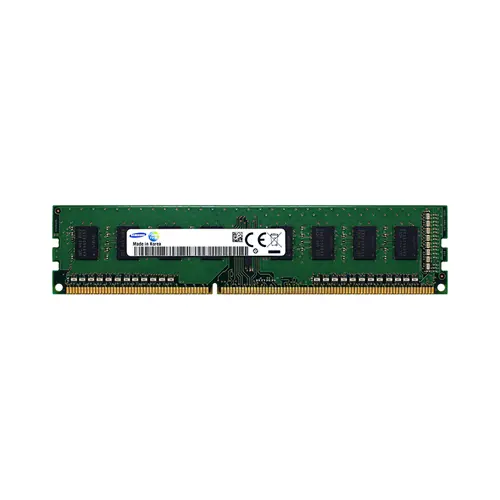
Optimized for legacy server platforms, this Samsung M393B5270DH0-CH9 DDR3-1333 RDIMM delivers critical data integrity through ECC and registered signal buffering, making it ideally suited for virtualization hosts and memory-intensive database applications. Its single-rank x4 organization ensures stable signaling and reduced electrical loading, enabling reliable population of all DIMM slots in 2U rack servers that still depend on proven DDR3 infrastructure.
1. ECC protection silently corrects single-bit memory errors, preserving data integrity for virtualization hosts and preventing costly application crashes in always-on enterprise environments.
2. Registered buffering strengthens signal integrity across fully populated memory channels, enabling reliable scaling of memory capacity for dense virtual machine consolidation.
3. DDR3 technology delivers a mature and battle-tested memory foundation, offering proven compatibility and rock-solid uptime across legacy server deployments.
4. The memory speed sustains consistent data throughput under mixed enterprise workloads, keeping transaction latencies predictable for database and web serving.
5. Single Rank x4 organization utilizes x4-width DRAM chips to maximize chip-level error containment, reinforcing the fault-resilient design that mission-critical servers depend on.
The M393B5270DH0-CH9 is a server-grade DDR3-1333 Registered DIMM engineered for workloads where stability and data integrity are non-negotiable. In a VMware ESXi virtualized cluster, its ECC technology silently corrects single-bit memory errors that would otherwise corrupt hypervisor memory or application data, preventing random crashes and safeguarding continuous uptime for dozens of virtual machines. The Registered signal buffer addresses the real pain of populating all DIMM slots; it re-drives command and address signals so you can load a memory-hungry in-memory database like Redis across dense server channels without signal degradation or boot failures. That scalability directly supports larger datasets and more instances. The Single Rank x4 organization further reduces electrical loading on the memory controller, delivering higher signal integrity and consistent speed even in mixed-batch deployments—critical when you need predictable latency across a farm of servers. Finally, the CAS Latency of 9 cycles at 1333MHz accelerates column access; for a database handling millions of random lookups, each saved cycle cuts query response time, giving transaction-heavy applications a measurable performance edge. Together, these four characteristics translate into the resilient, low-latency foundation that data centers require.
The M393B5270DH0-CH9 is a 4GB DDR3-1333 Registered ECC RDIMM (1.5V, CL9, single-rank x4) for servers. Below is capacity planning guidance for typical server workloads.
General Virtualization
Populate memory channels symmetrically to leverage ECC and registered capabilities. For a triple-channel platform, install at least three identical modules per CPU (e.g., 6×4GB for 24GB) and keep all channels balanced. Scale by adding a second set of three to reach 48GB while preserving interleaving.
In-Memory Database
Maximize capacity by filling every DIMM slot with these 4GB RDIMMs—18 slots yield 72GB in a dual-socket node. The single-rank x4 organization ensures clean signaling when fully populated. Deploy multiple nodes with identical modules if larger datasets are needed.
High-Performance Computing (HPC)
Memory bandwidth is critical: install an equal number of DIMMs per channel. A common configuration uses two modules per channel (e.g., 12×4GB for 48GB on a six-channel system). This uniform population saturates the memory bus and delivers the highest sustainable throughput for parallel HPC jobs.
Rigorously tested server memory compatible with Dell PowerEdge R710, HP DL380 G7, IBM x3650 M3, and more.
Q: Can I mix this M393B5270DH0-CH9 with other memory modules of different brands or speeds?
A: Mixing is not recommended for this registered server DIMM. Mismatched brands, speeds, or rankings can cause instability, POST failures, and negate ECC protection. Uniform configurations are essential in server environments.
Q: Is this memory compatible with my system? It supports Intel Xeon E5-2600 v2 series processors.
A: Yes, this DDR3-1333 RDIMM is compatible with Intel Xeon E5-2600 v2 platforms using the C602 chipset and LGA2011 socket. Always verify your server board’s qualified vendor list for exact model support.
Q: What is the recommended DIMM population order for optimal performance?
A: Populate identical DIMMs per memory channel following the server manual. Typically, start with blue slots for the first rank, then black. Always balance capacity across CPU memory controllers for symmetric multi-channel performance.
Q: Does this module support overclocking or XMP profiles?
A: No. As an enterprise-grade registered ECC DIMM, it strictly adheres to JEDEC DDR3-1333 standards. XMP profiles and overclocking are unsupported; stability and data integrity take precedence over speed adjustments.
Q: What warranty and typical failure rate can I expect?
A: This module is covered by a 1-year warranty. Its Mean Time Between Failures (MTBF) is millions of hours under normal server operating conditions, resulting in a fraction of a percent Annualized Failure Rate (AFR).