











 Secure payments
Standard refund policy
Trade Assurance
Secure payments
Standard refund policy
Trade Assurance
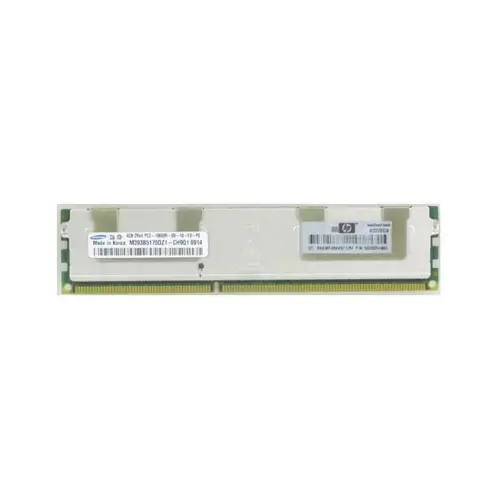
| Model | M393B5170DZ1-CH9Q1 |
|---|---|
| Product Type | Memory Module |
| Compliance Standards | EU RoHS,FCC |
| Memory Capacity | 4 GB |
| Memory Technology | DDR3 |
| Product Voltage | 1.5V |
| RAM Speed | 1333MHz |
| RAM Standard | DDR3-1333/PC3-10600 |
| Error Identifying | ECC |
| Signal Type | Registered |
| Column Access Strobe (CAS) | CL9 |
| Rank | Dual Rank x4 |
| Quantity of Pins | 240-pin |
| RAM Genre | RDIMM |
This is a server-grade DDR3 Registered DIMM with ECC, purpose-built for platforms requiring high data integrity and stability under sustained load, such as virtualization hosts or in-memory databases. The dual-rank x4 configuration and registered signal type reduce electrical loading on the memory controller, enabling reliable operation in fully populated multi-DIMM server environments while ECC mitigates single-bit errors in real time.
1. ECC error correction detects and corrects single-bit memory faults in real time, dramatically reducing silent data corruption risks and preventing costly downtime in transactional databases and financial processing systems.
2. Registered signal buffering conditions address and control lines so that multiple DIMMs per channel can populate a server board reliably, preserving signal integrity and enabling higher total memory capacity for virtualization hosts.
3. Dual Rank x4 organization alternates access between internal rank banks, fully saturating the memory channel and delivering consistent, low-latency throughput essential for dense containerized workloads under peak consolidation.
4. 1333MHz operating speed supplies predictable bandwidth ideal for mid-tier application servers and caching layers, sustaining smooth user-facing response times during concurrent request bursts without throttling.
5. A 4GB module capacity offers a cost-effective density increment for lightweight hypervisor deployments and scale-out node configurations, efficiently supporting dedicated microservices while maintaining manageable power budgets per socket.
The M393B5170DZ1-CH9Q1 is a server-grade DDR3 Registered DIMM that addresses real-world enterprise pain points through four critical features. First, ECC automatically corrects single-bit errors from cosmic radiation—without it, a flipped bit in a virtualized cluster could crash a hypervisor or corrupt an in-memory database transaction, leading to costly downtime. Second, the registered buffer re-drives command and address signals, allowing you to fill every DIMM slot reliably. This stability is vital when hosting dozens of VMs, eliminating reboot storms caused by signal degradation. Third, a dual-rank x4 design enables rank interleaving, which overlaps operations to increase effective bandwidth; for Redis or Memcached, this delivers higher query throughput under heavy loads. Fourth, CAS 9 latency at 1333MHz ensures rapid column access, reducing response times for transaction processing and real-time analytics. These characteristics keep your infrastructure both dependable and fast.
General Virtualization
For a DDR3 Registered ECC platform, each 4GB RDIMM offers a modest baseline. Populate all available channels symmetrically—typically six or eight modules per host—to maximize memory bandwidth for hypervisor overhead and multiple VMs. Aim for at least 32–48GB per socket by installing 8–12 identical M393B5170DZ1-CH9Q1 sticks, ensuring balanced NUMA access and reliable ECC protection.
In-Memory Database
In-memory workloads demand both capacity and low latency. Dense configurations with 16 or 24 of these dual-rank x4 modules can deliver 64–96GB of registered ECC memory, sufficient for small to mid-sized datasets. Always match DIMM population to the CPU’s memory controllers; populate all three channels per CPU with identical modules to sustain steady 1333MHz CL9 throughput under heavy read/write pressure.
High-Performance Computing
HPC clusters often prioritize bandwidth over raw capacity. Install a balanced set of RDIMMs—typically 12 or 18 modules across dual-socket nodes—to leverage triple-channel interleaving. This 4GB dual-rank DIMM fits nodes running memory-bandwidth-sensitive simulations, but for larger problem sizes consider filling all slots to reach 48–96GB while maintaining uniform access patterns and ECC integrity.
Rigorously tested for seamless server compatibility: Dell PowerEdge R710, HP ProLiant DL380 G7, Lenovo ThinkServer RD630.
Q: Can I mix this M393B5170DZ1-CH9Q1 with other memory modules of different brands or speeds?
A: Mixing with different brands or speeds is not recommended for server RDIMMs. To ensure stability, use identical modules with the same part number, rank, and timings. Incompatibility may cause POST failures.
Q: Is this memory compatible with my system?
A: This DDR3-1333 ECC Registered RDIMM is compatible with servers using Intel Xeon 5500/5600 series or AMD Opteron 6100/6200 series platforms. Verify your board supports registered memory.
Q: What is the recommended DIMM population order for optimal performance?
A: For dual-processor servers, populate equal DIMMs per CPU following the motherboard's slot numbering. Always fill channels identically, starting with the farthest slots from the CPU.
Q: Does this module support overclocking or XMP profiles?
A: No, this ECC Registered server memory does not support overclocking or XMP profiles. It runs at fixed JEDEC standard settings to guarantee data integrity and 24/7 stability.
Q: What warranty and typical failure rate can I expect?
A: This module comes with a 1-year warranty. Typical failure rate for DDR3 ECC modules is extremely low (<0.2% AFR) under normal operating conditions, ensuring high reliability.