











 Secure payments
Standard refund policy
Trade Assurance
Secure payments
Standard refund policy
Trade Assurance
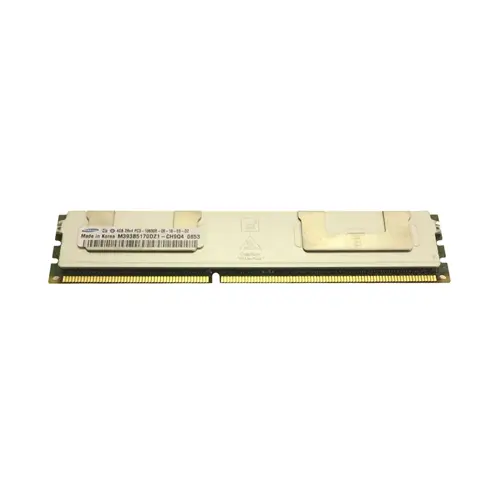
| Model | M393B5170DZ1-CH9Q4 |
|---|---|
| Product Type | Memory Module |
| Compliance Standards | EU RoHS,FCC |
| Memory Capacity | 4 GB |
| Memory Technology | DDR3 |
| Product Voltage | 1.5V |
| RAM Speed | 1333MHz |
| RAM Standard | DDR3-1333/PC3-10600 |
| Error Identifying | ECC |
| Signal Type | Registered |
| Column Access Strobe (CAS) | CL9 |
| Rank | Dual Rank x4 |
| Quantity of Pins | 240-pin |
| RAM Genre | RDIMM |
Designed for legacy server platforms, the Samsung M393B5170DZ1-CH9Q4 is a 4GB DDR3-1333 Registered DIMM with ECC, ideally suited for virtualization hosts and in-memory databases where data integrity and stable operation under full memory population are critical. Its dual-rank x4 configuration enables balanced interleaving for improved bandwidth efficiency, while the registered signal type and CL9 latency ensure reliable command/address signaling in multi-DIMM configurations.
1. Registered signal type buffers command and address signals to maintain rock-solid signal integrity across fully populated multi-DIMM server channels, essential for 24/7 data center uptime.
2. ECC protection continuously corrects single-bit errors and detects multi-bit faults, shielding virtualized workloads from silent data corruption that could compromise transactional databases.
3. DDR3 technology at 1333MT/s balances proven power efficiency with sufficient throughput, allowing dense rack servers to scale memory capacity without exceeding thermal budgets.
4. Dual Rank x4 organization interleaves accesses across internal banks to maximize sustained bandwidth, smoothing out performance dips under heavy concurrent VM request storms.
5. 4 GB capacity per module strikes a right-sized density for cost-effective hyperscale deployments, packing ample headroom for memory-hungry hypervisors while keeping replacement cycles predictable.
When you’re running a virtualized cluster or an in-memory database, the Samsung M393B5170DZ1-CH9Q4 is far more than a simple DDR3 module—it’s a safeguard for your data and a foundation for consistent performance. This 4GB RDIMM is purpose-built for servers, and its four defining characteristics directly address the pain points of IT managers who cannot afford silent corruption or unexpected downtime.
First, ECC error correction actively detects and corrects single-bit memory errors. In a virtualization host running dozens of VMs, a flipped bit in one guest can cascade into application failures or even hypervisor instability; ECC turns that risk into a non-event. Second, the registered signal buffer stabilizes the electrical load on the memory bus. When you populate all channels for high capacity in a database server, registered logic ensures clean command and address signals, preventing the signal degradation that causes random reboots in unbuffered designs. Third, the dual-rank x4 organization enables rank interleaving, letting the memory controller overlap access cycles. For an in-memory analytics platform like Redis or SAP HANA, this means lower latency and higher sustained throughput under concurrent requests, because while one rank is busy, the next command can already flow to the other rank. Finally, the DDR3-1333 speed at CL9 delivers a proven balance of bandwidth and response time, ensuring your legacy enterprise servers get a reliable, RoHS-compliant upgrade that keeps critical services running without adding thermal burden. Together, these features mean fewer service disruptions, firmer data integrity, and predictable performance where it matters most.
General Virtualization
This DDR3 Registered ECC module is designed for legacy server platforms hosting moderate-density virtual machines. For general virtualization with a hypervisor like VMware ESXi or Hyper-V, populate six to eight identical 4GB RDIMMs across triple-channel or quad-channel memory banks to achieve 24–32GB of total capacity. Balanced DIMM distribution ensures consistent memory access latency and stable operation under mixed-tenant workloads.
In-Memory Database
In-memory databases such as Redis or SAP HANA demand maximum capacity and absolute data integrity, making ECC and registered buffering essential. Deploy a full complement of eighteen or more DIMMs on dual-socket servers to reach 72GB or higher, populating all channels symmetrically for peak throughput. Always prioritize identical, validated kits to prevent signal integrity issues under sustained, write-intensive caching scenarios.
High-Performance Computing (HPC)
HPC applications benefit from parallel memory bandwidth rather than pure capacity. Install this dual-rank x4 RDIMM in multiples of three or four per processor—typically twelve to sixteen sticks across a two-socket node—to saturate memory channels and feed compute-bound simulations. Use uniform module placement to achieve symmetric NUMA domains, minimizing inter-socket latency in MPI-based or tightly coupled scientific workloads.
Rigorously tested, this server memory guarantees dependable operation in Dell PowerEdge R720, HP DL380p Gen8, and Lenovo RD430.
Q: Can I mix this M393B5170DZ1-CH9Q4 with other memory modules of different brands or speeds?
A: Mixing is not recommended for server environments. All modules should be identical in speed, rank, and type (DDR3 Registered ECC) to ensure signal integrity and prevent system instability.
Q: Is this memory compatible with my server system?
A: It is compatible with servers using Intel Xeon 5500/5600 or AMD Opteron 4100/6100 series platforms that support DDR3-1333 Registered ECC RDIMMs. Verify your motherboard's memory QVL for confirmation.
Q: What is the recommended DIMM population order for optimal performance?
A: Populate identical DIMMs in the first slot of each memory channel (usually blue slots), balancing across all available memory controllers. Always refer to the system's service manual for specific population rules.
Q: Does this module support overclocking or XMP profiles?
A: No. This is a server-grade Registered ECC module designed for maximum data integrity and stability, not for overclocking. XMP profiles are not supported.
Q: What warranty and typical failure rate can I expect?
A: It includes a 1-year warranty. The failure rate is extremely low, as the module undergoes rigorous testing for 24/7 enterprise operation and meets strict reliability standards like EU RoHS.