











 Secure payments
Standard refund policy
Trade Assurance
Secure payments
Standard refund policy
Trade Assurance
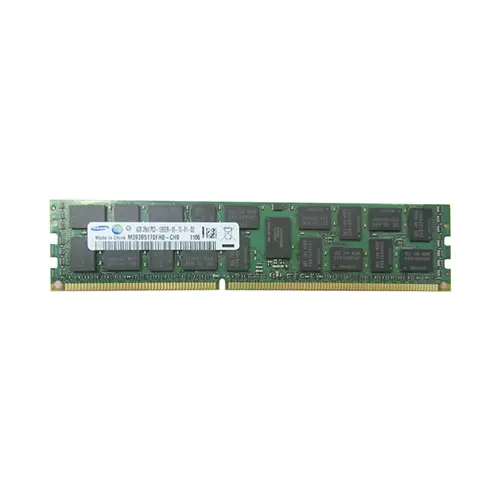
| Model | M393B5170FH0-CH9 |
|---|---|
| Product Type | Memory Module |
| Compliance Standards | EU RoHS,FCC |
| Memory Capacity | 4 GB |
| Memory Technology | DDR3 |
| Product Voltage | 1.5V |
| RAM Speed | 1333MHz |
| RAM Standard | DDR3-1333/PC3-10600 |
| Error Identifying | ECC |
| Signal Type | Registered |
| Column Access Strobe (CAS) | CL9 |
| Rank | Dual Rank x4 |
| Quantity of Pins | 240-pin |
| RAM Genre | RDIMM |
This Samsung M393B5170FH0-CH9 is a server-grade DDR3-1333 RDIMM with ECC and registered signal buffering, purpose-built for virtualization hosts, memory-resident databases, and other enterprise workloads that demand uncompromising data integrity. Its dual-rank x4 organization and CL9 latency strike a balance between capacity density and response time, while the registered command/address interface stabilizes multi-DIMM channels in dual-socket servers, making it an ideal pick for scaling reliable memory capacity in legacy data center platforms still running DDR3 infrastructure.
1. Error-correcting code (ECC) detects and corrects single-bit memory faults in real time, preventing silent data corruption that could crash critical database transactions or financial settlement processes.
2. Registered signal buffering stabilizes command and address lines across high-density server boards, ensuring clean signaling even when all memory slots are populated in large-scale virtualization hosts.
3. Dual Rank x4 organization interleaves memory accesses to keep server memory channels saturated, sustaining consistent throughput for heavy consolidation workloads like concurrent virtual machine memory ballooning.
4. The module’s 10.6 GB/s peak bandwidth handles sustained streaming of frequently accessed datasets, accelerating in-memory caches and reducing response latency under concurrent query loads.
5. A 4 GB capacity per module allows fine-grained memory expansion in entry-level hypervisors or edge compute appliances, balancing cost-efficiency with sufficient footprint for lightweight containerized services.
The Samsung M393B5170FH0-CH9 is a server-grade Registered DIMM purpose-built for mission-critical data center workloads, where reliability and stability directly translate to revenue protection. In a dense virtualization cluster hosting dozens of VMs, an uncorrected memory error can silently corrupt guest data or trigger a host crash. The built-in ECC engine continuously scans and corrects single-bit errors, effectively neutralizing the threat of cosmic-ray bit flips—this means your hypervisor stays up, and your tenants never experience unexplained service interruptions. For an in-memory database like Redis or a transactional SQL engine, every nanosecond counts and data integrity is non-negotiable. The registered interface buffers command and address signals, allowing the server to populate all 24 DIMM slots without signal degradation, so you can scale to hundreds of gigabytes of stable RAM. Meanwhile, the dual-rank x4 organization and 1333MHz clock with CL9 latency boost intra-rank interleaving, delivering higher sustained bandwidth under concurrent query loads. This combination ensures that your stock trading platform or real-time analytics cache returns consistent, accurate results instead of suffering performance jitter or silent data corruption. Simply put, this module turns raw capacity into dependable uptime and actionable insight.
General Virtualization
For a typical virtualization host using DDR3 Registered ECC memory, populate at least six identical 4 GB RDIMMs (24 GB total) across three channels per CPU to balance capacity and memory bandwidth. Deploy modules in matched sets of three or six to maintain triple‑channel symmetry, which is critical for consistent VM performance. Leave half the DIMM slots free for future scaling if the workload density grows.
In‑Memory Database
In‑memory databases demand both capacity and unwavering data integrity. Install the maximum supported number of these 4 GB dual‑rank RDIMMs—often 12 or 16 modules per server—to reach 48 GB to 64 GB, as larger total capacity reduces disk I/O. Always populate all memory channels identically to maximize throughput, because dual‑rank x4 configurations deliver the error correction required for transactional consistency.
High‑Performance Computing
HPC clusters benefit from fully populating every memory channel with these registered ECC modules to achieve peak memory bandwidth. A common configuration uses 12 DIMMs (48 GB) per dual‑socket node, arranged to saturate all six channels per CPU. The 1333 MHz speed and CL9 latency are adequate for bandwidth‑sensitive simulations, while registered ECC safeguards long‑running compute jobs against silent data corruption.
Rigorously tested server memory, compatible with Dell PowerEdge R620, R720, HP DL380p Gen8, and IBM x3650 M4.
Q: Can I mix this M393B5170FH0-CH9 with other memory modules of different brands or speeds?
A: Mixing is strongly discouraged in server environments. Even identical specs from different brands may cause signal integrity issues. For validated RAS, populate all channels with identical Samsung RDIMMs of the same MPN.
Q: Is this memory compatible with my Intel Xeon or AMD Opteron server platform?
A: It is designed for dual-socket servers supporting DDR3-1333 Registered ECC. Verify your board's qualified vendor list. It fits Intel 5500/5600 series and AMD G34/C32 platforms with 240-pin RDIMM slots.
Q: What is the recommended DIMM population order for optimal performance?
A: Follow your server manual's memory population guidelines. Typically, populate identical dual-rank RDIMMs per channel, starting with slots furthest from the CPU. Balance loading across memory controllers for maximum throughput.
Q: Does this module support overclocking or XMP profiles?
A: No. This is an enterprise RDIMM adhering to JEDEC DDR3-1333 CL9 at 1.5V. Overclocking or XMP is not supported and would compromise ECC reliability and platform stability.
Q: What warranty and typical failure rate can I expect?
A: This module carries a one-year warranty. As an enterprise-grade RDIMM, it achieves an annualized failure rate below 0.5% under standard operating conditions, assuming proper cooling and no electrical overstress.