











 Secure payments
Standard refund policy
Trade Assurance
Secure payments
Standard refund policy
Trade Assurance
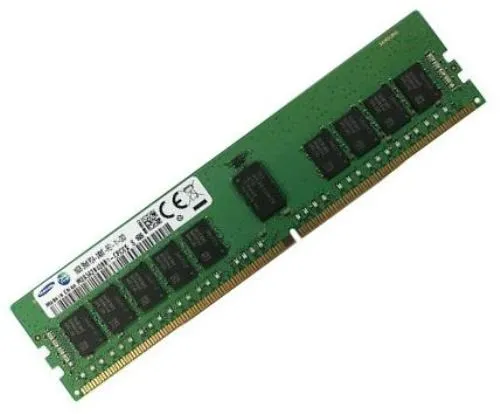
| Model | M393B5270CH0-CH9Q5 |
|---|---|
| Product Type | Memory Module |
| Compliance Standards | EU RoHS,FCC |
| Memory Capacity | 4 GB |
| Memory Technology | DDR3 |
| Product Voltage | 1.5V |
| RAM Speed | 1333MHz |
| RAM Standard | DDR3-1333/PC3-10600 |
| Error Identifying | ECC |
| Signal Type | Registered |
| Column Access Strobe (CAS) | CL9 |
| Rank | Single Rank x4 |
| Quantity of Pins | 240-pin |
| RAM Genre | RDIMM |
This DDR3-1333 Registered DIMM with ECC is a server-class memory module optimized for virtualization, in-memory databases, and other mission-critical workloads where end-to-end data integrity is non-negotiable. Its single-rank x4 configuration and registered signal architecture deliver stable operation in dense multi-DIMM platforms while the CL9 latency ensures efficient access in memory-bound server environments.
1. ECC protection detects and corrects single-bit memory errors on the fly, preventing silent data corruption in mission‑critical databases and financial transactions.
2. Registered signal buffering stabilizes command and address buses, enabling densely populated server boards to scale capacity without compromising signal integrity.
3. 4 GB capacity per module suits lightweight virtualization nodes or dedicated caching layers, where predictable low‑latency access is more valuable than raw density.
4. 1333 MHz speed delivers balanced throughput for mid‑range enterprise workloads, sustaining steady request‑response rates under moderate concurrent user loads.
5. Single Rank x4 organization concentrates all DRAM devices on one rank, cutting power consumption per channel and reducing thermal stress in compact rack enclosures.
When you are managing a virtualized server cluster or an in-memory database, every bit of data matters—yet a single undetected bit-flip caused by background radiation can silently corrupt financial records or crash an entire virtual machine. The Samsung M393B5270CH0-CH9Q5, a 4 GB Registered ECC DDR3-1333 RDIMM, is engineered precisely to prevent this nightmare. Its integrated ECC constantly scans and corrects single-bit errors in real time, ensuring data integrity for mission-critical workloads where accuracy is non-negotiable.
In dense virtualization environments hosting dozens of VMs per physical host, the Registered signal buffer becomes a critical safeguard; it stabilizes the electrical load on the memory bus so you can populate all 24 DIMM slots without sacrificing reliability. For memory-hungry databases like Redis or SAP HANA, the single-rank x4 organization delivers consistent low latency (CL9) and predictable bandwidth, eliminating the performance dips that occur when rank interleaving is mismanaged. This means your transactional queries execute faster and your multi-tenant platform stays up, even under peak load. With EU RoHS and FCC compliance, it also fits seamlessly into enterprise lifecycle standards, reducing deployment friction in your data center.
The M393B5270CH0-CH9Q5 is a 4GB DDR3-1333 Registered ECC RDIMM, indicating a server memory module. Capacity planning guidance for typical server workloads is provided below.
General Virtualization
Populate at least six modules (24GB) across all memory channels to balance access and support 10–15 lightweight VMs. This provides sufficient headroom for moderate consolidation. Use identical 4GB RDIMMs to preserve ECC reliability.
In-Memory Database
Fill every DIMM slot with these 4GB RDIMMs to maximize capacity; a dual-socket system can reach 72–96GB. Use the same single-rank x4 modules across channels to reduce electrical load and maintain signal integrity for in-memory datasets.
High-Performance Computing (HPC)
Install one 4GB RDIMM per channel (e.g., six modules on a triple-channel board) to maximize bandwidth and keep latency low. Do not populate more than one DIMM per channel to avoid frequency downgrades. ECC ensures data accuracy for long-duration simulations.
Rigorously tested server memory; compatible with Dell PowerEdge R720, HP DL380p Gen8, Lenovo System x3650 M4.
Q: Can I mix this M393B5270CH0-CH9Q5 with other memory modules of different brands or speeds?
A: Mixing is not recommended for server RDIMMs. Different brands, speeds, or ranks can cause stability issues and invalidate vendor support. Use identical modules with the same part number for validated platform compatibility.
Q: Is this memory compatible with my system?
A: This DDR3-1333 Registered ECC module requires a server board with a compatible Intel Xeon E5-2400/E5-2600 v1/v2 or AMD Opteron 6300/4300 series platform. Please verify your server's qualified vendor list for this exact part.
Q: What is the recommended DIMM population order for optimal performance?
A: Populate identical DIMMs per channel following your server's manual. Typically, matching slots across CPU memory channels first, filling blue or white slots before others to maintain balanced interleaving and maximize memory bandwidth.
Q: Does this module support overclocking or XMP profiles?
A: No. This registered ECC server module is strictly JEDEC-compliant for 24/7 data integrity. Overclocking and XMP are not supported, as stability and error correction take priority over speculative performance gains.
Q: What warranty and typical failure rate can I expect?
A: This module includes a one-year warranty. It is built with enterprise-grade components, exhibiting an annualized failure rate (AFR) well below 0.5% under specified operating conditions, ensuring long-term reliability.