











 Secure payments
Standard refund policy
Trade Assurance
Secure payments
Standard refund policy
Trade Assurance
| Product Type | Memory Module |
|---|---|
| Memory Capacity | 4 GB |
| Memory Technology | DDR3 |
| Product Voltage | 1.5V |
| RAM Speed | 1333MHz |
| RAM Standard | DDR3-1333/PC3-10600 |
| Error Identifying | ECC |
| Signal Type | Registered |
| Column Access Strobe (CAS) | CL9 |
| Rank | Dual Rank x4 |
| Quantity of Pins | 240-pin |
| RAM Genre | RDIMM |
This DDR3-1333 Registered ECC RDIMM is engineered for legacy server platforms requiring stable, high-capacity memory configurations, making it ideal for virtualization hosts and memory-intensive database applications where data integrity is critical. Its dual-rank x4 organization and registered signal architecture enhance signal integrity under heavy loading, while ECC protection reliably detects and corrects single-bit errors to maintain long-term operational stability.
1. ECC protection continuously corrects single-bit errors, safeguarding financial transactions and database integrity in always-on enterprise environments.
2. Registered signal buffering stabilizes command and address lines across fully populated memory channels, enabling seamless scaling to hundreds of gigabytes for heavy virtualization hosts.
3. Dual Rank x4 organization interleaves memory banks to maximize bandwidth utilization, reducing latency spikes when multiple virtual machines compete for shared resources.
4. 1333MHz clock speed delivers a steady 10.6 GB/s of peak throughput per channel, efficiently handling concurrent requests in mid-tier web serving and caching clusters.
5. A 4-gigabyte capacity per module supplies a cost-efficient granularity for building dense, power-conscious cloud nodes that run lightweight containerized workloads.
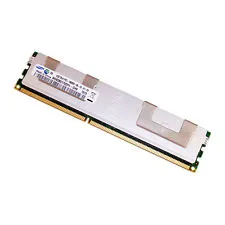
The Samsung M393B5170EH1-CH9 is a server-grade Registered DIMM engineered for mission-critical enterprise environments where downtime is not an option. Its four defining characteristics directly address the pain points of data centers running virtualization clusters and in-memory databases.
First, ECC (Error-Correcting Code) memory continuously detects and corrects single-bit errors caused by background radiation. In a financial trading system or an in-memory database like SAP HANA, a flipped bit can corrupt a transaction record or produce an incorrect analytics result. ECC shifts this risk from likely to nearly impossible, preserving data integrity without user intervention.
Second, the Registered (buffered) architecture stabilizes electrical signals when multiple modules are populated per server. In a virtualization cluster hosting dozens of virtual machines per node, populating all 24 DIMM slots is common. Without a register chip, signal degradation would cap capacity and trigger unpredictable crashes. The buffer ensures that a fully loaded server runs as reliably as one with a single module.
Third, the Dual Rank x4 organization interleaves memory banks to improve bandwidth. When multiple VMs hammer memory simultaneously during live migrations or heavy OLTP workloads, rank interleaving overlaps requests, reducing queuing delays and boosting effective throughput beyond what a single-rank module could achieve.
Finally, the DDR3-1333 speed at CL9 latency delivers a balanced thermal footprint and predictable performance for 24/7 operation, keeping energy costs manageable while satisfying the steady-state demands of Always-On infrastructure. For IT managers tasked with deploying dense, stable server fleets, this module translates directly into fewer service calls and longer platform longevity.
General Virtualization
Consolidating multiple VMs demands ample capacity and rock-solid stability; the ECC and registered buffer ensure reliability under constant load. Populate all memory channels evenly with the 4 GB registered ECC modules to guarantee balanced interleaving. For a dual-socket server with six channels per CPU, twelve modules (48 GB) provide a robust base; scale up with identical DIMMs as VM density grows.
In-Memory Database
In-memory databases demand large capacity and low latency. Maximize slot usage with these 4 GB dual-rank RDIMMs; a 24-slot server can reach 96 GB. Populate all channels with identical modules to ensure consistent access times, and rely on registered ECC to safeguard data integrity during intense read/write operations.
High-Performance Computing (HPC)
High-performance computing craves memory bandwidth. Install at least one 4 GB dual-rank RDIMM per channel, and ideally two per channel for maximum aggregate bandwidth at 1333 MHz—e.g., 16 modules per socket (64 GB) in an eight-channel system. This balanced, registered configuration prevents throttling and exploits dual-rank x4 organization for parallel speed. Always populate all channels symmetrically and avoid mixing different ranks or speeds.
Tested server memory: compatible with Dell PowerEdge R720, HP ProLiant DL380p Gen8, and more.
Q: Can I mix this M393B5170EH1-CH9 with other memory modules of different brands or speeds?
A: Mixing with different brands or speeds is strongly discouraged in servers. It can cause RDIMM signal integrity issues, forcing fallback to the lowest common speed and potentially triggering ECC errors.
Q: Is this memory compatible with my Intel Xeon E5 or AMD Opteron server platform?
A: This is a standard DDR3-1333 Registered ECC module. It is validated for Intel 5500/5600 series and AMD G34/C32 platforms. Please verify 1.5V support and DIMM slot availability in your board.
Q: What is the recommended DIMM population order for optimal performance with this RDIMM?
A: Populate identical DIMMs per channel, starting with the furthest slot from the CPU. Balance across memory channels to maximize bandwidth, adhering strictly to your server board's population guide for dual rank x4 modules.
Q: Does this module support overclocking or XMP profiles?
A: No. As an enterprise-grade Registered ECC module running at JEDEC standard DDR3-1333 CL9, it does not support overclocking or XMP profiles. It is designed for 24/7 data integrity at rated specifications.
Q: What warranty and typical failure rate can I expect with this Samsung module?
A: This module includes a 1-year warranty. Annualized failure rates (AFR) for genuine Samsung server RDIMMs are typically very low, around 0.5% under normal thermal and voltage conditions.