











 Secure payments
Standard refund policy
Trade Assurance
Secure payments
Standard refund policy
Trade Assurance
| Product Type | Memory Module |
|---|---|
| Memory Capacity | 4 GB |
| Memory Technology | DDR3 |
| Product Voltage | 1.5V |
| RAM Speed | 1333MHz |
| RAM Standard | DDR3-1333/PC3-10600 |
| Error Identifying | ECC |
| Signal Type | Registered |
| Column Access Strobe (CAS) | CL9 |
| Rank | Single Rank x4 |
| Quantity of Pins | 240-pin |
| RAM Genre | RDIMM |
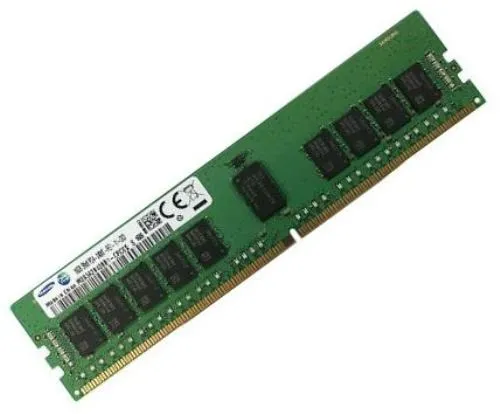
This DDR3-1333 Registered ECC memory module (RDIMM) is engineered for legacy server platforms, where its ECC and registered signal buffering ensure data integrity and reliable operation under sustained memory-intensive workloads like virtualization and small in-memory databases. The single-rank x4 organization combined with a CAS latency of 9 delivers balanced electrical loading and predictable access times, making it a stable upgrade for aging dual-socket servers requiring affordable, error-correcting capacity.
1. ECC protection continuously detects and corrects single-bit errors in memory cells, eliminating silent data corruption risks that could compromise transactional accuracy in databases and critical enterprise workloads.
2. Registered signal buffering stabilizes address and command paths across large memory arrays, allowing dense server configurations to maintain rock‑solid uptime under sustained 24/7 operation.
3. Single‑rank x4 organization reduces the electrical load on the memory channel, enabling higher per‑channel throughput consistency that keeps virtual machines responsive during consolidation spikes.
4. A conservative 1.5V operating voltage aligns with widely validated server power budgets, ensuring long‑term thermal predictability and minimal integration surprises across heterogeneous rack deployments.
5. The 1333 MT/s data rate yields a steady 10.6 GB/s peak bandwidth per channel, matching the throughput demands of legacy web serving, caching, and content delivery platforms without excess power draw.
In server environments, the Samsung M393B5270CH0-CH9 RDIMM directly addresses the demands of enterprise reliability and performance. Its registered design buffers command and address signals, allowing dense memory configurations without signal degradation—critical in virtualization clusters where dozens of virtual machines run on a single node. In tandem, the ECC technology continuously detects and corrects single-bit errors, preventing silent data corruption in memory-intensive databases like in-memory caches or financial transaction logs. A single-bit flip in these contexts can cascade into incorrect analytics or downtime, so hardware-level error correction is non-negotiable.
The module’s DDR3-1333 speed and CL9 latency strike a deliberate balance between bandwidth and response time, ensuring steady throughput for simultaneous read/write operations. When a virtualized database server scales to handle thousands of transactions per second, the x4-organized single rank architecture maximizes bank utilization, delivering consistent low-latency access under load. A standard 1.5V operating voltage keeps thermal and power budgets predictable in rack-dense data centers. You gain not just a memory upgrade, but a safeguard for data integrity and a foundation for workload consolidation that directly reduces the risk of system crashes and operational costs.
General Virtualization
For a typical hypervisor hosting multiple VMs, memory capacity often becomes the primary bottleneck. With these 4 GB Registered ECC RDIMMs, populate at least six or eight modules (24–32 GB total) across all memory channels in a dual-socket platform to maximize interleaving and available headroom. The ECC and registered signaling ensure rock‑solid stability for mixed workloads, and using identical single‑rank x4 DIMMs helps maintain uniform latency across channels.
In‑Memory Database
In‑memory databases demand both high capacity and low latency, making a 4 GB module a modest building block. Deploy three DIMMs per channel across all populated channels—for example, 12 modules (48 GB) in a dual‑socket system with three channels per CPU—to satisfy a small‑scale Redis or SAP HANA footprint. The CL9 latency and single‑rank x4 organization deliver faster row‑cycle times than dual‑rank alternatives, but plan for a future swap to larger modules when datasets outgrow this configuration.
High‑Performance Computing
HPC workloads thrive on memory bandwidth as much as on capacity. Install at least one DIMM per channel to populate all channels symmetrically; two DIMMs per channel (2DPC) can further boost bandwidth, though the 1333 MHz speed may drop to 1066 MHz in some DDR3 platforms at 2DPC. The single‑rank x4 construction offers excellent signal integrity, helping maintain consistent throughput during tightly‑coupled MPI jobs. Balance each CPU’s memory controllers identically to avoid NUMA-induced performance skew.
Rigorously tested, this 4GB DDR3-1333 RDIMM is compatible with Dell PowerEdge R710, R720, HP DL380 G7, and more.
Q: Can I mix this M393B5270CH0-CH9 with other memory modules of different brands or speeds?
A: Mixing is not recommended. Registered ECC memory requires identical ranks, timings, and organization for stable operation. Dissimilar modules may cause POST failures or silent data corruption in server environments.
Q: Is this memory compatible with my system?
A: This is a DDR3-1333 ECC Registered RDIMM. It supports platforms like Intel Xeon E5-2600 v1/v2 series or AMD Opteron 6300. Please verify your server board's qualified vendor list for RDIMM support.
Q: What is the recommended DIMM population order for optimal performance?
A: Follow your motherboard's manual. Typically, populate identical DIMMs per channel starting with the farthest slot from the CPU. Balance memory across all populated channels for maximum throughput and RAS features.
Q: Does this module support overclocking or XMP profiles?
A: No. This is an enterprise server module strictly adhering to JEDEC standards. It operates only at 1333MHz with no XMP or overclocking capabilities, ensuring platform stability and data integrity.
Q: What warranty and typical failure rate can I expect?
A: This module includes a one-year warranty. Enterprise-class ECC memory has a very low annualized failure rate, typically under 0.5%, ensuring reliable operation in mission-critical server deployments.