











 Secure payments
Standard refund policy
Trade Assurance
Secure payments
Standard refund policy
Trade Assurance
| Model | M392B5270CH0-YH9 |
|---|---|
| Product Type | Memory Module |
| Compliance Standards | EU RoHS,FCC |
| Memory Capacity | 4 GB |
| Memory Technology | DDR3 |
| Product Voltage | 1.35V |
| RAM Speed | 1333MHz |
| RAM Standard | DDR3-1333/PC3-10600 |
| Error Identifying | ECC |
| Signal Type | Registered |
| Column Access Strobe (CAS) | CL9 |
| Rank | Single Rank x4 |
| Quantity of Pins | 240-pin |
| RAM Genre | VLP RDIMM |
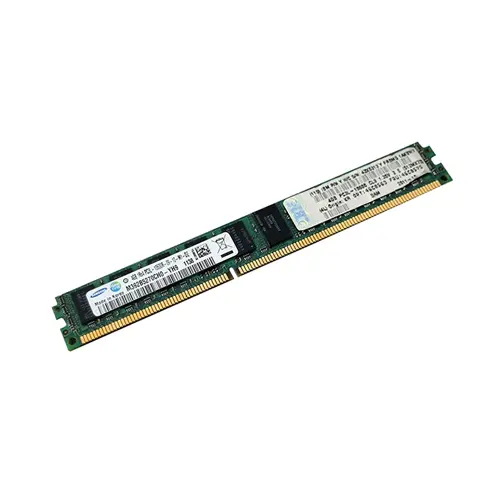
This Samsung M392B5270CH0-YH9 is a server-grade DDR3 VLP RDIMM engineered for dense virtualization clusters and memory-intensive enterprise workloads, where its registered ECC architecture ensures data integrity in high-capacity configurations. The single-rank x4 design reduces electrical loading on the memory bus, enabling stable 1333MHz operation at a low 1.35V, which minimizes power consumption in 1U/2U rack servers.
1. ECC detection and correction safeguards transactional data integrity in financial databases and virtualized workloads, eliminating silent memory errors that could corrupt critical business operations.
2. Registered signal buffering stabilizes command and address lines across fully populated server banks, allowing reliable scaling to large memory footprints without signal degradation under 24/7 uptime.
3. Very low profile module height maximizes clearance for streamlined airflow in dense 1U or blade server chassis, directly lowering fan power draw and extending component lifespan in hyperscale deployments.
4. 1.35V low-voltage operation reduces overall server power budget and junction temperatures inside the rack, driving significant cumulative energy savings across a multi-node datacenter without sacrificing reliability.
5. Single Rank x4 organization presents a lighter electrical load per channel, enabling stable operation at rated frequency even when all DIMM slots are populated—essential for maintaining balanced memory bandwidth in memory-intensive HPC jobs.
When managing a dense virtualization cluster or an in-memory database, every memory module choice directly impacts uptime and total cost of ownership. The Samsung M392B5270CH0-YH9 is a DDR3-1333 VLP RDIMM engineered specifically for these enterprise workloads, and four of its characteristics stand out as critical enablers.
First, its Error-Correcting Code (ECC) actively detects and corrects single-bit memory errors caused by background radiation—a silent threat that, without ECC, would corrupt financial transactions or silently flip a database index, leading to costly application crashes or data loss. Second, the Registered signal type buffers the command and address lines, keeping electrical loading low. This allows a server to populate all 24 DIMM slots at full capacity without signal degradation, essential for a virtualization host running 100+ VMs where total memory capacity dictates consolidation ratios. Third, the 1.35V ultra-low voltage operation reduces memory power draw by up to 20% compared to standard 1.5V modules. In a fully populated rack, this cumulative thermal and energy saving directly lowers cooling costs and extends component lifespan. Finally, the Very Low Profile (VLP) design is not just about physical fit; it eliminates airflow blockage in 1U blade servers, keeping CPU and memory temperatures well within safe limits under sustained 100% load in an in-memory analytics engine. Together, these features mean a server stays stable, dense, and economical 24/7.
General Virtualization
For a typical hypervisor hosting multiple VMs, capacity is the priority over raw bandwidth. Populate all available channels with these 4 GB RDIMMs—three modules per channel for triple-channel platforms or one per channel on modern servers—to reach 24–48 GB per host, balancing density and cost. Avoid mixing ranks; this single-rank x4 module is ideal for maintaining signal integrity at moderate speeds when using two or three DIMMs per channel.
In-Memory Database
Latency-sensitive workloads demand careful rank and channel alignment. Deploy a minimum of six identical M392B5270CH0-YH9 modules to fully utilize memory interleaving, delivering 24 GB at CL9 latency with ECC protection. For datasets exceeding 48 GB, combine two kits across all channels, always populating symmetrically to avoid NUMA penalties and ensure the rated 1333 MHz speed is sustained under load.
High-Performance Computing
HPC clusters rely on memory bandwidth and error resilience. Install these registered ECC DIMMs in balanced configurations—for example, eight modules (32 GB) across four channels in a dual-socket node, leveraging single-rank characteristics for faster refresh cycles. Prioritize channel population over maximum capacity per socket; a 64 GB setup with 16 modules maintains peak throughput for memory-bound scientific simulations while Registered logic stabilizes the command bus.
Rigorously tested server memory compatible with Dell PowerEdge R720, HP ProLiant DL380p Gen8, IBM System x3650 M4, and more.
Q: Can I mix this M392B5270CH0-YH9 with other memory modules of different brands or speeds?
A: Mixing is not recommended for server environments. To ensure signal integrity and stability, always populate identical modules with the same part number, rank, and speed across all channels.
Q: Is this memory compatible with my server (Intel/AMD platform)?
A: It is designed for dual-socket servers supporting DDR3-1333 Registered ECC VLP RDIMMs, such as Intel Xeon E5-2600 v1/v2 or select AMD Opteron 6300 platforms. Verify with your system's QVL.
Q: What is the recommended DIMM population order for optimal performance?
A: Follow your server board's manual. Typically, populate identical DIMMs per channel symmetrically, starting from the farthest slot of each channel (e.g., DIMM_A1, B1) to balance memory interleaving.
Q: Does this module support overclocking or XMP profiles?
A: No. As an enterprise-grade Registered ECC DIMM, it operates at JEDEC-standard 1333MHz CL9 with no XMP or overclocking support, prioritizing data integrity and long-term reliability.
Q: What warranty and typical failure rate can I expect?
A: This module is covered by a one-year warranty. It delivers enterprise-class reliability with an extremely low annualized failure rate under normal operating conditions, backed by rigorous component screening.