











 Secure payments
Standard refund policy
Trade Assurance
Secure payments
Standard refund policy
Trade Assurance
| Model | M393B5273EB0-CH9 |
|---|---|
| Product Type | Memory Module |
| Compliance Standards | EU RoHS,FCC |
| Memory Capacity | 4 GB |
| Memory Technology | DDR3 |
| Product Voltage | 1.5V |
| RAM Speed | 1333MHz |
| RAM Standard | DDR3-1333/PC3-10600 |
| Error Identifying | ECC |
| Signal Type | Registered |
| Column Access Strobe (CAS) | CL9 |
| Rank | Dual Rank x8 |
| Quantity of Pins | 240-pin |
| RAM Genre | RDIMM |
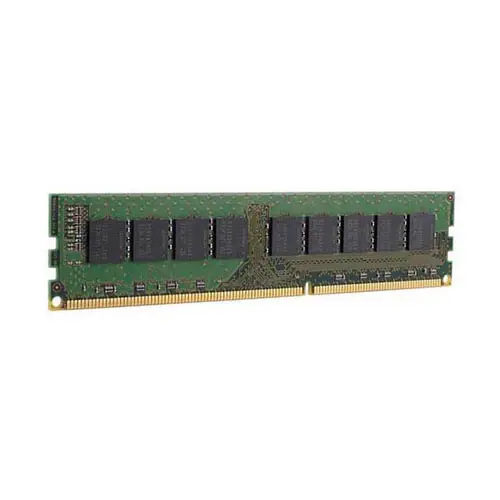
This Samsung M393B5273EB0-CH9 is a DDR3-1333 registered ECC RDIMM, purpose-built for servers and workstations running virtualization, in-memory databases, or other mission-critical workloads where data integrity is non-negotiable. Its registered signal architecture stabilizes high-density memory configurations, while the dual-rank x8 organization and CL9 latency deliver a balanced mix of capacity and responsiveness under sustained enterprise loads.
1. ECC actively corrects single-bit memory errors in real time, safeguarding financial transaction integrity and preventing unplanned server reboots in always-on data centers.
2. Registered signal buffering isolates the memory controller from heavy DIMM loads, enabling fully populated 24-slot servers to operate without signal degradation or boot failures.
3. Dual Rank x8 organization doubles the number of accessible banks per channel, maximizing interleaved throughput for dense virtual machine deployments under mixed-workload bursts.
4. 1333MHz clock delivers a steady 10.6 GB/s per channel, perfectly matching the sustained throughput demands of legacy enterprise ERPs without introducing platform validation risks.
5. 1.5V standard voltage aligns with mature server power stages, ensuring thermal consistency and power supply compatibility across multi-generational rack deployments.
The Samsung M393B5273EB0-CH9 is a server-grade DDR3 Registered DIMM purpose-built to tackle the relentless demands of enterprise data centers. In a virtualization cluster, its Registered buffer re-drives address and command signals, allowing you to fully populate all memory channels without the signal degradation that plagues unbuffered modules. This translates directly to denser VM consolidation and rock-solid stability, reducing your total cost per virtual machine while avoiding unexplained host crashes. In parallel, the integrated ECC actively corrects single-bit errors caused by background radiation. For an in-memory database such as Redis, this protection is non-negotiable; it prevents silent data corruption that could instantly invalidate financial transactions or force an unplanned outage. The module’s Dual Rank x8 architecture further exploits interleaving to amplify effective bandwidth, meaning that under heavy database query concurrency your response times remain low and predictable. Coupled with a fast CL9 timing at 1333MHz, it delivers responsive throughput without excessive power draw—essential for keeping thermals in check across dense rack deployments. For your virtualized clusters and real-time database servers, this RDIMM translates technical features into meaningful business outcomes: uncompromising data integrity, maximum memory scalability, and the consistent performance critical infrastructure demands.
General Virtualization
Balance memory channels by installing one 4 GB RDIMM per channel (6 modules, 24 GB) in a typical dual-socket, three-channel server. This configuration supports roughly 10–15 light VMs. For higher consolidation density, fully load all 12 slots for 48 GB, but be prepared for a slight speed reduction when running two DIMMs per channel.
In-Memory Database
Fill every available DIMM socket to reach a 48 GB ECC-protected footprint, suitable for caching layers or small-scale datasets. Because 4 GB modules limit maximum capacity, larger in-memory workloads should scale out across multiple nodes, each fully populated to 48 GB, preserving ECC integrity and reducing single-node bottlenecks.
High-Performance Computing (HPC)
Maximize bandwidth by using a single DIMM per channel (6×4 GB, 24 GB) to sustain the full DDR3-1333 speed. If capacity requirements grow, add a second DIMM per channel for 48 GB total, though the memory bus may downclock to 1066 MHz, which can impact performance on bandwidth-sensitive, memory-bound codes.
Rigorously tested, compatible with Dell PowerEdge R710/R720, HPE ProLiant DL380 G7, and Lenovo ThinkServer RD630.
Q: Can I mix this M393B5273EB0-CH9 with other memory modules of different brands or speeds?
A: Mixing is strongly discouraged in servers. Mismatched modules may cause instability or disable ECC. For guaranteed reliability, populate all channels with identical Samsung M393B5273EB0-CH9 RDIMMs.
Q: Is this memory compatible with my system?
A: It is compatible with servers using Intel Xeon 5500/5600 series or AMD Opteron 6100 series platforms. Verify your board supports DDR3 Registered ECC 240-pin RDIMMs at 1333MHz.
Q: What is the recommended DIMM population order for optimal performance?
A: Follow your server board’s manual. Typically, populate identical RDIMMs starting with the farthest slot from the CPU per channel to balance memory interleaving and maximize throughput.
Q: Does this module support overclocking or XMP profiles?
A: No. As a server-grade Registered ECC module, it adheres strictly to JEDEC standards for reliable 24/7 operation. Overclocking is disabled to preserve data integrity and system stability.
Q: What warranty and typical failure rate can I expect?
A: This module includes a 1-year warranty. The typical annualized failure rate (AFR) for Samsung server memory is very low, usually under 0.5%, ensuring long-term operational reliability.