











 Secure payments
Standard refund policy
Trade Assurance
Secure payments
Standard refund policy
Trade Assurance
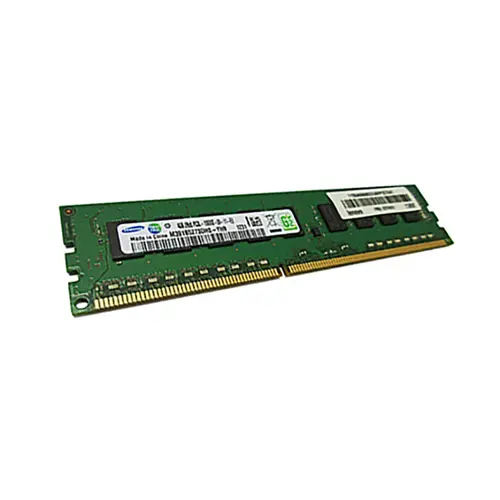
| Model | M391B5273DH0-YH9 |
|---|---|
| Product Type | Memory Module |
| Compliance Standards | EU RoHS,FCC |
| Memory Capacity | 4 GB |
| Memory Technology | DDR3 |
| Product Voltage | 1.35V |
| RAM Speed | 1333MHz |
| RAM Standard | DDR3-1333/PC3-10600 |
| Error Identifying | ECC |
| Signal Type | Unbuffered |
| Column Access Strobe (CAS) | CL9 |
| Rank | Dual Rank x8 |
| Quantity of Pins | 240-pin |
| RAM Genre | UDIMM |
This DDR3L-1333 ECC Unbuffered DIMM, with its dual-rank x8 organization and 1.35V low-voltage operation, is purpose-built for entry-level servers and single-socket workstations where it delivers reliable data integrity without the cost of registered memory. Its CL9 latency and error-correcting code make it especially suitable for file servers, light virtualization hosts, and mission-critical small business applications that demand stable, uninterrupted operation.
1. ECC error correction safeguards against bit-flip errors, preserving data accuracy in always-on server applications where silent corruption cannot be tolerated.
2. Unbuffered signal type offers direct command and address control from the memory controller, minimizing access latency in single-socket servers and lightweight virtualized nodes.
3. Dual Rank x8 organization keeps memory channels fully saturated, improving bandwidth delivery for steady multi-VM workloads and entry-level database operations.
4. Operating at a low 1.35V reduces power draw and thermal footprint in dense microserver clusters, helping to extend hardware lifespan and cut cooling costs.
5. A 1333MT/s transfer rate delivers consistent throughput for web hosting and file serving environments, matching performance demands without excessive energy overhead.
For your entry-level server or workstation, the Samsung M391B5273DH0-YH9 is not merely a memory module—it is a strategic safeguard for critical small-business operations. This 4GB DDR3 UDIMM wields four decisive features that translate directly into real-world resilience. First, its authentic ECC engine continuously corrects single-bit memory errors. In a financial database server processing thousands of daily transactions, that means you prevent silent data corruption that could manifest as a miscalculated balance or a broken ledger entry, protecting your reputation without question. Second, operating at 1.35V, this low-voltage DDR3L module draws measurably less power, reducing the thermal strain inside a compact office server or a 24/7 surveillance NVR system. You gain lower energy costs and extended component lifespan, not just a wattage spec. Third, the dual-rank x8 organization enables intelligent interleaving, which overlaps memory accesses so your lightweight virtualization host runs multiple VMs with perceptibly better multitasking fluidity. Finally, as an unbuffered ECC module with standard 240-pin UDIMM topology, it drops effortlessly into cost-conscious single-socket platforms based on Xeon E3, delivering enterprise-grade data integrity without the premium of registered memory. This is affordable dependability engineered for environments where downtime is not an afterthought.
General Virtualization
For light to moderate virtualization hosts using ECC UDIMMs, populate memory channels symmetrically to maximize interleaving and bandwidth. Start with four identical 4GB M391B5273DH0-YH9 modules across four slots (16GB total), which suits around 8–10 low‑overhead VMs. Avoid mixing DIMM sizes or leaving channels unbalanced, as this degrades memory throughput under simultaneous VM demands.
In‑Memory Database
In‑memory databases like Redis or Memcached thrive on capacity and data integrity, making ECC essential. However, 4GB DIMMs limit total RAM severely for production caches. Configure all available slots with these modules to reach the board’s maximum (commonly 32GB via eight DIMMs) while ensuring one DIMM per channel for reliable dual‑rank operation. For datasets exceeding 32GB, select higher‑capacity ECC UDIMMs; otherwise, prioritize the lowest latency timings the platform allows, keeping the CAS 9 rating intact.
High‑Performance Computing (HPC)
HPC clusters that still run DDR3‑era nodes require full population of memory channels to feed multi‑core CPUs. Deploy six or eight of these dual‑rank x8 DIMMs per node to occupy all channels, achieving 24GB or 32GB of ECC‑protected memory. Dual‑rank modules deliver better command‑rate compatibility and bandwidth at 1333MHz. Validate that the 1.35V low‑voltage operation is supported by the node’s BIOS to reduce power draw across dense compute racks without sacrificing the error‑correcting protection crucial for long‑running scientific workloads.
Server-validated DDR3 ECC UDIMM. Rigorously tested. Compatible with Dell PowerEdge T110 II, R210 II, HP MicroServer Gen8, Lenovo TS140.
Q: Can I mix this M391B5273DH0-YH9 with other memory modules of different brands or speeds?
A: Mixing is not recommended. Even identical specs can cause instability. For server environments, mixing brands, speeds, or ranks risks ECC errors and system crashes. Use matched kits to ensure reliability and warranty compliance.
Q: Is this memory compatible with my system?
A: This DDR3 ECC UDIMM fits select Intel Xeon E3 series and single-socket servers with 240-pin slots. Verify your motherboard supports unbuffered ECC and 1.35V low-voltage DIMMs. Consult the vendor’s QVL for exact platform qualifications, such as Intel C202/C204 chipsets.
Q: What is the recommended DIMM population order for optimal performance?
A: Populate identical DIMMs per channel, starting with the farthest slot from the CPU. For this dual-rank module, install in matched pairs to enable dual-channel ECC. Refer to your server board manual for specific slot numbering to minimize electrical loading.
Q: Does this module support overclocking or XMP profiles?
A: No. This is a JEDEC-compliant server module running at PC3-10600 (1333MHz, CL9). It does not support XMP or overclocking. Designed for 24/7 stability, it operates exclusively at the predefined 1.35V low-voltage profile with ECC enabled.
Q: What warranty and typical failure rate can I expect?
A: This module includes a one-year warranty covering manufacturing defects. Samsung’s stringent testing yields an annualized failure rate below 0.1% under normal server workloads. Proper cooling and ESD handling are essential to maintain long-term reliability.