











 Secure payments
Standard refund policy
Trade Assurance
Secure payments
Standard refund policy
Trade Assurance
| Product Type | Memory Module |
|---|---|
| Compliance Standards | EU RoHS,FCC |
| Memory Capacity | 4 GB |
| Memory Technology | DDR3 |
| RAM Speed | 1333 |
| RAM Standard | DDR3-1333/PC3-10600 |
| Error Identifying | Non-ECC |
| Signal Type | Unbuffered |
| Column Access Strobe (CAS) | CL9 |
| Rank | Dual Rank x8 |
| Quantity of Pins | 204-pin |
| RAM Genre | SoDIMM |
This SODIMM module is tailored for notebook and mobile workstation upgrades, providing a plug-and-play 4 GB DDR3-1333 solution with low CL9 latency for responsive everyday multitasking. Its dual-rank x8 organization enhances memory bandwidth efficiency on older platforms, while the unbuffered, non-ECC design keeps power consumption minimal for extended battery life.
1. A 4GB capacity breathes new life into aging laptops, comfortably supporting modern web browsers, office productivity suites, and video calls without overtaxing limited system resources.
2. SoDIMM form factor with 204-pin footprint ensures instant physical compatibility with mainstream notebook slots, turning a memory upgrade into a tool-free, plug-and-play refresh.
3. DDR3-1333 speed grade provides ample bandwidth for seamless HD video streaming and responsive multitasking on mobile processors, all within a thermally constrained chassis.
4. CL9 latency delivers snappy data access that keeps everyday applications feeling fluid, directly improving user experience during rapid task switching on battery power.
5. Dual Rank x8 organization interleaves memory banks to lift integrated graphics throughput, reducing stutter during presentations and light media editing when a dedicated GPU is absent.
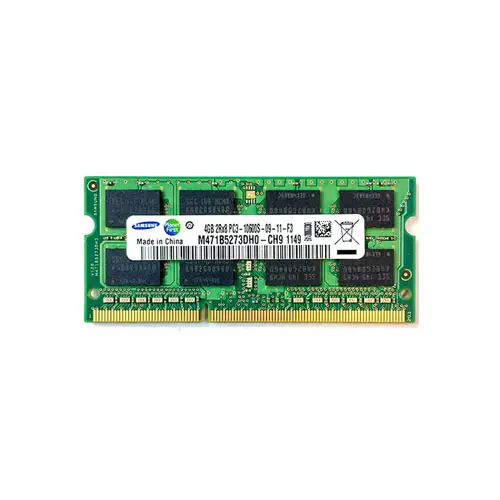
When upgrading an aging laptop, every technical detail in a memory module directly shapes everyday experience. The Samsung M471B5273DH0-CH9, a 4GB DDR3-1333 SoDIMM, is built specifically for mobile computing, and its four defining characteristics translate into real-world reliability and ease. The unbuffered, non-ECC design eliminates the overhead of error correction, reducing power draw and heat generation—critical for extending battery runtime during long flights or back-to-back meetings in a thin-and-light notebook. Its dual-rank x8 organization increases bank interleaving, meaning that when you have multiple browser tabs, a document editor, and a video call running simultaneously on a mobile workstation, the memory can pipeline data more efficiently, visibly reducing lag during context switches. The 204-pin SoDIMM form factor saves precious internal space, allowing it to fit cleanly into ultra-compact chassis without mechanical interference. Meanwhile, the JEDEC-standard DDR3-1333 speed with CL9 latency offers a plug-and-play stability guarantee: you simply insert the module and the system boots reliably, with no BIOS tuning required. Whether you are revitalising a travel laptop to handle modern web workloads or expanding a portable workstation for field data analysis, this module delivers the exact balance of compatibility, energy efficiency, and responsive multitasking that mobile users depend on every day.
Memory Type Identification:
The specifications—204-pin SoDIMM, Non-ECC, Unbuffered, DDR3-1333, and 4GB capacity—confirm this is a laptop memory module designed for mainstream notebooks and small-form-factor systems.
Capacity Planning for Laptop Memory
Laptop Upgrade
Most older laptops ship with a single 4GB module like this one, leaving one slot free. The most cost-effective upgrade is to add a matching second 4GB SoDIMM (DDR3-1333, CL9, 1.5V or 1.35V if supported) to enable dual-channel mode and double capacity to 8GB. This noticeably improves system responsiveness for everyday multitasking and light productivity.
Mobile Workstation
For professional workloads—CAD, 3D rendering, or large data analysis—capacity is paramount. Replace the existing module entirely with a kit of two 8GB SoDIMMs to reach the common 16GB maximum supported by DDR3-era mobile workstations. If the chipset allows, a 2x16GB configuration (32GB) provides headroom for memory-intensive applications, but verify platform limits carefully, as many older mobile CPUs cap at 16GB.
Ultrabook Power Saving
Ultrabooks prioritize battery life, so memory choice affects power consumption. If the system supports DDR3L (low-voltage, 1.35V), replacing a standard 1.5V module with a 4GB or 8GB DDR3L SoDIMM reduces memory power draw by roughly 10–15%. A single high-capacity module minimizes the number of active DRAM chips and leaves one slot empty, further trimming active power. For maximum runtime, pair a low-voltage DIMM with aggressive OS power-management settings.
Rigorously tested, this DDR3 SoDIMM guarantees flawless compatibility with laptops like Dell Latitude E6420, Lenovo ThinkPad T420, and HP EliteBook 8460p.
Q: Can I mix this M471B5273DH0-CH9 with other memory modules of different brands or speeds?
A: Mixing is possible but not recommended. The system will match the slowest module and may disable dual-channel mode, potentially causing instability. For best results, use identical modules.
Q: Is this memory compatible with my system?
A: This 204-pin DDR3 SoDIMM fits notebooks with DDR3 slots. It’s widely compatible with laptops based on Intel HM55/HM65/QM67 or AMD A-series chipsets. Please verify your model supports 1333MHz non-ECC memory.
Q: What is the recommended DIMM population order for optimal performance?
A: For single-module use, install it in the primary slot. In dual-slot notebooks, populate both slots with a matched pair to enable dual-channel mode, which improves memory bandwidth significantly.
Q: Does this module support overclocking or XMP profiles?
A: No, this module adheres to JEDEC DDR3-1333 standards and does not support overclocking or XMP. It operates at fixed timings of CL9 for reliable, plug-and-play performance.
Q: What warranty and typical failure rate can I expect?
A: This module includes a 1-year warranty. The typical annualized failure rate (AFR) is well below 0.5%, reflecting strict manufacturing quality and extensive pre-shipment testing.