











 Secure payments
Standard refund policy
Trade Assurance
Secure payments
Standard refund policy
Trade Assurance
| Product Type | Memory Module |
|---|---|
| Compliance Standards | CE,WEEE,RoHS |
| Memory Capacity | 4 GB |
| Memory Technology | DDR3 |
| RAM Speed | 1333MHz |
| RAM Standard | DDR3-1333/PC3-10600 |
| Error Identifying | Non-ECC |
| Signal Type | Unbuffered |
| Column Access Strobe (CAS) | CL9 |
| Rank | Dual Rank x8 |
| Quantity of Pins | 240-pin |
| RAM Genre | UDIMM |
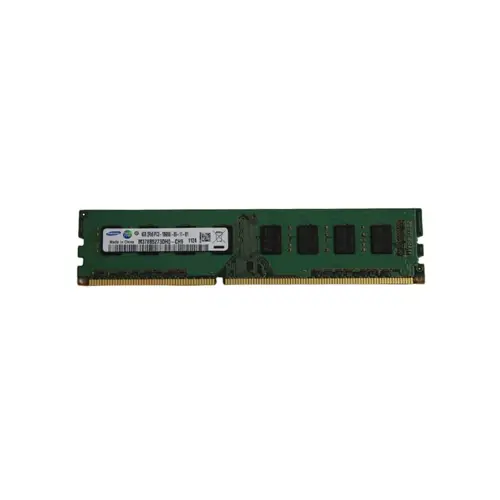
This is a standard desktop memory module based on its Non-ECC, Unbuffered UDIMM DDR3-1333 design. It is well-suited for mainstream productivity desktops and content creation workloads, where its dual-rank x8 organization improves memory interleaving efficiency to sustain consistent throughput under multi-tasking scenarios.
1. DDR3 backward compatibility turns aging desktop platforms into budget-friendly upgrades, letting users revitalize old gaming rigs without costly motherboard swaps.
2. A 4GB capacity handles everyday multitasking and light productivity workloads smoothly, preventing slowdowns when juggling browsers, office apps, and background processes.
3. The 1333MHz clock rate provides consistent memory bandwidth, which sustains stable frame delivery in classic games and entry-level e‑sports titles.
4. CL9 low latency tightens command response time, giving bread-and-butter gaming desktops snappier feel and a subtle advantage in reaction-critical moments.
5. Dual Rank x8 interleaving increases effective data throughput, helping content creators process photo batches and light video edits with noticeably less waiting.
As a DDR3 UDIMM designed for desktop platforms, the Samsung M378B5273DHO-CH9 (4GB, PC3-10600, 1333MHz) brings four decisive attributes that directly translate into a smoother, more responsive user experience. First, its non-ECC, unbuffered architecture eliminates the extra clock cycle overhead of registered or error-corrected memory. This means lower command latency, a critical advantage in fast-twitch AAA gaming where every nanosecond of input lag impacts aim and frame timing. Second, the tight CAS Latency of 9 cycles at 1333MHz strikes an optimal balance between frequency and data access time, ensuring snappy load transitions and minimal stutter during open-world texture streaming. Third, the dual-rank x8 organization interleaves accesses across two internal sets of chips, boosting sustained bandwidth. For a video editor rendering a 1080p timeline with multiple effects, this dual-rank design can shave minutes off export jobs by reducing memory controller wait states. Finally, CE, WEEE, and RoHS certification ensures rigorous manufacturing and long-term reliability.
Gaming Build
For a legacy DDR3 gaming system, a dual‑channel configuration is vital to reduce stuttering and improve frame times. Install a matched pair of these 4 GB UDIMMs for an 8 GB total, which remains the sweet spot for many older titles. If the motherboard has four slots, populate two channels with identical 4 GB sticks to guarantee symmetric interleaving and avoid performance penalties from single‑channel operation.
Content Creation
Content‑creation workloads like 1080p video editing or entry‑level 3D rendering demand as much capacity as the platform allows. Because each module is only 4 GB, aim for a quad‑channel‑like configuration by installing four modules across both memory channels to achieve 16 GB. On boards that support 8 GB DIMMs, consider replacing these with higher‑density sticks for a 32 GB ceiling, ensuring scratch‑disk thrashing is minimized during timeline scrubs.
General Productivity
For office suites, web browsing, and light multitasking, a single 4 GB module is workable but limits responsiveness. A cost‑effective upgrade pairs two of these modules into a dual‑channel 8 GB kit, which dramatically boosts integrated‑graphics performance and application‑switching speed. Stick to two identical UDIMMs rather than mixing ranks or speeds, keeping the CL9 latency and 1333 MHz frequency aligned for plug‑and‑play stability on older chipsets.
Verified compatible after rigorous testing with Dell OptiPlex 790, HP Compaq 8200, etc.
Q: Can I mix this M378B5273DHO-CH9 with other memory modules of different brands or speeds?
A: Mixing is possible but not recommended. All modules will default to the slowest speed and highest latency, potentially causing instability. For guaranteed dual-channel operation, use identical part numbers.
Q: Is this memory compatible with my system?
A: This desktop UDIMM is compatible with motherboards supporting DDR3 non-ECC unbuffered memory, such as Intel 6/7/8 Series or AMD FM2/AM3 platforms. Always check your board’s QVL for 4GB DDR3-1333 modules.
Q: What is the recommended DIMM population order for optimal performance?
A: Install matched pairs in the same-colored slots (typically DIMM 1&3 or 2&4) to enable dual-channel mode. This configuration maximizes bandwidth. Refer to your desktop motherboard manual for specific slot recommendations.
Q: Does this module support overclocking or XMP profiles?
A: No, this module adheres to JEDEC DDR3-1333 CL9 specifications and does not include XMP profiles. It is designed for reliable operation at standard speeds and is not intended for overclocking.
Q: What warranty and typical failure rate can I expect?
A: This module is backed by a 1-year warranty. Failure rates are exceptionally low under normal conditions, as all units undergo rigorous testing and comply with CE, WEEE, and RoHS standards.