











 Secure payments
Standard refund policy
Trade Assurance
Secure payments
Standard refund policy
Trade Assurance
| Product Type | Memory Module |
|---|---|
| Memory Capacity | 4 GB |
| Memory Technology | DDR3 |
| Product Voltage | 1.35V |
| RAM Speed | 1600MHz |
| RAM Standard | DDR3-1600/PC3-12800 |
| Error Identifying | ECC |
| Signal Type | Registered |
| Column Access Strobe (CAS) | CL11 |
| Rank | Single Rank x4 |
| Quantity of Pins | 240-pin |
| RAM Genre | RDIMM |
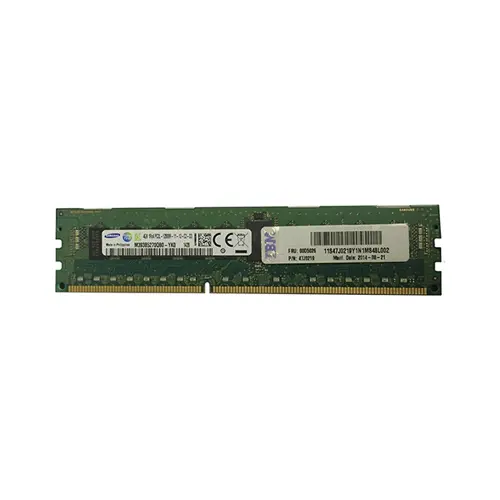
Designed as a server-grade DDR3-1600 Registered ECC RDIMM with 1.35V low-voltage operation and Single Rank x4 organization, this module ensures robust data integrity and signal stability for mission-critical virtualization and in-memory database workloads. Its 11-cycle CAS latency and registered architecture enable reliable 24/7 error correction and scalable memory density in multi-DIMM server configurations.
1. ECC protection detects and corrects single-bit errors in real time, preventing silent data corruption that could compromise financial transaction integrity or virtualization stability in always-on server environments.
2. Registered buffering re-drives address and command signals across fully populated memory channels, maintaining signal integrity essential for large-scale in-memory databases and dense multi-socket platforms.
3. Operating at 1.35V significantly cuts DRAM power draw and associated cooling overhead, a direct energy-cost advantage when scaling out racks of cloud-hosted application servers.
4. Single Rank x4 organization minimizes electrical loading on the memory bus, allowing the memory controller to sustain higher clock frequencies and deliver consistent latency under mixed enterprise workloads.
5. The RDIMM architecture provides the fault-resilient infrastructure required by hypervisors, enabling reliable memory expansion and stable live migration of critical virtual machines.
The M393B5270QB0-YK0Q8 is a 4GB DDR3L-1600 Registered ECC DIMM for servers, whose four key attributes solve real-world problems. In virtualization farms, silent memory corruption can crash multiple VMs; ECC detects and corrects single-bit errors, safeguarding transaction logs and user data. Registered buffering stabilizes the memory bus under heavy loading, letting you fully populate DIMM slots for large in-memory databases like SAP HANA without signal degradation. The 1.35V low voltage trims power draw by around 20%, accumulating into substantial savings on electricity and cooling in a server room. Finally, the single-rank x4 organization at CL11 provides efficient access and enables Chipkill-level correction that can survive an entire chip failure—vital when database uptime is non-negotiable. This means enhanced reliability, lower operational costs, and the assurance that your virtualized and data-intensive applications run on a resilient, power-smart memory platform.
General Virtualization
Populate each memory channel with one 4GB DDR3L‑1600 RDIMM for balanced bandwidth. A baseline of 16 modules (64 GB) supports typical VM density, while 24 DIMMs (96 GB) handles larger consolidation. The 1.35V low‑voltage ECC design ensures uptime and power efficiency.
In-Memory Database
Fill all DIMM slots: a dual‑socket server with three channels and three slots per channel accepts 18 of these 4GB RDIMMs, yielding 72 GB of error‑correcting capacity. Ensure every module uses the single‑rank x4 layout and matched part number for clean signals during heavy query loads. Scale to two DIMMs per channel only with identical modules to maintain interleaving.
High-Performance Computing (HPC)
For maximum bandwidth, install one DIMM per channel—twelve 4GB modules (48 GB) in a six‑channel server. A single‑rank‑per‑channel config maintains 1600 MHz and CL11 latency, ideal for compute‑bound codes. For capacity‑heavy runs, double to two matched DIMMs per channel without disrupting interleaving.
Rigorously tested server memory, verified for Dell PowerEdge R720/R620, HPE DL380p Gen8, and Lenovo System x3650 M4.
Q: Can I mix this M393B5270QB0-YK0Q8 with other memory modules of different brands or speeds?
A: Mixing with different brands or speeds is not recommended for this RDIMM. Mismatched ranks, timings, or voltages can cause instability. For reliable server operation, use identical modules with the same MPN and firmware.
Q: Is this memory compatible with my system?
A: It is compatible with servers using DDR3 Registered ECC memory, such as Intel Xeon E5-2600 v2 or AMD Opteron 6300 platforms. Verify your board supports 240-pin, 1.35V low-voltage RDIMMs and check the manufacturers compatibility list.
Q: What is the recommended DIMM population order for optimal performance?
A: Install pairs in slots of the same memory channel, typically filling the furthest slots from the CPU first. Follow your server’s manual for population sequence—usually A1/B1, then A2/B2—to maintain multi-channel symmetry and signal integrity.
Q: Does this module support overclocking or XMP profiles?
A: No. As a JEDEC-compliant server RDIMM, it does not support XMP or overclocking. It operates strictly at DDR3-1600 (PC3-12800) with fixed timings, prioritizing data integrity and 24/7 stability under mission-critical workloads.
Q: What warranty and typical failure rate can I expect?
A: This module includes a 1-year warranty. Enterprise-class registered DDR3 memory is highly reliable, with a typical annualized failure rate below 0.1% and an MTBF exceeding 2 million hours under normal operating conditions.