











 Secure payments
Standard refund policy
Trade Assurance
Secure payments
Standard refund policy
Trade Assurance
| Model | M392B5273DH0-YK0 |
|---|---|
| Product Type | Memory Module |
| Compliance Standards | EU RoHS,FCC |
| Memory Capacity | 4 GB |
| Memory Technology | DDR3 |
| Product Voltage | 1.35V |
| RAM Speed | 1600MHz |
| RAM Standard | DDR3-1600/PC3-12800 |
| Error Identifying | ECC |
| Signal Type | Registered |
| Column Access Strobe (CAS) | CL11 |
| Rank | Dual Rank x8 |
| Quantity of Pins | 240-pin |
| RAM Genre | VLP RDIMM |
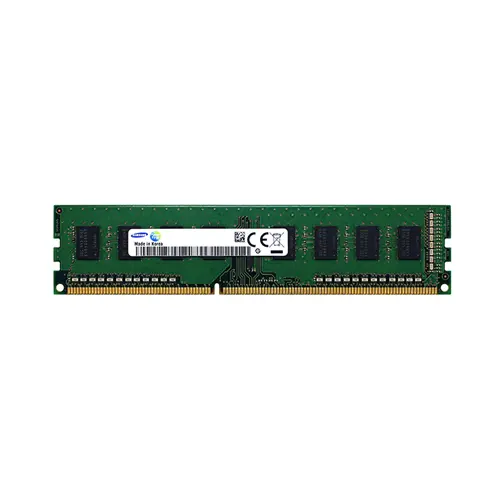
Designed as a VLP Registered ECC DDR3 module, this 4GB DIMM is purpose-built for dense server deployments where vertical clearance is limited. Its ECC support ensures data integrity for virtualization and in-memory databases, while the registered signaling and dual-rank x8 organization provide stable operation at 1600MHz even when all memory channels are fully populated.
1. ECC memory detects and corrects single-bit errors on the fly, safeguarding financial transactions and virtualized database integrity against silent data corruption in 24/7 server operations.
2. Registered signal type buffers command and address lines, enabling higher per-channel DIMM counts for dense virtualization hosts without compromising signal stability.
3. VLP RDIMM form factor reduces module height to clear tight vertical clearances in 1U rack servers, improving airflow and preventing thermal throttling in compact data center deployments.
4. 1.35V low-voltage operation cuts per-DIMM power draw, directly lowering energy bills and waste heat in hyperscale farms running thousands of memory modules simultaneously.
5. Dual Rank x8 configuration leverages rank interleaving to overlap memory accesses, delivering higher effective throughput for latency-sensitive workloads like real-time analytics and high-frequency trading.
The M392B5273DH0-YK0 is unmistakably a server-grade memory module, built as a DDR3 VLP RDIMM. In virtualization clusters, where multiple virtual machines share the same physical hardware, this module’s ECC feature becomes your most trusted safeguard. It actively corrects single-bit memory errors, preventing silent data corruption that could crash entire virtual environments or quietly flip a transaction record in your database. That same reliability is reinforced by the Registered design, which buffers command and address signals so you can populate all memory channels fully without signal degradation — a non-negotiable requirement when you scale your in-memory database like SAP HANA or Redis to several hundred gigabytes.
Beyond integrity, the Dual Rank x8 organization directly accelerates real-world latency-sensitive workloads. By interleaving accesses across two ranks per DIMM, it raises sustained bandwidth under heavy concurrency, meaning your virtualization host responds faster to spikes in user requests. Meanwhile, the very low-profile form factor and 1.35V low-voltage operation tackle two data center pain points simultaneously: thermal density and energy cost. In dense rack or blade servers, the reduced height improves airflow, while the ultra-low power draw lowers accumulated electricity bills without sacrificing the 1600MHz speed grade. Every one of these four traits converts directly into uptime, performance, and operational savings for the server room that never sleeps.
The Samsung M392B5273DH0-YK0 is a DDR3-1600 4GB very-low-profile registered ECC DIMM, built for server platforms. Its 1.35V operation and dual-rank x8 design target dense, power-conscious data centers. Below is capacity planning guidance for key server workloads.
General Virtualization
Populate all memory channels symmetrically with identical 4GB modules to maximize interleaving and avoid NUMA penalties. For a dual-socket server with 12 DIMM slots per CPU, install 12 modules per socket (48GB total) to balance memory bandwidth across VMs. With moderate consolidation ratios, this configuration supports dozens of lightweight Linux guests or several Windows VMs while maintaining ECC protection.
In-Memory Database
Use the maximum number of identical 4GB DIMMs to build the largest possible capacity pool. Fill every available slot — for example, 24 modules in a dual-socket server yielding 96GB — to hold entire datasets in RAM. Registered ECC corrects single-bit errors in flight, crucial for data integrity. Since 4GB modules limit scale, consider migrating to higher-density RDIMMs if the dataset grows beyond this ceiling.
High-Performance Computing
For memory-bandwidth-sensitive HPC jobs, populate one DIMM per channel initially to achieve balanced throughput; dual-rank modules already provide good bank-level parallelism. In a typical 8-channel-per-socket platform, install eight 4GB modules per CPU (32GB total) for peak bandwidth symmetry. The 1.35V VLP form factor reduces power draw and improves airflow in tightly packed cluster nodes, helping sustain full-speed operation during long compute runs.
Rigorously tested DDR3 server memory; fits Dell R720, HP DL380p Gen8, Lenovo RD630, and similar platforms.
Q: Can I mix this M392B5273DH0-YK0 with other memory modules of different brands or speeds?
A: Mixing with different brands, speeds, or ranks is not recommended. Mixing Registered ECC modules can cause system instability and is unsupported in most server environments.
Q: Is this memory compatible with my server?
A: This DDR3-1600 Registered ECC VLP RDIMM is compatible with servers using Intel Xeon E5-2600/E5-2400 series or AMD Opteron 6300 series platforms. Verify your motherboard supports 1.35V LR/RDIMMs.
Q: What is the recommended DIMM population order for optimal performance?
A: Follow your server board's population guide. Typically, populate identical modules per channel, starting with slot 1 of each memory channel, to maintain balanced interleaving and full ECC functionality.
Q: Does this module support overclocking or XMP profiles?
A: No. This is a JEDEC-compliant server memory module. It does not support overclocking or XMP profiles, as reliability and stability are prioritized over frequency scaling in enterprise environments.
Q: What warranty and typical failure rate can I expect?
A: This module comes with a 1-year warranty. As server-grade ECC memory, it exhibits very low failure rates under normal operating conditions, ensuring high reliability for mission-critical workloads.