











 Secure payments
Standard refund policy
Trade Assurance
Secure payments
Standard refund policy
Trade Assurance
| Model | M392B5270CH0-CK0 |
|---|---|
| Product Type | Memory Module |
| Compliance Standards | EU RoHS,FCC |
| Memory Capacity | 4 GB |
| Memory Technology | DDR3 |
| Product Voltage | 1.5V |
| RAM Speed | 1600MHz |
| RAM Standard | DDR3-1600/PC3-12800 |
| Error Identifying | ECC |
| Signal Type | Registered |
| Column Access Strobe (CAS) | CL11 |
| Rank | Single Rank x4 |
| Quantity of Pins | 240-pin |
| RAM Genre | VLP RDIMM |
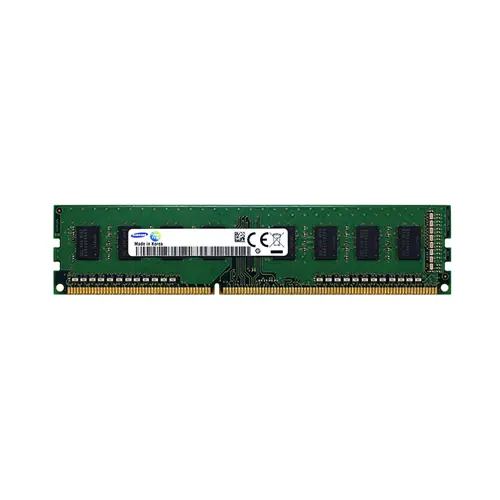
Designed for legacy server platforms requiring high data integrity, the M392B5270CH0-CK0 is a DDR3-1600 VLP Registered DIMM that leverages ECC and a single-rank x4 organization to deliver stable, low-latency performance under heavy memory loads. This module is ideally suited for space-constrained 1U/2U rack servers running virtualization, in-memory databases, and mission-critical workloads where error correction and signal integrity are paramount.
1. ECC protection detects and corrects single-bit memory errors in real time, preventing silent data corruption in mission-critical server workloads and safeguarding long-running virtualization environments.
2. Registered signal architecture buffers command and address signals, enabling high-capacity memory configurations across numerous DIMM slots without compromising electrical stability in large-scale server deployments.
3. VLP RDIMM form factor minimizes module height to fit dense 1U rack servers and blade enclosures, optimizing airflow and cooling efficiency in tightly packed data center racks.
4. Single Rank x4 organization provides the perfect balance of low latency and moderate power draw, ideal for maximizing memory channel efficiency in scale-out server nodes running distributed applications.
5. DDR3-1600 speed class delivers ample bandwidth per channel, sustaining smooth throughput for moderate VM density and legacy enterprise applications without imposing unnecessary thermal overhead.
In virtualization clusters and in-memory databases, the M392B5270CH0-CK0 registered ECC module fundamentally safeguards your operations. Its ECC technology automatically detects and corrects single-bit errors, silently preventing memory corruption that would otherwise crash virtual machines or compromise transactional data integrity in financial systems. The registered buffer amplifies command signals, letting you fully populate all memory channels without the signal degradation that cripples stability when hosting dozens of VMs or massive database instances. Equally critical is its very low profile design. In dense 1U rack servers, the VLP form factor reclaims space, dramatically improving airflow and lowering thermal stress — directly translating to longer component life and fewer emergency outages. Finally, the single-rank x4 organization minimizes electrical loading on the memory bus, delivering a consistently low CAS 11 latency and the full 1600MHz bandwidth where in-memory databases demand microsecond response times and live virtual machine migration requires deterministic throughput. This module isn’t just a specification sheet; it is a deliberate engineering choice that keeps your mission‑critical workloads running with unwavering precision and uptime.
General Virtualization
This registered ECC DDR3-1600 module is ideal for virtualization hosts where data integrity is paramount. A typical dual-socket server using balanced memory channels should be populated with at least six identical 4 GB modules (one per channel), yielding 24 GB total to comfortably host a dozen lightweight VMs. For higher consolidation ratios, scale to twelve modules across both processor memory buses to avoid bottlenecks.
In-Memory Database
In-memory databases demand both capacity and fault tolerance, making Registered ECC essential. Start with a minimum of sixteen 4 GB modules (64 GB) distributed evenly across all available memory channels to maximize bandwidth for Redis or Memcached workloads. If your dataset exceeds this footprint, fully populate all DIMM slots with these low-profile RDIMMs to reach the platform’s maximum supported capacity while maintaining 1.5 V thermal efficiency.
High-Performance Computing
HPC clusters benefit from the module’s CL11 latency and registered signaling, which stabilize large node counts. Configure each compute node with eight modules (32 GB) in a balanced quad-channel population to match the processor’s memory interleaving. For memory-bound simulations, move to sixteen modules per node to keep data closer to the CPU and reduce cluster-wide MPI communication overhead.
Rigorously tested RDIMM server memory, compatible with Dell PowerEdge R720, HP ProLiant DL380p Gen8, Lenovo System x3650 M4.
Q: Can I mix this M392B5270CH0-CK0 with other memory modules of different brands or speeds?
A: Mixing RDIMMs from different brands or speeds is not recommended. It may cause instability or force all modules to the lowest common speed, compromising registered ECC performance in server environments.
Q: Is this memory compatible with my system?
A: This DDR3-1600 registered ECC module is designed for servers using Intel Xeon E5 series or AMD Opteron platforms. Please verify your motherboard supports 1.5V VLP RDIMMs with 240-pin interface.
Q: What is the recommended DIMM population order for optimal performance?
A: Populate identical modules per memory channel, starting with the farthest slot from the CPU. For single rank x4 DIMMs, fill all blue or black slots first to maintain balanced memory interleaving.
Q: Does this module support overclocking or XMP profiles?
A: No. This is a server-grade registered ECC module complying with JEDEC DDR3-1600 standards. It does not support overclocking or XMP and is optimized for reliability under sustained enterprise workloads.
Q: What warranty and typical failure rate can I expect?
A: This module is covered by a one-year warranty. With strict EU RoHS compliance and industrial binning, its annualized failure rate is extremely low under normal server operating conditions.