











 Secure payments
Standard refund policy
Trade Assurance
Secure payments
Standard refund policy
Trade Assurance
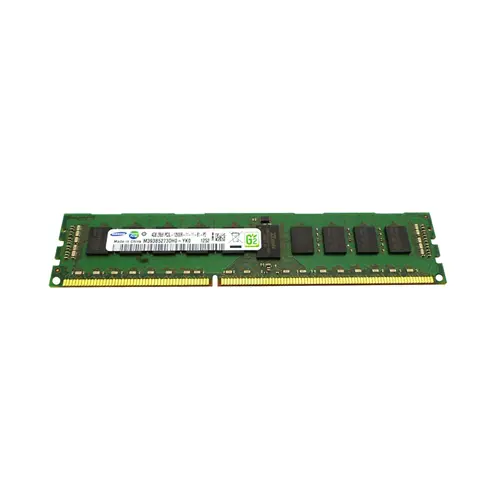
| Model | M393B5273DH0-YK0 |
|---|---|
| Product Type | Memory Module |
| Compliance Standards | CE,WEEE,RoHS |
| Memory Capacity | 4 GB |
| Memory Technology | DDR3 |
| Product Voltage | 1.35V |
| RAM Speed | 1600MHz |
| RAM Standard | DDR3-1600/PC3-12800 |
| Error Identifying | ECC |
| Signal Type | Registered |
| Column Access Strobe (CAS) | CL11 |
| Rank | Dual Rank x8 |
| Quantity of Pins | 240-pin |
| RAM Genre | RDIMM |
Targeted at server platforms, this Samsung M393B5273DH0-YK0 DDR3-1600 RDIMM leverages ECC and a registered signal path to ensure data integrity and robust signal stability under high-density memory populations, making it ideal for virtualization, in-memory databases, and mission-critical workloads. Its dual-rank x8 organization and CL11 latency balance capacity and access efficiency, allowing the memory controller to interleave operations across ranks for improved throughput in multi-DIMM configurations.
1. Registered DIMM architecture stabilizes signal integrity across fully populated server boards, ensuring reliable operation for memory-intensive virtualization and large-scale database workloads.
2. ECC protection detects and corrects single-bit errors in real time, preventing silent data corruption that could compromise financial transactions or analytics accuracy.
3. Low-voltage operation cuts overall power draw and thermal output, allowing higher rack density and reduced cooling expenditure in always-on data centers.
4. Elevated memory bandwidth sustains concurrent virtual machines and high-speed caching layers, eliminating bottlenecks during peak consolidation periods.
5. Dual-rank design leverages rank interleaving to overlap memory accesses, lowering effective latency and improving throughput for latency-sensitive enterprise applications.
The M393B5273DH0-YK0 is a server-grade DDR3 registered DIMM engineered for mission-critical enterprise environments. Its four core characteristics directly address real datacenter pain points. ECC error correction actively catches and fixes single-bit memory errors caused by background radiation or electrical noise, preventing silent data corruption that could crash an entire virtualization host or distort financial records. Registered buffering stabilizes command and address signals across fully populated memory channels, allowing your hypervisor to scale VM density into the tens or hundreds without signal integrity failures. Operating at just 1.35V, this low-voltage module slashes power consumption and cooling demands per node, delivering substantial OPEX savings in multi-rack deployments. The dual-rank x8 organization unlocks rank interleaving, where the memory controller pipelines requests across two internal ranks to amplify effective bandwidth. For an in-memory database like Redis or SAP HANA, this means tangibly lower latency and faster query throughput under heavy concurrent loads. In a virtualized cluster, this fourfold combination of end-to-end data integrity, scalable buffering, thermal efficiency, and interleaved performance ensures that your workloads remain stable, responsive, and economical, even as utilization spikes.
Capacity Planning Guide for M393B5273DH0-YK0 (4GB DDR3-1600 ECC RDIMM)
This module is a server-class Registered ECC DDR3 memory stick, suitable for enterprise deployments. Below are configuration recommendations for common workloads.
General Virtualization
Populate all memory channels evenly to avoid bandwidth bottlenecks. In a dual-socket server with three channels per CPU, install at least six identical 4GB RDIMMs (24GB total) for balanced performance. Scale to 12 modules (48GB) to host more virtual machines while maintaining NUMA awareness.
In-Memory Database
Maximize capacity and reliability by fully populating every DIMM slot with these 4GB RDIMMs—e.g., 24 modules in a 2U server for 96GB. Enable ECC and consider memory mirroring or sparing for mission-critical data protection. Although 4GB sticks are modest, high-density arrays still deliver low-latency access.
High-Performance Computing
Memory bandwidth is critical; install identical modules in all channels per CPU (e.g., 6 or 8 sticks) to enable symmetric interleaving. Use the same 4GB DDR3-1600 RDIMM across nodes for consistent performance. The low 1.35V voltage reduces total power draw in large clusters.
Rigorously tested, this DDR3 server memory is compatible with Dell PowerEdge R720, HP ProLiant DL380p Gen8, and Cisco UCS C220 M3.
Q: Can I mix this M393B5273DH0-YK0 with other memory modules of different brands or speeds?
A: Mixing registered ECC modules is not recommended; different brands or speeds can cause signal integrity issues and system instability. For guaranteed reliability, use identical Samsung 1600MHz RDIMMs across all channels.
Q: Is this memory compatible with my system?
A: This DDR3-1600 registered ECC DIMM is designed for Intel Xeon E5-series and AMD Opteron 6300-series platforms. Please verify that your server board supports 1.35V low-voltage, 240-pin RDIMMs with dual-rank x8 organization.
Q: What is the recommended DIMM population order for optimal performance?
A: Install identical DIMMs in sets of four to enable quad-channel mode. For common 2-DIMM-per-channel systems, populate slots A1/B1 first, then A2/B2. Always fill blue slots before black, following your server manual exactly.
Q: Does this module support overclocking or XMP profiles?
A: No. This is a server-grade ECC RDIMM locked to JEDEC DDR3-1600 timings at CL11. Overclocking or XMP is not supported; any deviation from standard voltage and speed may compromise data integrity and reliability.
Q: What warranty and typical failure rate can I expect?
A: This module carries a 1-year warranty. Enterprise Samsung DRAM typically exhibits an AFR below 0.3% under normal operating conditions, assuming proper airflow and voltage. Actual longevity depends on workload and thermal management.