











 Secure payments
Standard refund policy
Trade Assurance
Secure payments
Standard refund policy
Trade Assurance
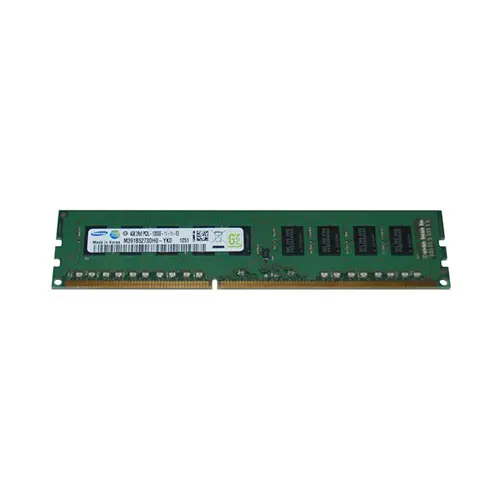
| Model | M391B5273DH0-YK0 |
|---|---|
| Product Type | Memory Module |
| Compliance Standards | EU RoHS,FCC |
| Memory Capacity | 4 GB |
| Memory Technology | DDR3 |
| Product Voltage | 1.35V |
| RAM Speed | 1600MHz |
| RAM Standard | DDR3-1600/PC3-12800 |
| Error Identifying | ECC |
| Signal Type | Unbuffered |
| Column Access Strobe (CAS) | CL11 |
| Rank | Dual Rank x8 |
| Quantity of Pins | 240-pin |
| RAM Genre | UDIMM |
Designed for entry-level servers and workstations demanding data integrity, this DDR3L-1600 UDIMM leverages ECC error correction, a 1.35V low-voltage profile, and a dual-rank x8 configuration for stable, energy-efficient 1600 MT/s operation. Its unbuffered architecture and CL11 latency make it an ideal fit for memory-reliable workloads such as single-socket NAS appliances, light virtualization hosts, and always-on embedded systems.
1. ECC protection corrects single-bit errors automatically, safeguarding data accuracy for always-on micro-server workloads where uptime is paramount.
2. 1.35V low-voltage operation substantially cuts power consumption and waste heat, enabling denser, fanless server builds with improved long-term stability.
3. 1600MHz clock speed provides balanced throughput to keep modern multi-core server CPUs fed, preventing I/O stalls during concurrent lightweight service tasks.
4. Dual Rank x8 organization leverages bank interleaving to accelerate access patterns, improving effective bandwidth for virtualization hosts running mixed tenant loads.
5. Unbuffered signal type eliminates register latency, delivering lower memory access delays that benefit latency-tuned edge computing and small business server applications.
When you are running a virtualized cluster or an in-memory database on a legacy server platform, a single undetected bit-flip can crash a production workload or silently corrupt transactional data. The Samsung M391B5273DH0-YK0 is an Unbuffered ECC DDR3 module purpose-built for exactly those risk-sensitive environments. Its ECC engine continuously catches and corrects single-bit errors in real time, meaning your hypervisor can safely pack multiple VMs onto the node without sacrificing data integrity—an essential safeguard when hours of database processing or citizen record lookups must never be compromised. Operating at 1.35V, the module also draws noticeably less power than standard 1.5V DDR3, which directly reduces thermal load inside dense 1U rack servers that often struggle with airflow. The dual-rank x8 organization pushes balanced bandwidth across ranks, allowing the memory controller to interleave accesses and sustain throughput during heavy concurrent queries. Whether you are extending the life of a critical micro-server running Active Directory and file services or maintaining a budget-conscious Hadoop edge node, this UDIMM gives you the error-free, low-power stability that keeps your service-level agreements intact.
Server Memory Type:
This is a DDR3-1600 ECC Unbuffered UDIMM (240-pin, 1.35V), designed for entry-level servers and workstations. It supports single- and dual-channel configurations with limited DIMM slots, so capacity and bandwidth planning must balance density and reliability.
General Virtualization
Start with a minimum of four 4GB modules to provide 16GB total, running in dual-channel mode. This satisfies light VM workloads (4–6 small VMs) while ECC guards against in-memory errors. For moderate consolidation, populate all available UDIMM slots to reach 32GB—more than 4 DIMMs per channel is unsupported on most UDIMM platforms.
In-Memory Database
Capacity is the priority, but 4GB DIMMs impose low density. Fully load each memory channel (e.g., 4 x 4GB = 16GB) to host small Redis or Memcached instances. For any dataset beyond 20GB, Unbuffered ECC modules become a bottleneck; consider a transition to registered DIMMs. Ensure 1.35V operation for thermal stability in always-on caching nodes.
High-Performance Computing (HPC)
Deploy paired modules to enable dual-channel interleaving, maximizing bandwidth to 25.6 GB/s per channel pair. With only 4GB per DIMM, use a cluster of nodes rather than a single fat node. For memory-bound MPI tasks, equip each socket with at least 16GB (4 x 4GB) to avoid swapping, but plan to replace these modules with higher-density UDIMMs or migrate to RDIMM-based systems for larger workloads.
Proven server-grade compatibility: rigorously tested with Dell PowerEdge T110 II, HP ProLiant MicroServer Gen8, and Lenovo ThinkServer TS140.
Q: Can I mix this M391B5273DH0-YK0 with other memory modules of different brands or speeds?
A: Mixing is not recommended for server environments. Different timings or ranks may cause instability. For guaranteed reliability, populate all channels with identical Samsung M391B5273DH0-YK0 modules.
Q: Is this memory compatible with my system?
A: It is designed for servers and workstations using Intel Xeon E3/E5 or AMD Opteron platforms. Your board must explicitly support 240-pin DDR3 ECC Unbuffered (UDIMM) memory at 1.35V.
Q: What is the recommended DIMM population order for optimal performance?
A: Populate one DIMM per channel first, typically starting with the slots farthest from the CPU. Use identical Dual Rank x8 modules in symmetric configurations to enable balanced memory interleaving.
Q: Does this module support overclocking or XMP profiles?
A: No. As an enterprise-grade ECC UDIMM, it is programmed with only JEDEC-standard profiles for DDR3-1600/PC3-12800 at CL11, prioritizing long-term data integrity over overclocking headroom.
Q: What warranty and typical failure rate can I expect?
A: This Samsung module is covered by a 1-year warranty. It delivers enterprise-class reliability with a very low annualized failure rate (AFR), backed by rigorous JEDEC-compliant testing.