











 Secure payments
Standard refund policy
Trade Assurance
Secure payments
Standard refund policy
Trade Assurance
| Model | M391B5273CH0-YK0 |
|---|---|
| Product Type | Memory Module |
| Compliance Standards | EU RoHS,FCC |
| Memory Capacity | 4 GB |
| Memory Technology | DDR3 |
| Product Voltage | 1.35V |
| RAM Speed | 1600MHz |
| RAM Standard | DDR3-1600/PC3-12800 |
| Error Identifying | ECC |
| Signal Type | Unbuffered |
| Column Access Strobe (CAS) | CL11 |
| Rank | Dual Rank x8 |
| Quantity of Pins | 240-pin |
| RAM Genre | UDIMM |
This unbuffered ECC DDR3 module is engineered for entry-level servers and single-socket workstations where data integrity is paramount, with error correction guarding against in-memory bit flips during critical transactional or storage workloads. Its dual-rank x8 configuration with 1.35V low-voltage operation maximizes memory bandwidth efficiency and power savings in platforms limited to 240-pin UDIMM slots, ensuring reliable 1600 MT/s throughput at CL11.
1. ECC error correction eliminates single-bit memory faults silently corrupting data, making it indispensable for financial record-keeping servers where transactional accuracy can never be compromised.
2. Dual Rank x8 interleaving keeps memory channels busy during heavy multi-tenant virtualization, preventing performance hiccups when multiple VMs access databases simultaneously.
3. 1.35V low-voltage operation cuts overall power draw and waste heat, allowing dense blade deployments to stay within strict datacenter power envelopes while trimming cooling OPEX.
4. 1600MHz speed with PC3-12800 bandwidth ensures smooth data flow for network-attached storage serving dozens of concurrent file requests without queue buildup.
5. Unbuffered DIMM design strips away register chips to minimize memory access latency, giving latency-sensitive microservices and edge caching nodes an immediate responsiveness advantage.
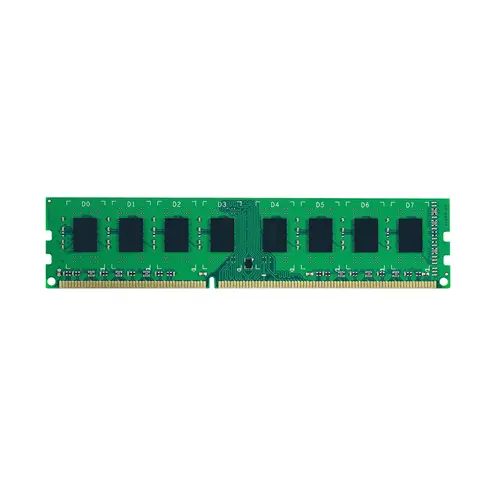
The Samsung M391B5273CH0-YK0 is a 4 GB DDR3 unbuffered ECC UDIMM, purpose-built for entry-level servers and professional workstations where data integrity and power efficiency directly impact business outcomes. Its four defining characteristics translate into real-world reliability that spec sheets alone cannot convey.
First, the ECC capability continuously detects and corrects single-bit memory errors. In a small-business server running a customer database or handling financial transactions, an undetected bit flip can corrupt records and trigger costly downtime; ECC ensures those silent corruptions are caught before they compromise your data. Second, the 1.35 V ultra-low voltage slashes power consumption across always-on systems, reducing cooling demands and electricity bills for a fleet of office servers or a 24/7 network-attached storage device. Third, the dual-rank x8 organization improves memory interleaving, giving virtualization hosts smoother multitasking when several lightweight VMs compete for bandwidth—you experience snappier console response during peak loads. Fourth, the DDR3-1600 speed at CL11 latency keeps read access swift, so a render node or CAD workstation recalculates complex models without stalling on memory fetches. Together, these traits mean fewer service interruptions, lower operational costs, and consistent performance in mission-critical environments where every transaction and rendering pass matters.
Server Memory Model M391B5273CH0-YK0 (DDR3 4GB ECC UDIMM) – Capacity Planning Guide
General Virtualization
Virtual hosts rely on ample memory headroom to avoid ballooning and swapping under multi-VM workloads. Populate all available memory channels symmetrically (e.g., six identical modules in a triple-channel platform) to maximize bandwidth while maintaining ECC protection. Start with a baseline of 32 GB (8 x 4 GB) for light consolidation and scale to 64 GB or higher for denser virtual machine fleets.
In-Memory Database
In-memory databases demand both capacity and consistently low latency; ECC UDIMMs safeguard data integrity during large in-line operations. Fully populate each memory channel with one dual-rank module per channel to avoid rank contention penalties. A minimum of 64 GB (16 x 4 GB) is recommended for moderate datasets, expanding to 128 GB where the platform supports quad-channel topologies without sacrificing clock speeds.
High-Performance Computing
HPC kernels thrive on peak memory throughput, making balanced channel population critical. Install modules in identical sets of four or eight to exploit quad-channel architectures, delivering the aggregate bandwidth needed for parallel flop-intensive tasks. Target 32 GB to 64 GB configurations, using all identical M391B5273CH0-YK0 sticks to maintain uniform rank interleaving and ECC coverage, ensuring stable day-long compute runs.
Rigorously tested for server compatibility: Dell PowerEdge T20, HP MicroServer Gen8, Lenovo ThinkServer TS140.
Q: Can I mix this M391B5273CH0-YK0 with other memory modules of different brands or speeds?
A: Mixing is not recommended. Different timings, voltages, or chip densities may cause instability. For reliable server operation, use identical M391B5273CH0-YK0 modules in matched sets.
Q: Is this memory compatible with my Intel Xeon E3 or AMD server platform?
A: It is designed for platforms supporting DDR3 ECC UDIMMs. Verify that your motherboard specifically accepts 1.35V, 1600MHz unbuffered ECC modules and that the CPU memory controller is compatible.
Q: What is the recommended DIMM population order for optimal performance?
A: Populate identical modules in the same-coloured slots first, typically starting with the farthest slot from the CPU per channel. Refer to your server board manual for proper channel interleaving and ECC configuration.
Q: Does this module support overclocking or XMP profiles?
A: No, it operates strictly at JEDEC standard DDR3-1600 with CL11 timings. This server-grade ECC UDIMM prioritizes data integrity and stability, not overclocking, and does not include XMP support.
Q: What warranty and typical failure rate can I expect?
A: This module is covered by a 1-year warranty. Typical failure rate is very low under specified server operating conditions, with long-term reliability built into Samsung’s ECC memory design.