











 Secure payments
Standard refund policy
Trade Assurance
Secure payments
Standard refund policy
Trade Assurance
| Product Type | Memory Module |
|---|---|
| Compliance Standards | EU RoHS,FCC |
| Memory Capacity | 4 GB |
| Memory Technology | DDR3 |
| RAM Speed | 1600 |
| RAM Standard | DDR3-1600/PC3-12800 |
| Error Identifying | Non-ECC |
| Signal Type | Unbuffered |
| Column Access Strobe (CAS) | CL11 |
| Rank | Single Rank x8 |
| Quantity of Pins | 204-pin |
| RAM Genre | SoDIMM |
This DDR3-1600 SODIMM is a non-ECC, unbuffered memory module purpose-built for notebook and mobile workstation upgrades, where its 204-pin form factor and single-rank x8 configuration ensure low power consumption, efficient thermal dissipation, and broad plug-and-play compatibility across a wide range of portable platforms. The standard CL11 latency paired with 1600MT/s bandwidth delivers responsive multitasking performance for everyday productivity workloads without compromising battery runtime, making it a reliable drop-in solution for extending the life of older laptops.
1. 4GB capacity comfortably supports everyday multitasking, keeping browser tabs and office applications responsive without triggering performance-sapping disk swaps.
2. 1600 MT/s data rate delivers smooth application launches and steady media playback, ensuring a fluid experience during typical on-the-go productivity.
3. CL11 latency provides the necessary timing precision for snappy window switching and web scrolling, reducing micro-stutters in everyday laptop use.
4. Single Rank x8 configuration draws less power and emits minimal heat, helping to preserve battery endurance and maintain a cooler chassis during extended mobile sessions.
5. SoDIMM form factor guarantees hassle-free plug-and-play installation, making memory upgrades in standard notebook slots instantly accessible for non-technical users.
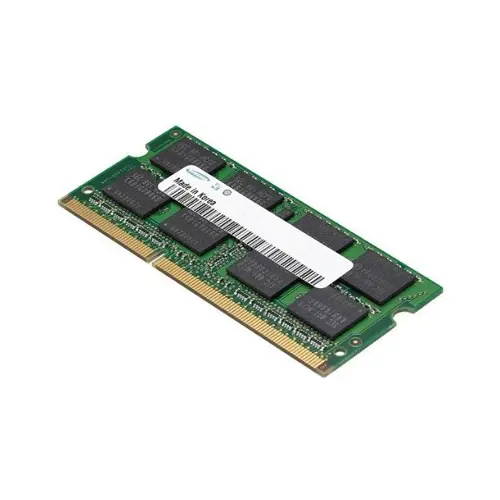
The Samsung M471B5173CB0-CK0 is a notebook memory module, immediately identifiable by its 204-pin SODIMM form factor and unbuffered, non-ECC design. This 4GB DDR3-1600 module is purpose-built for the unique demands of portable computing, and its specifications translate into tangible benefits for real-world users.
For the mobile professional running demanding applications on a workstation laptop, the DDR3-1600 speed and single-rank x8 organization deliver snappy responsiveness when multitasking across large spreadsheets, presentation decks, and browser-based research tools. The CL11 latency keeps command-to-data turnaround tight, preventing the subtle lags that can disrupt a creative flow or drag down productivity during a business trip. Meanwhile, the non-ECC, unbuffered architecture draws less power than its server-grade counterparts, which directly extends battery life—a critical factor when a power outlet is nowhere in sight during a cross-country flight.
For the thin-and-light user or IT department conducting fleet upgrades, its standard 204-pin SODIMM design ensures a drop-in fit into a vast range of ultrabooks and compact notebooks. The single-rank configuration places a lighter electrical load on the memory controller, which improves compatibility with systems that are finicky about mixed ranks and reduces heat output inside cramped chassis. Upgrading from an older, slower module to this 4GB stick breathes new life into an aging laptop, slashing application load times and making tab-heavy browsing feel fluid. This module’s compliance with EU RoHS and FCC standards also guarantees it meets strict environmental and electromagnetic emission requirements, so you can integrate it into your corporate environment with confidence. In every scenario, the M471B5173CB0-CK0 marries energy-conscious operation, effortless installation, and the dependable performance that keeps your notebook running smoothly throughout the workday.
Laptop Upgrade
This 4 GB DDR3-1600 SoDIMM is ideal for breathing new life into aging notebooks. Installing a single matching module in a free slot delivers a cost-effective 4 GB increase; for the best performance, pair it with an identical stick (same speed, CL11, 1.5 V) to enable dual-channel mode and achieve a total of 8 GB. Always verify the system’s maximum capacity per slot before upgrading.
Mobile Workstation
To meet the demands of CAD, 3D rendering, or large datasets, maximize capacity by populating both SoDIMM slots with the highest-density modules the chipset supports—typically two 8 GB DDR3-1600 kits for a 16 GB total. While a single 4 GB stick can supplement existing memory, professional environments benefit more from fully matched dual-channel pairs. Confirm whether your workstation prefers 1.5 V standard or 1.35 V DDR3L modules to ensure stability under sustained loads.
Ultrabook Power Saving
Though this 4 GB module operates at 1.5 V, ultrabook users should prioritize DDR3L (1.35 V) variants to extend battery runtime. A single 4 GB or 8 GB low-voltage SoDIMM reduces power draw and heat, making it the strategic choice for long mobile sessions. If platform constraints require a 1.5 V part, use only one module and disable unused memory slots in the BIOS to minimize idle energy consumption.
Rigorously tested and validated for laptops. Compatible with DDR3-1600 SoDIMM systems like Dell Latitude E6430, Lenovo ThinkPad T430, HP EliteBook 8470p.
Q: Can I mix this M471B5173CB0-CK0 with other memory modules of different brands or speeds?
A: Mixing is not advised. Differing brands, speeds, or ranks may cause stability issues. For reliable dual‑channel operation, install an identical DDR3 1600 CL11 SoDIMM.
Q: Is this memory compatible with my notebook system?
A: It fits notebooks with a 204‑pin DDR3 SoDIMM slot, Intel 5th/6th Gen or AMD equivalent. Confirm your laptop supports 4 GB, single‑rank x8, 1600 MT/s modules.
Q: What is the recommended DIMM population order for optimal performance?
A: Most laptops have two slots. For dual‑channel, install matched pairs. In single‑slot designs, simply populate the available socket; no specific order is required.
Q: Does this module support overclocking or XMP profiles?
A: No, it is a JEDEC‑compliant module running at 1600 MT/s CL11. XMP and overclocking are not supported, ensuring stable, standard operation in mobile platforms.
Q: What warranty and typical failure rate can I expect?
A: It includes a 1‑year warranty. The AFR is typically under 0.5% under normal conditions. Using proper ESD handling further minimizes any early-life failure risk.