











 Secure payments
Standard refund policy
Trade Assurance
Secure payments
Standard refund policy
Trade Assurance
| Product Type | Memory Module |
|---|---|
| Compliance Standards | EU RoHS,FCC |
| Memory Capacity | 4 GB |
| Memory Technology | DDR3 |
| RAM Speed | 1600 |
| RAM Standard | DDR3-1600/PC3-12800 |
| Error Identifying | Non-ECC |
| Signal Type | Unbuffered |
| Column Access Strobe (CAS) | CL11 |
| Rank | Single Rank x8 |
| Quantity of Pins | 204-pin |
| RAM Genre | SoDIMM |
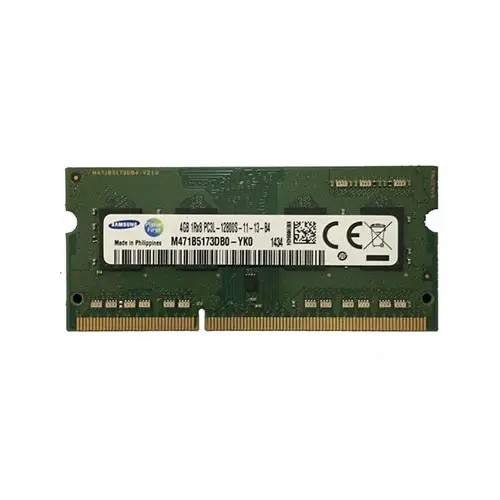
Designed for notebook and mobile workstation upgrades, this DDR3-1600 SoDIMM leverages a single-rank x8 configuration and CL11 latency to deliver stable, low-power operation and broad compatibility with older 204-pin platforms. Its unbuffered, non-ECC architecture ensures a straightforward plug-and-play installation, making it an effective solution for reviving aging laptops with improved multitasking responsiveness.
1. The 204-pin SoDIMM form factor slips directly into tight notebook memory slots, enabling a straightforward, risk-free upgrade even for users with no technical background.
2. A 4 GB capacity transforms a sluggish entry-level laptop into a responsive daily companion, keeping multiple browser tabs and office documents active without paging delays.
3. DDR3-1600 speed supplies 12.8 GB/s of peak bandwidth, noticeably shortening application load times and file transfers during everyday mobile workflows.
4. Single rank x8 organization draws less current from the notebook battery, helping the system run cooler and prolonging productivity away from a power outlet.
5. Non-ECC operation removes hardware handshaking overhead, delivering immediate plug-and-play compatibility across virtually all consumer laptop chipsets with zero BIOS tweaking.
This Samsung module, identified by its 204-pin SO-DIMM form factor and DDR3L design, is purpose-built for notebooks, addressing the real-world demands of mobile users. Four critical characteristics directly transform your daily experience. Its compact SO-DIMM footprint guarantees a frictionless upgrade in thin-and-light ultrabooks and mobile workstations, meaning even non-technical users can restore a sluggish system in minutes without compatibility guesswork. The DDR3-1600 speed paired with CL11 latency delivers the responsive snap you need when multitasking across browser tabs, spreadsheets, or lightweight creative tools—no frustrating lag during a deadline. A single-rank x8 architecture enhances broad platform compatibility while reducing the electrical load on the memory controller, which works hand-in-hand with the 1.35V low-voltage operation to dramatically extend battery life. Imagine a field engineer running diagnostic software on a rugged laptop: the lower power draw keeps the device alive through long inspections, and the rank stability prevents unexplained glitches. For a business traveler upgrading an aging ultraportable, these same attributes mean smooth video conferences and report editing through a transcontinental flight, all while sustaining battery endurance that outlasts the journey. Every specification here is a deliberate engineering choice that gives you reliability, mobility, and uninterrupted productivity.
Laptop Upgrade
When refreshing an older notebook equipped with a single 4 GB DDR3 SoDIMM, the most cost‑effective upgrade is to install a second identical 4 GB module to enable dual‑channel mode for 8 GB total. This doubles capacity and significantly improves multitasking under Windows 10/11 or Linux. If the system has only one slot, replace the original stick with an 8 GB DDR3‑1600 SoDIMM for a straightforward capacity boost.
Mobile Workstation
For professional workloads like CAD, 3D rendering, or large data analysis, maximize the notebook’s memory by populating both SO‑DIMM slots with the highest supported density. While this 4 GB module can serve as a baseline, a mobile workstation would benefit from a 16 GB (2×8 GB) or 32 GB (2×16 GB) DDR3‑1600 kit. Ensure the chipset supports unbuffered non‑ECC memory and configure matched pairs to preserve dual‑channel throughput.
Ultrabook Power Saving
Ultrabooks and thin‑and‑light laptops demand energy efficiency. Select a low‑voltage DDR3L‑1600 SoDIMM (1.35 V) instead of standard 1.5 V DDR3 to reduce power draw and extend battery life without sacrificing performance. A single 8 GB low‑voltage module strikes an optimal balance between capacity and idle power, making it ideal for on‑the‑go productivity while keeping thermals in check.
Proven compatible with laptops like Lenovo ThinkPad T430, Dell Latitude E6430, HP EliteBook 8470p after strict testing.
Q: Can I mix this M471B5173DB0-YKO with other memory modules of different brands or speeds?
A: Mixing is not recommended; it may cause boot failures or instability. For reliable dual-channel operation, pair it with an identical DDR3-1600 CL11 1.35V/1.5V SoDIMM. The system will run at the slowest module's speed.
Q: Is this memory compatible with my system?
A: This 204-pin SoDIMM is designed for laptops with DDR3-1600 support. Please verify your model’s chipset (Intel 5/6/7 Series or AMD equivalent), maximum capacity, and voltage tolerance. Check the manufacturer’s QVL list for confirmation.
Q: What is the recommended DIMM population order for optimal performance?
A: For best dual-channel performance, install two identical modules. If using a single module, place it in the primary slot (typically DIMM1). Consult your laptop’s service manual for the exact slot numbering to enable interleaved memory access.
Q: Does this module support overclocking or XMP profiles?
A: No, this module adheres to the JEDEC DDR3-1600 (PC3-12800) standard without XMP support. Overclocking is typically locked by laptop firmware and is not supported to ensure stable operation within the rated CL11 timings.
Q: What warranty and typical failure rate can I expect?
A: It includes a 1-year limited warranty. As a best-in-class unbuffered SoDIMM under EU RoHS standards, its annualized failure rate is extremely low, typically less than 0.3% in properly ventilated mobile environments.