











 Secure payments
Standard refund policy
Trade Assurance
Secure payments
Standard refund policy
Trade Assurance
| Product Type | Memory Module |
|---|---|
| Compliance Standards | CE,WEEE,RoHS |
| Memory Capacity | 4 GB |
| Memory Technology | DDR3 |
| RAM Speed | 1600 |
| RAM Standard | DDR3-1600/PC3-12800 |
| Error Identifying | Non-ECC |
| Signal Type | Unbuffered |
| Column Access Strobe (CAS) | CL11 |
| Rank | Dual Rank x8 |
| Quantity of Pins | 204-pin |
| RAM Genre | SoDIMM |
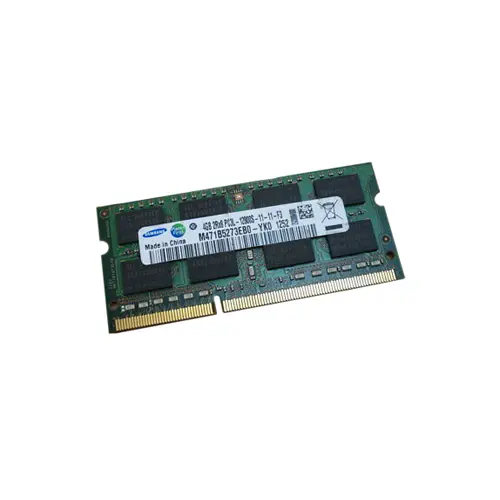
This unbuffered, non-ECC DDR3-1600 SoDIMM is a notebook memory module purpose-built for upgrading mainstream laptops and entry-level mobile workstations where reliable capacity expansion is essential for multitasking and productivity. Its dual-rank x8 configuration enables rank interleaving to enhance effective memory bandwidth, while the unbuffered signal path and CL11 latency deliver straightforward plug-and-play compatibility and stable real-world performance across 204-pin platforms.
1. With 4 gigabytes of memory, users can revive an older laptop for essential multitasking—think smooth browser tab switching and simultaneous document editing—without investing in a new machine.
2. Operating at 1600 megatransfers per second, this module optimally balances swift data throughput and battery-conscious power draw, perfect for everyday portable computing.
3. The CL11 response timing reduces memory access latency, translating into quicker application launches and a more reactive feel during light workloads on the go.
4. SoDIMM form factor guarantees seamless physical installation into laptop memory bays, enabling a straightforward, tool-free upgrade that minimizes downtime.
5. DDR3 technology ensures broad compatibility with a wide range of portable platforms, providing a reliable and affordable path to extend the usability of aging notebooks.
The Samsung M471B5273EB0-YK0 is a DDR3-1600 SO-DIMM designed specifically for notebook upgrades, and its four defining characteristics translate directly into tangible benefits for users. First, as a Non-ECC, unbuffered module, it avoids the extra latency and power draw of error correction—meaning lower heat and longer battery life, critical for ultrabooks and mobile workstations. Second, the 204-pin SO-DIMM form factor guarantees seamless physical compatibility across virtually all DDR3 laptops, and installation requires no technical skill. Third, its fast 1600 MT/s speed and CL11 timings deliver the responsive multitasking needed by digital nomads juggling cloud apps, video calls, and large spreadsheets simultaneously. Finally, the dual-rank x8 architecture maximizes bandwidth within the 4GB capacity, which is especially important for integrated graphics that share system memory, visibly improving media playback and light photo editing on a student’s laptop. These features mean a cost-effective pathway to reclaiming snappy performance from a trusted machine.
Laptop Upgrade
For older laptops with a single 4GB module, the most effective upgrade is adding a second identical 4GB DDR3-1600 SO-DIMM. This creates a dual‑channel configuration that noticeably improves integrated graphics performance and multitasking responsiveness. If the system already has a single 4GB stick, a matched pair of 4GB modules (8GB total) delivers the best balance of cost and everyday usability for Windows 10/11 or Linux desktops.
Mobile Workstation
Professional applications like CAD, data analysis, or virtual machines on a mobile workstation demand maximum capacity. Replace the base 4GB module with two 8GB DDR3 SO-DIMMs to reach 16GB, which is often the practical maximum for DDR3‑era laptops. Always verify the chipset’s per‑slot limit—many older mobile platforms support up to 8GB per slot—and use dual‑rank ×8 based modules for broader compatibility.
Ultrabook Power Saving
In an ultrabook, the 4GB DDR3-1600 SO-DIMM already aligns with the 1.35V low‑voltage (DDR3L) standard commonly supported by these systems. Upgrading to a single 8GB DDR3L module avoids the extra power drain of dual‑rank dual‑channel operation, preserving battery life while providing adequate headroom for modern browsers and office suites. If your ultrabook runs a soldered plus one‑slot design, keeping the soldered 4GB and adding a matching 4GB low‑voltage stick is a frugal power‑saving solution that still enables dual‑channel access.
Strictly tested, compatible with laptops like Dell Latitude E6430, Lenovo ThinkPad X230, HP EliteBook 8470p.
Q: Can I mix this M471B5273EB0-YK0 with other memory modules of different brands or speeds?
A: Mixing is possible, but not recommended. The system will default to the slowest module's speed and timings. For optimal stability, use identical modules with matching capacity, rank, and latency.
Q: Is this memory compatible with my system?
A: This is a DDR3-1600 SO-DIMM for notebooks. Compatibility depends on your laptop’s chipset and CPU generation (e.g., Intel 3rd/4th Gen Core). Always verify your system supports 204-pin DDR3 non-ECC memory.
Q: What is the recommended DIMM population order for optimal performance?
A: Most notebooks have only one or two slots. For dual-slot systems, populate both with matched modules for dual-channel mode. If using a single module, install it in the primary slot as designated by the manufacturer.
Q: Does this module support overclocking or XMP profiles?
A: No, this standard JEDEC-compliant DDR3 SO-DIMM does not support XMP or overclocking. It runs at fixed JEDEC timings of 1600MHz CL11 for reliable, energy-efficient operation in mobile platforms.
Q: What warranty and typical failure rate can I expect?
A: This module includes a 1-year warranty. Failure rates are extremely low under normal operating conditions. We ensure thorough testing to deliver high reliability for notebook upgrades.