











 Secure payments
Standard refund policy
Trade Assurance
Secure payments
Standard refund policy
Trade Assurance
| Product Type | Memory Module |
|---|---|
| Compliance Standards | EU RoHS,FCC |
| Memory Capacity | 4 GB |
| Memory Technology | DDR3 |
| RAM Speed | 1600MHz |
| RAM Standard | DDR3-1600/PC3-12800 |
| Error Identifying | Non-ECC |
| Signal Type | Unbuffered |
| Column Access Strobe (CAS) | CL11 |
| Rank | Single Rank x8 |
| Quantity of Pins | 240-pin |
| RAM Genre | UDIMM |
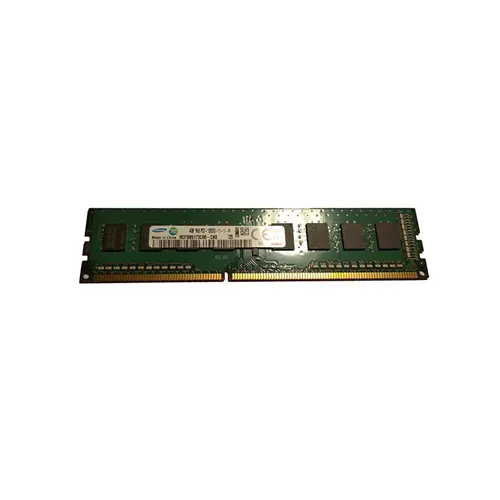
Designed as a single-rank x8 unbuffered Non-ECC UDIMM, this 4 GB DDR3-1600 module operates at a tight CL11 latency, delivering stable and responsive performance for entry-level desktop productivity, media playback, and light gaming workloads. Its 240-pin form factor and broad compliance with PC3-12800 standards ensure seamless plug-and-play compatibility in older DDR3-based systems, while the single-rank configuration minimizes electrical loading on the memory controller for reliable everyday operation.
1. The module's fast DDR3 data rate ensures fluid frame pacing and prevents asset-load hitches in open-world gaming scenarios.
2. Tight CAS timings reduce memory access latency, giving video editors a snappier preview scrub during multi-layer timeline compositions.
3. A mainstream memory footprint handles modern OS multitasking and media-rich browser sessions while keeping the page file usage minimal.
4. Single-rank construction lowers electrical loading on the CPU’s IMC, offering better stability and frequency margin for tuners seeking extra performance.
5. Unbuffered command path strips away buffer delays, delivering the low-latency responsiveness that competitive gamers rely on for quick reflexes.
For desktop users, this M378B5173CB0-CK0 DDR3 4GB UDIMM’s four core characteristics directly solve real-world pain points. The Non-ECC, unbuffered design eliminates the latency penalty of registered memory—when you are playing a demanding AAA title like Cyberpunk 2077, every nanosecond saved on command delivery can prevent frame drops during explosive action scenes. Its 1600MHz frequency and 12.8 GB/s bandwidth keep up with the data-hungry needs of 4K video rendering; timeline scrubbing in Premiere Pro stays smooth because large frame buffers are refreshed without hesitation. CL11 latency tightens the request-to-delivery window, shortening shader compilation and scene load times. The single-rank x8 organization eases strain on the memory controller, ensuring exceptional stability in older dual-channel rigs. Pairing two modules for 8GB revives a legacy desktop into a responsive HD content creation and gaming station.
Based on the specifications—Non-ECC, Unbuffered, DDR3, 240-pin UDIMM—this is a desktop memory module. The 4 GB capacity, single-rank x8 design, and 1600 MHz speed with CL11 timings are ideal for mainstream desktop platforms. Below are capacity planning recommendations for typical desktop workloads.
Gaming Build
For a responsive gaming experience, dual-channel configurations are essential. Use two of these 4 GB modules to create an 8 GB kit (2x4 GB) as a budget-friendly foundation for most modern titles at medium settings. For a smoother multitasking gaming setup, a 16 GB configuration using four matching 4 GB modules fully populating all DIMM slots is recommended to minimize stuttering and leverage dual-rank interleaving where supported.
Content Creation
Demanding video editing, 3D rendering, and large photo manipulation benefit from high capacity. However, with 4 GB UDIMMs, the maximum realistic capacity on a typical 4-slot consumer board is 16 GB, which falls short for 4K workflows. For entry-level content creation, install four identical 4 GB modules for 16 GB total to reduce disk swapping. Professionals requiring 32 GB or 64 GB should migrate to higher-density 8 GB or 16 GB DDR3 modules, as this single-rank 4 GB stick is insufficient for sustained heavy rendering tasks.
General Productivity
Cost-effective multitasking is best served by an 8 GB dual-channel configuration using two 4 GB modules. This balances price and performance for web browsing, office suites, and video conferencing. Adding a third module breaks dual-channel symmetry, so stick to matched pairs. For minimal budgets, a single 4 GB stick is viable for basic operating system tasks but will struggle with more than a handful of browser tabs.
Rigorously tested DDR3 UDIMM, compatible with desktops such as Dell OptiPlex 3010, HP Compaq 8300 Elite, and Lenovo ThinkCentre M92p.
Q: Can I mix this M378B5173CB0-CK0 with other memory modules of different brands or speeds?
A: While physically possible, mixing brands or speeds forces the system to the lowest common specification and often causes instability. For reliable operation, we strongly recommend using identical modules with the same part number.
Q: Is this memory compatible with my system? (desktop motherboards)
A: This 4GB DDR3-1600 UDIMM is compatible with desktop chipsets supporting DDR3, such as Intel 6/7 Series or AMD 900/8 Series. Please verify your motherboard’s chipset and RAM standard to ensure compatibility.
Q: What is the recommended DIMM population order for optimal performance?
A: For dual‑channel operation, install modules in slots of the same color, typically DIMM_A2 and DIMM_B2. Always consult your motherboard manual for the exact population order to enable full memory bandwidth.
Q: Does this module support overclocking or XMP profiles?
A: This module complies with JEDEC DDR3-1600 standards and does not feature XMP profiles. Overclocking beyond its rated CL11 specification is not supported; it delivers reliable performance at stock speed and voltage.
Q: What warranty and typical failure rate can I expect?
A: The module includes a 1‑year warranty. Samsung’s rigorous testing ensures an annualized failure rate typically below 0.5%, providing excellent long‑term reliability for desktop deployments.