











 Secure payments
Standard refund policy
Trade Assurance
Secure payments
Standard refund policy
Trade Assurance
| Product Type | Memory Module |
|---|---|
| Compliance Standards | EU RoHS,FCC |
| Memory Capacity | 4 GB |
| Memory Technology | DDR3 |
| RAM Speed | 1600MHz |
| RAM Standard | DDR3-1600/PC3-12800 |
| Error Identifying | Non-ECC |
| Signal Type | Unbuffered |
| Column Access Strobe (CAS) | CL11 |
| Rank | Single Rank x8 |
| Quantity of Pins | 240-pin |
| RAM Genre | UDIMM |
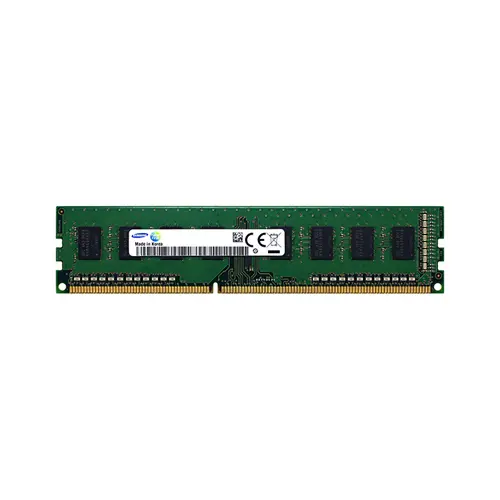
Identified as a standard desktop memory module, this Samsung 4GB DDR3-1600 UDIMM is ideally suited for entry-level productivity builds and legacy system upgrades where stable single-rank operation ensures broad motherboard compatibility. Its unbuffered architecture and CL11 latency deliver responsive performance for everyday multitasking and light content creation without the overhead of error correction.
1. 4GB density supplies just enough headroom for an office PC or entry-level gaming rig, preventing swap thrashing during light multitasking and older title sessions.
2. 1600MHz clock pushes up to 12.8GB/s of peak bandwidth per channel, keeping legacy game textures and HD video streams feeding the CPU without visible stutter.
3. CL11 latency tightens the gap between memory requests and data delivery, sharpening the mouse-to-screen feel in fast-paced RTS and FPS games on aging platforms.
4. Single Rank x8 layout reduces electrical loading on the memory bus, giving older desktop motherboards a higher chance of stable POST and mild overclocking headroom.
5. 240-pin UDIMM form factor slips straight into standard desktop DDR3 slots, making it a no-hassle drop-in upgrade for refurbished towers or DIY home servers.
Designed specifically for desktop platforms, the M378B5173CB0-YK0 arrives as a 240-pin DDR3 UDIMM built for responsiveness. For users breathing new life into an aging tower, the key lies in how its four cornerstone characteristics solve real-world slowdowns. Its 1600MHz clock and 12.8 GB/s bandwidth slash loading times in demanding AAA games and smooth out 1080p video editing timelines. The CL11 latency keeps command response tight, meaning every mouse click and filter preview feels instantaneous. Because it’s unbuffered and non-ECC, the module communicates directly with the memory controller without the nanoseconds of overhead that registered memory adds—a real advantage for interactive desktop tasks. And the single-rank, 4GB capacity ensures hassle-free compatibility with a wide range of older Intel and AMD chipsets, while the open slot enables a dual-channel upgrade, restoring multitasking fluidity to a struggling office PC. Whether you’re battling stuttering frame rates in Witcher 3 or waiting for a Premiere Pro render, this module delivers relief.
Memory Type Identification: Desktop (UDIMM, Non-ECC, Unbuffered)
This DDR3-1600 UDIMM is a standard desktop memory module. Its non-ECC, unbuffered design aligns with consumer motherboards and CPUs, not servers or laptops. For capacity planning with this 4GB single-rank module, consider the following desktop scenarios.
Gaming Build
For dual-channel performance, pair two identical modules for an 8GB kit (2x4GB). This provides sufficient capacity for most modern titles at moderate settings and ensures optimal memory bandwidth. To build a 16GB setup, use four 4GB sticks across all DIMM slots, though a 2x8GB kit is preferable if future expansion is needed. Avoid mixing different capacities to maintain stable dual-channel operation.
Content Creation
Content workloads demand far more than 4GB per module allows. A 64GB configuration using 4GB UDIMMs would require 16 modules, which is impossible on standard desktop platforms. Therefore, this 4GB DDR3 isn't suitable for heavy video editing or 3D rendering. Plan for higher-density 8GB or 16GB DDR3 modules if your board supports them, or migrate to a DDR4 platform for efficient 64GB+ capacities.
General Productivity
A single 4GB module is the entry point for web browsing, office suites, and light multitasking. The most cost-effective upgrade is adding a second identical 4GB stick for 8GB dual-channel, noticeably improving system responsiveness. For a 16GB budget productivity build, four matched 4GB modules offer solid performance without overspending on older DDR3 technology.
Rigorously tested, M378B5173CB0-YK0 ensures flawless compatibility with desktops like Dell OptiPlex, HP EliteDesk, Lenovo ThinkCentre.
Q: Can I mix this M378B5173CB0-YK0 with other memory modules of different brands or speeds?
A: Mixing is possible but not recommended. Different brands or speeds may force the system to run at the lowest common specification, potentially causing instability or preventing boot. For guaranteed dual-channel operation and reliability, use identical modules.
Q: Is this memory compatible with my Intel 6/7/8 Series or AMD socket FM1/FM2/AM3+ desktop motherboard?
A: Yes, if your motherboard supports non‑ECC unbuffered DDR3 UDIMMs. It is a standard DDR3-1600 PC3-12800 module, compatible with Intel 6/7/8 Series and equivalent AMD platforms that accept 240‑pin desktop memory.
Q: What is the recommended DIMM population order for optimal performance?
A: For dual‑channel motherboards, populate identical DIMMs in the same‑color slots per your manual. Using a single module limits memory to single‑channel mode; install a matched pair in the correct slots to enable dual‑channel bandwidth.
Q: Does this module support overclocking or XMP profiles?
A: No, this standard JEDEC‑compliant DDR3-1600 module does not include XMP profiles and is not designed for overclocking. It operates at fixed default timings (CL11) and the standard 1.5V voltage for consistent, out‑of‑the‑box stability.
Q: What warranty and typical failure rate can I expect?
A: We provide a 1‑year warranty. The typical annualized failure rate (AFR) for this Samsung module is well below 0.2%, backed by rigorous component screening and full factory testing to ensure long‑term reliability in desktop environments.