











 Secure payments
Standard refund policy
Trade Assurance
Secure payments
Standard refund policy
Trade Assurance
| Product Type | Memory Module |
|---|---|
| Compliance Standards | CE,WEEE,RoHS |
| Memory Capacity | 4 GB |
| Memory Technology | DDR3 |
| RAM Speed | 1600MHz |
| RAM Standard | DDR3-1600/PC3-12800 |
| Error Identifying | Non-ECC |
| Signal Type | Unbuffered |
| Column Access Strobe (CAS) | CL11 |
| Rank | Single Rank x8 |
| Quantity of Pins | 240-pin |
| RAM Genre | UDIMM |
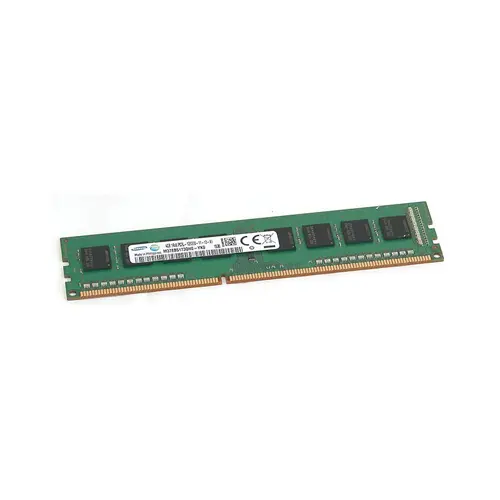
This 4 GB DDR3-1600 UDIMM is a desktop memory module featuring a single-rank x8 configuration that reduces electrical loading for improved signal integrity and broad platform compatibility. Its unbuffered, Non-ECC design paired with standard CL11 timings makes it well-suited for upgrading mainstream desktops used in office productivity, light content creation, and everyday multitasking where cost-effective, low-latency operation is prioritized over error correction.
1. The unbuffered architecture reduces command latency, giving gamers a more responsive feel in fast-paced titles where every microsecond counts.
2. DDR3 technology ensures seamless compatibility with a vast ecosystem of desktop motherboards, making it a reliable drop-in upgrade for aging systems.
3. The high data rate provides enough bandwidth to keep multiple creative applications and browser tabs fluidly responsive at once.
4. A tightly tuned CAS latency speeds up data retrieval from memory, minimizing frame-time spikes during intense gaming sessions.
5. Single Rank construction puts less electrical load on the CPU’s memory controller, unlocking extra overclocking headroom for enthusiasts chasing benchmark records.
The Samsung M378B5173QH0-YK0 is a desktop UDIMM engineered for mainstream PC users who require responsive performance in gaming and content creation. Its 1600MHz DDR3 frequency provides a peak bandwidth of 12.8 GB/s, which directly translates into faster texture streaming in AAA titles and smoother timeline scrubbing during 4K video editing. The CL11 latency keeps the interval between a memory request and data delivery extremely short, minimizing micro-stutters in fast-paced shooters and accelerating filter application in photo manipulation software. Designed as a single‑rank x8 module, it presents a lighter electrical load to the memory controller, enhancing compatibility across diverse motherboards and giving overclockers more headroom to push frequencies without sacrificing stability. The unbuffered architecture eliminates the register chip found in server memory, permitting direct CPU-to-DRAM communication that cuts access latency to the absolute minimum—an advantage you feel as instant application switching and reduced input lag in competitive gaming. Compliant with CE, WEEE, and RoHS, this module combines reliable high-speed operation with environmental responsibility. For anyone upgrading a desktop, these four characteristics work together to turn everyday multitasking and demanding creative workloads into a fluid, frustration‑free experience where the hardware keeps pace with your ambition.
This DDR3-1600 non‑ECC UDIMM is a desktop memory module. Below is capacity planning guidance for typical desktop workloads.
Gaming Build
Dual‑channel operation is critical for gaming performance. To achieve 16 GB, install four matched 4 GB modules to populate all DIMM slots on mainstream boards, creating two interleaved channels. A 32 GB configuration is impractical with these low‑density sticks—most consumer platforms lack the eight slots required—so consider upgrading to 8 GB DIMMs for higher‑capacity gaming kits.
Content Creation
Video editing and 3D rendering rely on large memory footprints. Using this 4 GB UDIMM, the practical maximum on a four‑slot motherboard is 16 GB (4×4 GB), which suits only light content tasks. A professional 64 GB setup demands higher‑density modules, because installing sixteen 4 GB sticks is physically impossible on standard desktop platforms.
General Productivity
For everyday office work and multitasking, a cost‑effective 8 GB dual‑channel pair (2×4 GB) delivers smooth responsiveness. Users who keep many browser tabs and productivity apps open can move to 16 GB (4×4 GB), fully occupying all DIMM slots while staying budget‑friendly. This strategy balances initial cost and ample headroom for a long system lifespan.
Rigorously tested, compatible with DDR3 desktops: Dell OptiPlex 9020, HP EliteDesk 800 G1, Lenovo ThinkCentre M93p.
Q: Can I mix this M378B5173QH0-YK0 with other memory modules of different brands or speeds?
A: Mixing is possible, but all modules will operate at the lowest common speed and timings. For optimal stability and performance on a desktop platform, we recommend using identical modules from a single kit.
Q: Is this memory compatible with my system?
A: This DDR3 UDIMM is compatible with desktops using Intel 6/7/8 Series or AMD FM1/FM2/AM3+ chipsets. Please verify your motherboard supports non-ECC, 240-pin DDR3-1600 modules with 4GB capacity per slot.
Q: What is the recommended DIMM population order for optimal performance?
A: For a single module, install it in slot A2 or the primary channel. For dual-channel operation on a desktop, populate identically colored slots with two matching modules. Consult your motherboard manual for optimal configuration.
Q: Does this module support overclocking or XMP profiles?
A: No. This module follows JEDEC standard DDR3-1600 at CL11 and does not include an XMP profile. It runs at its rated speed without overclocking and is not designed for manual frequency tuning.
Q: What warranty and typical failure rate can I expect?
A: This product includes a 1-year warranty. Its typical annualized failure rate (AFR) is well below 0.5%, reflecting high manufacturing standards and compliance with CE, WEEE, and RoHS regulations.