











 Secure payments
Standard refund policy
Trade Assurance
Secure payments
Standard refund policy
Trade Assurance
| Product Type | Memory Module |
|---|---|
| Compliance Standards | EU RoHS,FCC |
| Memory Capacity | 4 GB |
| Memory Technology | DDR3 |
| RAM Speed | 1600MHz |
| RAM Standard | DDR3-1600/PC3-12800 |
| Error Identifying | Non-ECC |
| Signal Type | Unbuffered |
| Column Access Strobe (CAS) | CL11 |
| Rank | Dual Rank x8 |
| Quantity of Pins | 240-pin |
| RAM Genre | UDIMM |
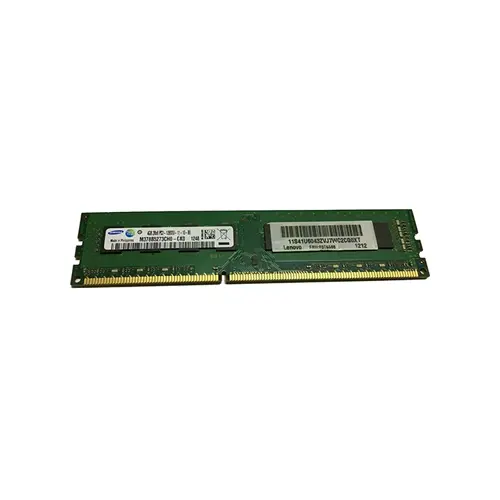
This UDIMM is a standard desktop memory module designed for DDR3-based systems, best suited for productivity, content creation, and legacy gaming builds where reliable non-ECC performance is prioritized over data integrity features. Its dual-rank x8 organization at DDR3-1600 with CL11 latency delivers a balance of capacity and rank interleaving benefits, improving multitasking efficiency by allowing concurrent memory accesses across two ranks on a single channel.
1. DDR3 technology offers a mature, cost-effective platform for upgrading aging desktops, delivering the bandwidth needed for snappy everyday multitasking and media playback.
2. 1600MHz speed keeps frame times consistent in less demanding esports titles, ensuring a fluid gaming experience without micro-stutter on budget system builds.
3. 4GB capacity provides just enough headroom for office productivity suites and web browsing, making it a practical drop-in upgrade for reviving older home PCs.
4. CL11 latency contributes to a responsive desktop feel, reducing the lag between user input and on-screen action during light content creation tasks.
5. Dual Rank x8 organization interleaves memory banks for higher effective throughput, which accelerates photo batch processing and smooths heavy spreadsheet manipulation.
Designed for desktop users who demand responsive everyday performance, this Samsung M378B5273CH0-CK0 UDIMM blends four crucial characteristics that directly shape your real-world experience. The unbuffered, non-ECC architecture strips away the extra controller chip and error-correction overhead found in server memory, dramatically reducing electrical latency on the memory bus. In fast-paced AAA gaming, that translates to fewer micro-stutters during texture streaming and quicker input-to-frame response when every millisecond counts. With a native 1600MHz clock and a tight CAS latency of just 11 cycles, the module feeds your CPU with high-bandwidth, low-delay data ideal for scrubbing through 1080p video timelines or applying real-time effects in rendering workloads, where waiting on memory access can stall the entire project. The dual-rank x8 organization interleaves two sets of memory chips on a single stick, which boosts effective bandwidth by allowing the memory controller to pipeline commands. For a video editor exporting a complex composition, that means the system can stay fluid under heavy multitasking instead of choking on concurrent application demands. Together, these attributes ensure your desktop never becomes the bottleneck between your intent and the final frame.
Gaming Build
For a dual-channel gaming configuration, install two matching 4GB DDR3-1600 UDIMMs to enable 8GB of interleaved memory, which noticeably improves frame-time consistency over a single module. If your budget or motherboard supports 16GB, pair four identical 4GB sticks (or two 8GB with similar rank/timing) to keep headroom for modern titles and background apps. Avoid mixing single and dual rank modules in the same channel to prevent subtle latency penalties.
Content Creation
Content workloads demand capacity first: 4GB modules alone are insufficient. Plan a 32GB or 64GB setup by populating all four DIMM slots with identical 4GB sticks to reach 16GB, or if your board supports it, combine four 8GB DDR3-1600 UDIMMs for 32GB. For 3D rendering and 4K video editing, 64GB is ideal—this typically requires a workstation platform, but on a consumer desktop you may need to source higher-density DDR3 UDIMMs rather than relying solely on these 4GB modules.
General Productivity
A cost-effective 8GB (2×4GB) dual-channel kit delivers smooth multitasking for office suites, web browsing, and video conferencing. This configuration exploits 1600MHz bandwidth without overspending, and the dual rank x8 design of the referenced module ensures good signal integrity on mainstream platforms. If additional slots are available, upgrading to 12GB (3×4GB) or 16GB (4×4GB) later provides a sensible path for heavier spreadsheets and virtual desktop use without replacing existing modules.
This desktop memory has been rigorously tested and is compatible with systems like Dell OptiPlex, HP EliteDesk, and Lenovo ThinkCentre.
Q: Can I mix this M378B5273CH0-CK0 with other memory modules of different brands or speeds?
A: Mixing is possible but not recommended. All installed modules will operate at the slowest speed and loosest timings, potentially causing instability. For best results, use identical modules.
Q: Is this memory compatible with my system?
A: This 240-pin DDR3-1600 non‑ECC UDIMM fits desktop motherboards with Intel 6/7/8 Series or AMD 900/FM chipsets. Verify that your board supports 4 GB, dual‑rank DIMMs and check the manufacturer’s QVL list.
Q: What is the recommended DIMM population order for optimal performance?
A: Install matching pairs in the same colored slots (usually DIMM2 and DIMM4 first) to enable dual‑channel mode. Always refer to your motherboard manual for the exact slot population sequence.
Q: Does this module support overclocking or XMP profiles?
A: This module follows the JEDEC DDR3-1600 standard at CL11 and does not include an XMP profile. It runs only at its rated speed; overclocking is not officially supported and may void the warranty.
Q: What warranty and typical failure rate can I expect?
A: This module comes with a one-year warranty. Typical annualized failure rate for such memory is well below 0.5%, ensuring reliable long‑term operation under standard desktop conditions.