











 Secure payments
Standard refund policy
Trade Assurance
Secure payments
Standard refund policy
Trade Assurance
| Product Type | Memory Module |
|---|---|
| Compliance Standards | CE,WEEE,RoHS |
| Memory Capacity | 4 GB |
| Memory Technology | DDR3 |
| RAM Speed | 1600MHz |
| RAM Standard | DDR3-1600/PC3-12800 |
| Error Identifying | Non-ECC |
| Signal Type | Unbuffered |
| Column Access Strobe (CAS) | CL11 |
| Rank | Single Rank x8 |
| Quantity of Pins | 240-pin |
| RAM Genre | UDIMM |
This is a standard desktop DDR3 UDIMM, best suited for mainstream productivity builds and light content creation, where its single-rank x8 organization ensures stable signaling on older platforms. The unbuffered design and CL11 latency offer straightforward plug-and-play performance at 1600MHz, delivering reliable bandwidth for everyday multitasking.
1. 1600MHz data rate supplies the sustained throughput needed to keep frame times consistent and background tasks responsive during demanding desktop gaming or live streaming.
2. CL11 cycle latency shortens the turnaround between data requests, helping to minimize micro-stutters when switching between content creation tools and heavy browser workloads.
3. Single Rank x8 topology reduces electrical loading on the memory controller, improving signal stability and giving enthusiasts cleaner headroom for manual frequency tuning.
4. UDIMM unbuffered architecture ensures direct plug-and-play compatibility with standard consumer desktop boards, making system refreshes straightforward for DIY builders.
5. Non-ECC signaling strips away server-grade parity checks, delivering every bit of bandwidth directly to rendering and encoding pipelines where absolute speed matters more than correction.
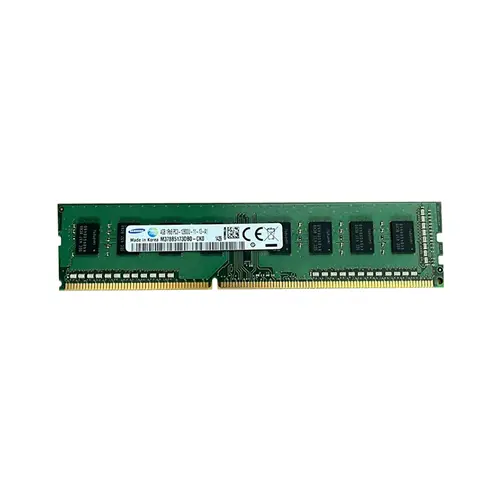
Designed for performance desktop platforms, the Samsung M378B5173DB0-CKO is a 4GB DDR3 UDIMM that prioritizes speed and responsiveness over server-class error correction. Its Non‑ECC and unbuffered architecture strips away the latency‑inducing buffers and parity checking found in server memory, giving the processor a direct, unimpeded path to the DRAM. For a gamer immersed in a triple‑A title, this translates into faster command execution and fewer micro‑stutters during frantic firefights, where every nanosecond of input lag matters. The DDR3‑1600 speed grade paired with a CL11 latency delivers a tight balance of bandwidth and timing, ensuring that texture loads and level streaming feel seamless rather than jittery. In a video editing rig, that same throughput keeps high‑bitrate 1080p footage flowing smoothly through previews and render queues, cutting seconds off repeated scrubbing tasks. The module’s single‑rank x8 configuration exerts a lighter electrical load on the memory controller, which improves stability when populating multiple DIMM slots and leaves more headroom for overclockers to push frequencies beyond stock. This means fewer crashes during prolonged rendering sessions and the confidence to fine‑tune your system for a genuinely fluid, delay‑free computing experience.
Gaming Build
For dual-channel gaming setups using this 4GB DDR3-1600 UDIMM, combine two identical modules into an 8GB kit for entry-level rigs, or populate all four slots for a 16GB configuration that still handles modern titles comfortably. Always match rank and timings (CL11, single-rank x8) to avoid stability issues, and enable XMP profiles if your board supports it to maintain the rated 1600MHz speed.
Content Creation
Content creation demands larger capacities, so start with four of these 4GB modules to reach 16GB, which is the baseline for 1080p video editing and light 3D work. For more ambitious projects, upgrade to a 32GB setup by replacing them with higher-density sticks, as four single-rank DIMMs may still leave headroom on older DDR3 platforms; prioritize frequency consistency across all slots to prevent render stalls.
General Productivity
A single 4GB module offers a cost-effective upgrade for basic office tasks, web browsing, and document editing on legacy desktop systems. Moving to a 2×4GB dual-channel kit provides a noticeable multitasking boost at minimal extra cost, letting users keep numerous browser tabs and productivity apps open without hitting memory limits. Given the non-ECC, unbuffered nature, this RAM fits perfectly in consumer boards that value affordability over error correction.
Verified compatible with Dell OptiPlex 3020/7020, HP EliteDesk 800 G1, and similar DDR3 desktops. Rigorously tested.
Q: Can I mix this M378B5173DB0-CKO with other memory modules of different brands or speeds?
A: Mixing is not recommended. The system will default to the slowest module's speed and timings, often causing instability. For guaranteed compatibility, use identical modules from a single kit.
Q: Is this memory compatible with my Intel 7 Series / AMD 9 Series chipset motherboard?
A: Yes, it is compatible with DDR3 desktop platforms using Intel 6/7 Series or AMD 900/9 Series chipsets that support unbuffered, non-ECC, 240-pin UDIMMs at 1.5V standard voltage.
Q: What is the recommended DIMM population order for optimal dual-channel performance?
A: Install matching pairs into the same-colored slots (typically slots 2 and 4 first, then 1 and 3). Consult your motherboard manual to enable dual-channel symmetric mode and maximize memory bandwidth.
Q: Does this module support overclocking or XMP profiles?
A: This is a standard JEDEC DDR3-1600 CL11 module without XMP support. It operates at the rated 1600MHz with default timings. Overclocking is not officially supported and may void the warranty.
Q: What warranty and typical failure rate can I expect?
A: This product includes a 1-year warranty. It is built with Samsung semiconductor-grade components and undergoes rigorous reliability testing, resulting in a very low annualized failure rate under normal operating conditions.