











 Secure payments
Standard refund policy
Trade Assurance
Secure payments
Standard refund policy
Trade Assurance
| Model | M393B5270QB0-CMA |
|---|---|
| Product Type | Memory Module |
| Compliance Standards | CE,WEEE,RoHS |
| Memory Capacity | 4 GB |
| Memory Technology | DDR3 |
| Product Voltage | 1.5V |
| RAM Speed | 1866MHz |
| RAM Standard | DDR3-1866/PC3-14900 |
| Error Identifying | ECC |
| Signal Type | Registered |
| Column Access Strobe (CAS) | CL13 |
| Rank | Single Rank x4 |
| Quantity of Pins | 240-pin |
| RAM Genre | RDIMM |
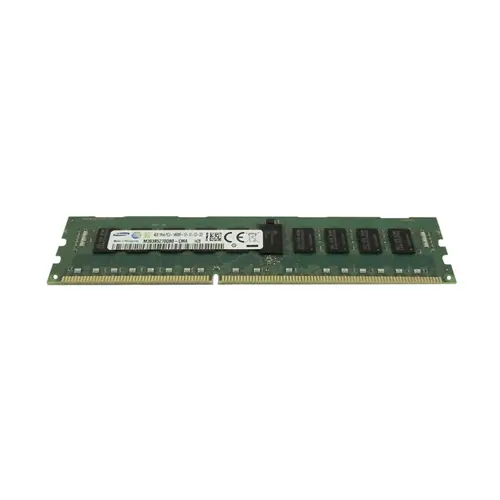
Characterized by its registered ECC design and single-rank x4 organization, this 4GB DDR3-1866 RDIMM is purpose-built for legacy server platforms running virtualization or in-memory database workloads where data integrity is non-negotiable. Its 1.5V operation, CL13 latency, and registered signaling work together to minimize electrical loading and ensure stable, error-free performance in multi-DIMM configurations.
1. ECC detection and correction safeguards transactional data integrity, eliminating silent memory errors that could crash critical financial or database services.
2. Registered signal buffering stabilizes command and address lines, allowing fully loaded server boards to maintain reliable operation across numerous DIMMs per channel.
3. Single Rank x4 organization minimizes electrical load per rank, enabling higher memory density in virtualized hosts without compromising signal quality.
4. The PC3-14900 peak bandwidth supplies consistent 14.9 GB/s throughput, preventing memory bottlenecks during heavy multi-tenant workload consolidation.
5. CL13 cycle latency shortens data retrieval time, directly accelerating query response in latency-sensitive enterprise applications.
The Samsung M393B5270QB0-CMA is a 4GB DDR3-1866 Registered ECC RDIMM, purpose-built for server environments where reliability and uptime are non-negotiable. Its four critical characteristics work together to solve real-world pain points. First, ECC detects and corrects single-bit errors—essential for financial databases or in-memory caching systems like Redis, where an undetected bit flip can silently corrupt records and cause application failures. Second, registered buffering stabilizes command and address signals, enabling you to fully populate all memory channels with multiple DIMMs; in a virtualization cluster running 50+ VMs per node, this prevents the signal degradation that would otherwise trigger random reboots. Third, the 1866MHz frequency delivers PC3-14900 bandwidth, accelerating concurrent data access during live migration or large-scale analytics queries. Finally, a single-rank x4 configuration presents a lighter electrical load, letting servers sustain full memory speed when every slot is filled—critical for hypervisors that demand maximum capacity without throttling. In practice, that translates to fewer crashes, consistent VM performance, and ironclad data integrity under constant load.
General Virtualization
For a general virtualization host, populate at least one DIMM per memory channel to maintain balanced memory interleaving and consistent performance. Using eight of these 4 GB RDIMMs (32 GB total) across two processors provides a solid entry point for hosting a dozen light to moderate VMs, while scaling to 64 GB or more is recommended for higher consolidation ratios.
In-Memory Database
In-memory databases demand maximum capacity and reliability, so you should fill all available channels with as many modules as the server platform supports. A configuration of 24 identical 4 GB RDIMMs (96 GB) per dual-socket node delivers ample headroom for large datasets, and leveraging the ECC and registered nature of these DIMMs safeguards data integrity during sustained operation.
High-Performance Computing
HPC workloads benefit from high memory bandwidth and low latency. Install one of these DDR3-1866 RDIMMs per channel (typically 4 or 8 modules per CPU) to run at the rated 1866 MHz speed without throttling. For bandwidth-sensitive codes, a minimal per-socket configuration of 16 GB (4 x 4 GB) keeps costs low while maximizing stream throughput and maintaining stable registered-clocked signal integrity.
Rigorously validated server memory. Compatible with Dell PowerEdge R720, HP DL380p Gen8, Lenovo RD430, and more.
Q: Can I mix this M393B5270QB0-CMA with other memory modules of different brands or speeds?
A: Mixing different brands or speeds with registered ECC memory is not advised. It may cause signal conflicts or boot failures, as servers require identical timing, rank, and voltage for guaranteed stability.
Q: Is this memory compatible with my system?
A: This RDIMM is built for Intel Xeon E5/E7 and AMD Opteron 6300 platforms that support DDR3-1866 registered ECC. Verify your motherboard explicitly requires 240-pin registered DIMMs at 1.5V.
Q: What is the recommended DIMM population order for optimal performance?
A: Populate identical DIMMs starting with the slot farthest from the CPU per channel. Balance memory across all memory channels and follow the server manual's numbering system for single-rank x4 modules.
Q: Does this module support overclocking or XMP profiles?
A: No. This is a JEDEC-compliant server memory module operating at DDR3-1866 CL13. It purposely excludes XMP and overclocking to prioritize data integrity and 24/7 stability in enterprise environments.
Q: What warranty and typical failure rate can I expect?
A: It includes a 1-year warranty. Samsung's stringent testing keeps the typical annualized failure rate well under 0.5% in properly cooled server environments, ensuring long-term mission-critical reliability.