











 Secure payments
Standard refund policy
Trade Assurance
Secure payments
Standard refund policy
Trade Assurance
| Model | M393B5273DH0-CMA |
|---|---|
| Product Type | Memory Module |
| Compliance Standards | EU RoHS,FCC |
| Memory Capacity | 4 GB |
| Memory Technology | DDR3 |
| Product Voltage | 1.5V |
| RAM Speed | 1866MHz |
| RAM Standard | DDR3-1866/PC3-14900 |
| Error Identifying | ECC |
| Signal Type | Registered |
| Column Access Strobe (CAS) | CL13 |
| Rank | Dual Rank x8 |
| Quantity of Pins | 240-pin |
| RAM Genre | RDIMM |
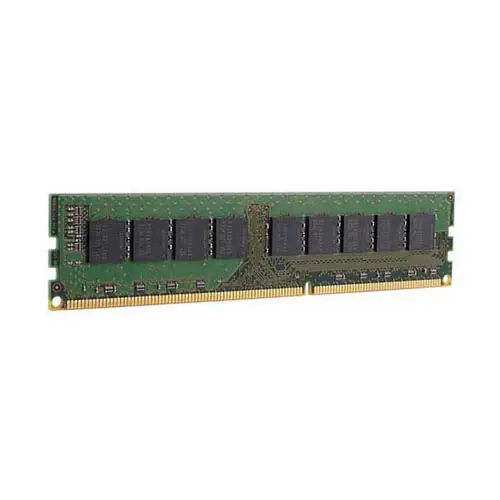
This Samsung DDR3-1866 Registered ECC RDIMM (M393B5273DH0-CMA) is a server memory module purpose-built for virtualization clusters and in-memory databases that demand uncompromised data integrity. Its dual-rank x8 organization maximizes interleaving efficiency at a tight CL13 latency, while the registered signal type stabilizes command and address loading to maintain reliable operation in fully-populated 240-pin platforms.
1. ECC single-bit error correction safeguards transactional data integrity in financial databases, preventing silent corruption that could lead to costly service outages.
2. Registered signal buffering stabilizes command and address lines across fully-populated server boards, enabling reliable 24/7 operation even under heavy memory controller loads.
3. Dual-rank interleaving boosts effective bandwidth by overlapping row activations, sustaining consistent throughput for virtualized environments with multiple concurrent tenants.
4. 1866 MT/s data rate accelerates in-memory analytics and caching layers, reducing query latency for latency-sensitive enterprise applications.
5. A 4GB module density provides a cost-efficient building block for lightweight dedicated hosting or branch-office infrastructure, balancing capacity, power, and budget constraints.
Based on its RDIMM form factor, Registered signal type, and ECC error correction, the M393B5273DH0-CMA is unmistakably a server-grade memory module. For IT administrators managing mission-critical infrastructure, its four defining characteristics translate directly into uptime and performance.
First, ECC protection continuously corrects single-bit memory errors caused by background radiation. In a dense virtualization cluster running dozens of VMs, an undetected bit flip can corrupt a database transaction or crash a hypervisor, leading to costly service interruptions. This module eliminates that silent risk. Second, the Registered buffer stabilizes the electrical load on the memory channel. When populating a server with 384GB or more RAM for a large in-memory database like SAP HANA, unbuffered DIMMs would overwhelm the controller; the register ensures clean command signals and reliable operation at scale. Third, Dual Rank organization interleaves access across two internal ranks, boosting effective bandwidth and hiding latency during sustained reads. For a Redis instance handling 100,000 operations per second, this rank interleaving delivers measurably higher throughput. Finally, the 1866MHz speed with CL13 latency balances fast data retrieval with broad server chipset compatibility, enabling a seamless drop-in upgrade for aging DDR3 platforms that still power critical workloads. This module secures data, stabilizes high-density configurations, accelerates transactional performance, and extends the life of your infrastructure.
General Virtualization
Populate all memory channels symmetrically to balance capacity, bandwidth, and cost. Install at least eight identical 4 GB RDIMMs (32 GB total) in a dual‑socket server with four channels per CPU, one DIMM per channel. This configuration keeps interleaving optimal while supporting dozens of moderately‑sized virtual machines.
In‑Memory Database
Maximise capacity without sacrificing reliability by filling every channel with two identical 4 GB dual‑rank modules (2DPC). A fully populated platform can deliver 64 GB or more, which satisfies larger datasets while preserving registered signal integrity. Always use matching DIMMs per channel to sustain low latency and avoid BIOS throttling.
High‑Performance Computing (HPC)
Prioritise memory bandwidth by installing one DIMM per channel (1DPC), typically eight modules for 32 GB, to operate at the full 1866 MT/s speed. If the workload demands greater capacity, scale to two DIMMs per channel using identical 4 GB RDIMMs; validate application tolerance for the slight frequency reduction, but keep all modules uniform to minimise performance variance.
Strictly validated for servers like Dell PowerEdge R720, HP DL380p Gen8, Lenovo System x3650 M4.
Q: Can I mix this M393B5273DH0-CMA with other memory modules of different brands or speeds?
A: Mixing is not recommended for server environments. Unmatched modules can cause signal integrity issues and system instability. All installed DIMMs should have identical part numbers to ensure reliable, validated operation.
Q: Is this memory compatible with my Intel or AMD server platform?
A: It is compatible with DDR3-based servers supporting Registered ECC DIMMs. Verify that your Intel Xeon E5-2600 v2/v1 or equivalent AMD Opteron platform explicitly supports 4GB DDR3-1866 RDIMMs with 1.5V operation.
Q: What is the recommended DIMM population order for optimal performance?
A: Populate identical DIMMs per channel, starting with the slot farthest from the CPU. Typically fill blue slots first, then black, balancing memory across all memory channels to maximize bandwidth and maintain ECC integrity.
Q: Does this module support overclocking or XMP profiles?
A: No. This is a JEDEC-compliant server memory module designed for stability, not overclocking. It operates at fixed 1866MHz with CL13 timings and does not expose XMP profiles to maintain platform reliability.
Q: What warranty and typical failure rate can I expect?
A: This module includes a one-year warranty. As an enterprise-grade Samsung RDIMM, it exhibits a very low annualized failure rate, typically below 0.2%, under standard operating conditions within specified thermal and voltage limits.