











 Secure payments
Standard refund policy
Trade Assurance
Secure payments
Standard refund policy
Trade Assurance
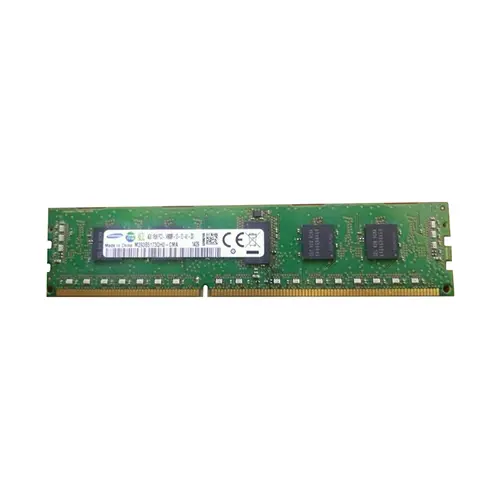
| Model | M393B5173QH0-CMA |
|---|---|
| Product Type | Memory Module |
| Compliance Standards | EU RoHS,FCC |
| Memory Capacity | 4 GB |
| Memory Technology | DDR3 |
| Product Voltage | 1.5V |
| RAM Speed | 1866MHz |
| RAM Standard | DDR3-1866/PC3-14900 |
| Error Identifying | ECC |
| Signal Type | Registered |
| Column Access Strobe (CAS) | CL13 |
| Rank | Single Rank x8 |
| Quantity of Pins | 240-pin |
| RAM Genre | RDIMM |
The M393B5173QH0-CMA is a server-grade DDR3-1866 Registered DIMM with ECC, purpose-built for virtualization platforms, in-memory databases, and mission-critical workloads where data integrity is non-negotiable. Its registered signal topology stabilizes high-capacity memory configurations by reducing electrical load on the memory controller, while the single-rank x8 organization and CL13 latency deliver consistent, low-latency access ideal for dense, multi-DIMM server deployments.
1. RDIMM architecture provides signal buffering, enabling large memory populations essential for heavy server workloads without compromising signal integrity.
2. ECC protection automatically corrects single-bit errors, safeguarding data integrity in mission-critical enterprise environments where uptime is paramount.
3. Registered signal lines reduce electrical loading on the memory bus, allowing servers to scale up to maximum capacity configurations reliably.
4. High-speed data rate delivers substantial memory bandwidth, accelerating database queries and virtual machine responsiveness under concurrent loads.
5. Modest density makes this module ideal for lightweight virtualization hosts, dedicated caching tiers, or micro-service deployments where power and cost efficiency take priority.
In mission‑critical server environments like virtualized clusters and in‑memory databases, the M393B5173QH0‑CMA RDIMM transforms key technologies into tangible uptime and performance. Its ECC engine continuously corrects single‑bit errors—an indispensable defense against cosmic‑ray‑induced bit flips that silently corrupt financial transactions or database indexes. With Registered logic, the module buffers command and address signals, allowing a hypervisor host to populate all channels with dozens of DIMMs without signal degradation; that translates directly into hosting more VMs per node and running larger Redis or Memcached footprints with deterministic latency. The 1866‑MHz clock rate, coupled with CL13 latency, feeds data‑hungry CPUs a steady 14.9 GB/s bandwidth, accelerating analytic queries and live migration operations. And because it’s built as a single‑rank x8 module, it places lighter electrical load on the memory controller, enabling dual‑socket systems to sustain high bus speeds even when fully loaded—eliminating the speed‑downgrade surprises that disrupt virtual machine responsiveness. For IT managers, this means fewer silent corruptions, denser consolidation, and predictable performance under the constant pressure of always‑on services.
General Virtualization
For general virtualization hosts, populate all memory channels symmetrically to maximize bandwidth and ensure consistent VM performance. Deploy these 4GB RDIMMs in sets of six or eight per CPU, aiming for total capacities of 96GB to 256GB depending on VM density, while leaving room for future scaling.
In-Memory Database
In-memory databases demand the lowest latency and highest capacity, so completely fill every DIMM slot with these modules and configure identical ranks across channels. Given the 4GB capacity per stick, target at least 384GB on a dual-socket system—using 24+ modules—to hold large datasets entirely in RAM and avoid storage I/O bottlenecks.
High-Performance Computing (HPC)
HPC workloads benefit from balanced memory bandwidth, so install an equal number of DIMMs per CPU socket and use the fastest supported speed (DDR3-1866) with all channels populated. While 4GB modules yield moderate node capacities (64–128GB), prioritize populating one or two DIMMs per channel to maintain high clock rates and avoid rank-induced speed reductions during parallel simulations.
Rigorously tested for server use; compatible with Dell PowerEdge R720, HPE DL380p Gen8, and Lenovo System x3650 M4.
Q: Can I mix this M393B5173QH0-CMA with other memory modules of different brands or speeds?
A: Mixing different brands or speeds is not recommended for this registered server memory. It may cause instability and compatibility issues. For optimal reliability, use identical modules with the same Samsung part number.
Q: Is this memory compatible with my system? For example, which Intel or AMD platforms support it?
A: This DDR3-1866 ECC RDIMM is compatible with servers using Intel Xeon E5-2600 v2 series or AMD Opteron 6300 series platforms that support 1.5V registered memory. Please verify your board’s qualified vendor list.
Q: What is the recommended DIMM population order for optimal performance?
A: Populate identical DIMMs per channel, typically filling blue slots first (A1, B1, C1 etc.). Refer to your server motherboard manual for the exact balanced memory configuration to maximize interleaving and performance.
Q: Does this module support overclocking or XMP profiles?
A: No, this is a server-grade registered DIMM built to JEDEC standards. It does not support overclocking or XMP profiles. It operates only at its specified speed of DDR3-1866 for maximum data integrity.
Q: What warranty and typical failure rate can I expect?
A: This Samsung module comes with a one-year warranty. It is manufactured to strict enterprise standards, yielding a very low annualized failure rate under normal server operating conditions.