











 Secure payments
Standard refund policy
Trade Assurance
Secure payments
Standard refund policy
Trade Assurance
| Model | M393B5270EB0-YK0 |
|---|---|
| Product Type | Memory Module |
| Compliance Standards | EU RoHS,FCC |
| Memory Capacity | 4 GB |
| Memory Technology | DDR3 |
| Product Voltage | 1.35V |
| RAM Speed | 1600MHz |
| RAM Standard | DDR3-1600/PC3-12800 |
| Error Identifying | ECC |
| Signal Type | Registered |
| Column Access Strobe (CAS) | CL11 |
| Rank | Single Rank x4 |
| Quantity of Pins | 240-pin |
| RAM Genre | RDIMM |
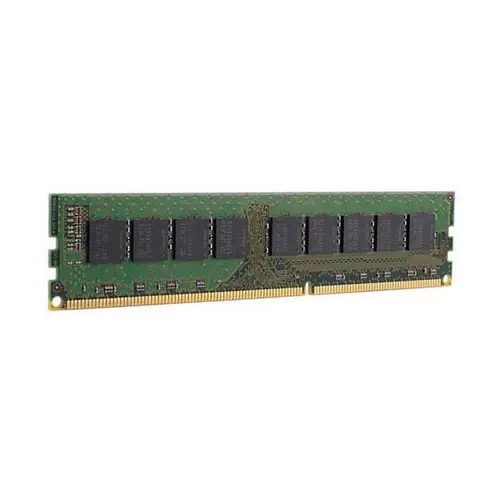
This DDR3-1600 Registered ECC RDIMM (M393B5270EB0-YK0) operating at a low 1.35 V is purpose-built for server platforms running virtualization, in-memory databases, and other mission-critical workloads where data integrity is paramount. Its single-rank x4 configuration combined with registered signal technology reduces electrical loading on the memory bus, delivering robust signal stability and reliable ECC error correction under sustained heavy loads.
1. Registered signal buffering reduces the electrical load on the memory controller, enabling large-capacity server configurations to run stably across all channels without signal degradation.
2. ECC protection detects and corrects single-bit memory errors in real time, safeguarding transactional data integrity and preventing silent corruption in always-on enterprise workloads.
3. Operating at a low-voltage DDR3L standard trims overall server power draw and associated cooling costs, directly benefiting dense rack deployments where every watt matters.
4. The high data rate delivers ample throughput for memory-bound virtualization clusters, ensuring that multiple guest instances access data with consistent, low-latency responsiveness.
5. A single-rank organization allows the module to sustain full rated speed even when server slots are fully populated, preserving predictable performance in capacity-maximized environments.
The Samsung M393B5270EB0-YK0 is clearly a server-grade registered DIMM, purpose-built for enterprise environments where downtime is measured in dollars and data integrity is non-negotiable. Its four defining characteristics directly address the pain points of IT infrastructure managers.
First, the ECC technology silently corrects single-bit memory errors in real time, shielding virtualized clusters from silent data corruption that could crash hypervisors or quietly poison financial transaction logs. In a memory database like Redis or SAP HANA, that means the difference between consistent query results and an unnoticed bit flip eroding your analytics accuracy over weeks. Second, the registered signal buffer stabilizes the command and address lines when you populate all memory channels across a server board; without it, a 24-slot VMware ESXi host would suffer signal degradation, leading to random kernel panics under heavy consolidation loads. Third, the 1.35V low-voltage operation slashes power consumption per DIMM by roughly 20% compared to standard 1.5V DDR3, which directly reduces cooling OPEX in a dense rack running hundreds of virtual desktops or container nodes. Finally, the 1600MHz speed with single-ranked x4 organization delivers consistent bandwidth per channel, preventing bottlenecks when multiple VMs compete for memory access during peak trading hours or large-scale in-memory ETL jobs. For a data center architect, this module translates into stable, predictable performance and a lower total cost of ownership at scale.
Server Memory (DDR3 4GB RDIMM ECC)
General Virtualization
For light to moderate VM density, install six to eight of these 4GB modules across all memory channels for 24–32GB total, ensuring balanced channel population for optimal bandwidth. Favor fully populating each channel with identical RDIMMs to maintain ECC reliability under mixed workloads. This cost-effective configuration suits entry-level hypervisors running multiple low-resource VMs.
In-Memory Database
Maximize capacity by fully populating all available DIMM slots—typically 12 or 16 modules (48–64GB)—to hold substantial working sets entirely in RAM. Pair every populated channel with matching modules to sustain consistent latency, which is critical for real-time query performance. Avoid mixing ranks or speeds, as the ECC registered design thrives on uniform configurations under heavy write loads.
High-Performance Computing (HPC)
Deploy eight or twelve modules in a symmetric layout across all memory channels, targeting 32–48GB total to supply high bandwidth per core. Use the same single-rank x4 RDIMMs in every slot to minimize memory access variability during parallel floating-point operations. A fully balanced configuration reduces NUMA penalties and keeps 1600MT/s throughput stable during sustained computational bursts.
Tested strictly for servers. Compatible with Dell PowerEdge R720, HP ProLiant DL380p Gen8, Lenovo ThinkServer RD430.
Q: Can I mix this M393B5270EB0-YK0 with other memory modules of different brands or speeds?
A: Mixing RDIMMs with different speeds or brands may cause instability. For optimal reliability, use identical Samsung modules with the same rank, speed, and CAS latency in a server environment.
Q: Is this memory compatible with my system?
A: This DDR3 Registered ECC module targets Intel Xeon E5-2600 v2 series and AMD G34 platforms. Verify your server board supports 1.35V DDR3 RDIMMs and a 240-pin interface before purchase.
Q: What is the recommended DIMM population order for optimal performance?
A: Populate identical RDIMMs per channel starting with the slots farthest from the CPU, following your server's memory population guide. Mixing single-rank x4 modules in balanced channels ensures maximum bandwidth.
Q: Does this module support overclocking or XMP profiles?
A: No. This is a server-grade Registered ECC module with fixed JEDEC timings (DDR3-1600 CL11). Overclocking and XMP are not supported, as enterprise platforms prioritize data integrity over frequency.
Q: What warranty and typical failure rate can I expect?
A: This Samsung module includes a 1-year warranty. It undergoes rigorous testing for enterprise use, with an typical annualized failure rate (AFR) well below 1% under specified conditions.