











 Secure payments
Standard refund policy
Trade Assurance
Secure payments
Standard refund policy
Trade Assurance
| Product Type | Memory Module |
|---|---|
| Memory Capacity | 4 GB |
| Memory Technology | DDR4 |
| Product Voltage | 1.2V |
| RAM Speed | 2133MHz |
| RAM Standard | DDR4-2133/PC4-17000 |
| Error Identifying | ECC |
| Signal Type | Registered |
| Column Access Strobe (CAS) | CL15 |
| Rank | Single Rank x8 |
| Quantity of Pins | 288-pin |
| RAM Genre | RDIMM |
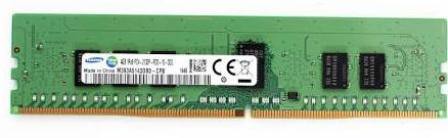
Designed specifically for entry-level server and small-scale virtualization platforms, this Samsung M393A5143DB0-CPBQ DDR4-2133 Registered DIMM leverages ECC and a registered signal architecture to ensure critical data integrity and stable operation under sustained memory loads. Its single-rank x8 configuration and CL15 latency efficiently minimize electrical loading on the memory bus, making it a cost-effective choice for memory-dense microservers and light in-memory database caching.
1. Error-correcting code protection silently identifies and repairs single-bit data corruption, safeguarding transactional accuracy in always-on enterprise databases.
2. Registered clock buffering maintains signal integrity across fully loaded memory channels, enabling massive capacity scaling for dense virtualization clusters.
3. Tightly timed column access latency reduces read retrieval stalls, giving latency-sensitive financial and caching workloads a consistent responsiveness edge.
4. Single-rank topology lowers per-channel electrical load, allowing stable high-speed data transfers even when every DIMM slot in a blade server is populated.
5. Low-voltage operation curbs overall power draw and waste heat, directly shrinking cooling costs and energy bills in large-scale data center deployments.
The Samsung M393A5143DB0-CPBQ is a DDR4 registered server module, purpose-built for environments where uptime and data accuracy are non-negotiable. In an in-memory database like SAP HANA or Redis, a single undetected bit flip can corrupt transactional records. Its ECC technology continuously corrects single-bit errors and catches multi-bit faults, turning silent data corruption into a non-event. For virtualized clusters hosting dozens of VMs, the registered clock driver buffers command and address signals, enabling you to fully populate memory channels without signal degradation—this directly prevents the cascading host failures that threaten consolidated workloads. The single-rank x8 organization further guarantees consistent, low-latency access, preserving predictable bandwidth even under heavy NUMA-aware scheduling. Meanwhile, the 1.2V power envelope reduces energy draw and thermal stress across 24/7 rack operation, shrinking both OpEx and cooling demands. What this means for you is clear: resilient transactional performance in memory-hungry virtualization and database scenarios, delivered with the energy discipline your data center demands.
General Virtualization
For dense VM hosting, this 4 GB DDR4-2133 RDIMM is best deployed in large quantities—start with at least 16 identical modules across all memory channels to maximize capacity and interleaving. Given its single-rank x8 design, populating two DIMMs per channel still allows speeds up to 2133 MHz on most platforms, providing a balanced mix of density and latency for moderate overcommit ratios.
In-Memory Database
Low latency is critical, so configure all memory channels symmetrically with one module per channel to avoid rank-switching penalties and maintain CL15 timings. A six- or eight-channel server fully loaded with 4 GB RDIMMs yields 24–32 GB, enough for moderate Redis or Memcached instances; for larger in-memory datasets, consider supplementing with higher-capacity Registered DIMMs while keeping the operating frequency consistent.
High-Performance Computing
HPC workloads favor bandwidth over raw capacity, so install this ECC Registered memory in a balanced configuration that populates every channel identically—typically one or two modules per channel. The 1.2 V operating voltage and 2133 MHz speed deliver a solid baseline for memory-bandwidth-bound simulations; however, for scale-out clusters, ensure an identical set of RDIMMs across all nodes to guarantee predictable floating-point reproducibility under ECC protection.
Rigorously tested, compatible with Dell PowerEdge R750, HPE ProLiant DL380 Gen10, Lenovo ThinkSystem SR650, and more.
Q: Can I mix this M393A5143DB0-CPBQ with other memory modules of different brands or speeds?
A: Mixing is strongly discouraged in server environments. For reliable ECC operation and system stability, always use identical modules with the same part number, rank, and speed across all populated channels.
Q: Is this memory compatible with my system?
A: This DDR4-2133 Registered ECC RDIMM is designed for servers based on Intel Xeon E5-2600 v3/v4 or AMD EPYC platforms. Verify your system board’s memory QVL for exact model support before purchasing.
Q: What is the recommended DIMM population order for optimal performance?
A: Follow your server vendor’s guidelines. Typically, populate identical DIMMs symmetrically across memory channels, beginning with the slot furthest from the CPU per channel, to ensure balanced interleaving and maximum bandwidth.
Q: Does this module support overclocking or XMP profiles?
A: No. This is a JEDEC-compliant enterprise memory module operating strictly at DDR4-2133 CL15. It does not support overclocking or XMP profiles to guarantee data integrity and maximum stability in mission-critical applications.
Q: What warranty and typical failure rate can I expect?
A: It includes a one-year warranty. As server-grade registered ECC memory, it demonstrates an extremely low annualized failure rate, typically under 0.5%, under normal thermal and electrical operating conditions.