











 Secure payments
Standard refund policy
Trade Assurance
Secure payments
Standard refund policy
Trade Assurance
| Model | M393A5143DB0-CPB00 |
|---|---|
| Product Type | Memory Module |
| Compliance Standards | EU RoHS,FCC |
| Memory Capacity | 4 GB |
| Memory Technology | DDR4 |
| Product Voltage | 1.2V |
| RAM Speed | 2133MHz |
| RAM Standard | DDR4-2133/PC4-17000 |
| Error Identifying | ECC |
| Signal Type | Registered |
| Column Access Strobe (CAS) | CL15 |
| Rank | Single Rank x8 |
| Quantity of Pins | 288-pin |
| RAM Genre | RDIMM |
Designed as a registered DDR4-2133 RDIMM with ECC, this single-rank x8 module ensures robust signal integrity and data reliability for server environments. It is ideally suited for virtualization, in-memory databases, and other enterprise workloads where consistent stability and error correction are critical.
1. DDR4 technology supplies the energy-efficient foundation needed to densely pack server nodes, lowering total power draw per virtual machine in large-scale data centers.
2. Error-correcting code protection automatically corrects single-bit memory errors, preserving transactional accuracy and uptime for mission-critical database engines.
3. Registered buffering decouples the memory bus from raw DRAM loads, enabling enterprises to scale system memory capacity reliably when deploying heavy in-memory analytics.
4. A 2133MHz transfer rate provides steady baseline bandwidth that keeps latency-sensitive financial or telco services responsive during concurrent request bursts.
5. Single Rank x8 organization minimizes bus loading per DIMM, granting administrators the flexibility to populate more channels and maximize virtualization density without signal degradation.
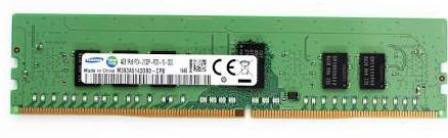
The Samsung M393A5143DB0-CPB00 is a DDR4-2133 Registered DIMM with ECC, engineered for relentless server environments. In virtualization clusters, where dozens of VMs contend for shared memory, the module’s Registered signal buffer ensures clean command/address signals even when all channels are fully loaded, eliminating the instability that plagues unbuffered memory under heavy load. Simultaneously, its ECC technology actively corrects single-bit errors—critical for in-memory databases like Redis or SAP HANA, where a silent bit flip could corrupt financial transactions or analytics results. The 1.2V ultra-low voltage significantly cuts power consumption and thermal output across rack-dense deployments, lowering cooling costs while preserving reliability. The Single Rank x8 organization at 2133MHz with CL15 latency delivers predictable, balanced throughput, preventing the performance cliffs that multi-rank configurations can impose during large sequential read operations. Backed by EU RoHS and FCC compliance, this module is purpose-built to sustain data fidelity and operational continuity when your business cannot tolerate downtime.
Server Memory Identification
This module is a DDR4-2133 Registered DIMM with ECC (RDIMM), 4 GB capacity, and standard 1.2 V. Designed for server platforms, it prioritizes data integrity and stable operation in multi-socket systems. The following capacity planning recommendations address three key enterprise workload profiles.
General Virtualization
Virtualized environments rely on ample, reliable memory to host numerous VMs. Using this single-rank 4 GB RDIMM, populate all memory channels symmetrically—for example, one DIMM per channel across eight channels yields 32 GB—to maximize interleaving and bandwidth. Configure additional identical modules to scale total capacity while maintaining balanced channel usage; ECC is critical for preventing silent data corruption during VM migration. For typical hypervisor overhead and guest density, aim for at least 64 GB by installing 16 modules across populated channels.
In-Memory Database
In-memory databases like Redis or SAP HANA demand the largest possible memory footprint with deterministic latency. Populate every available DIMM slot with these 4 GB RDIMMs to achieve the system’s maximum capacity, e.g., 96 GB using 24 slots. Single-rank modules can offer slightly better signal integrity at high slot counts. Although 2133 MT/s is moderate, the resulting large memory pool keeps hot datasets resident, and ECC safeguards transactional integrity. Pair with CPUs supporting high memory capacity and favor a balanced DIMM-per-channel layout.
High-Performance Computing (HPC)
HPC workloads are highly sensitive to memory bandwidth and parallel access. Install one DIMM per memory channel as a minimum, ideally two per channel if motherboard topology supports it without dropping speed, to populate all memory controllers. Even with this modest 4 GB capacity per stick, uniform population maximizes aggregate bandwidth through channel interleaving. Prioritize identical, single-rank RDIMMs to maintain consistent latency (CL15). For capacity-intensive simulations, scale by adding more modules per channel while keeping the interleaving scheme balanced, ensuring a stable, high-throughput fabric for scientific computing.
Rigorously tested server memory compatible with Dell PowerEdge R740, HPE ProLiant DL380 Gen10, Lenovo ThinkSystem SR650.
Q: Can I mix this M393A5143DB0-CPB00 with other memory modules of different brands or speeds?
A: Mixing is not recommended due to potential timing and signal integrity issues. Install identical RDIMMs to ensure stability. The system will clock down to the slowest module, and mixing may void support.
Q: Is this memory compatible with my Intel or AMD server platform?
A: It is compatible with DDR4-2133 ECC Registered platforms, such as Intel Xeon E5-2600 v3/v4 or select AMD EPYC. Verify RDIMM support and memory QVL for your specific motherboard.
Q: What is the recommended DIMM population order for optimal performance?
A: Populate identical DIMMs per memory channel starting with the farthest slot from the CPU. Follow your server’s manual for balanced channel configurations to maximize interleaving and throughput.
Q: Does this module support overclocking or XMP profiles?
A: No. As an enterprise RDIMM, it adheres to JEDEC DDR4-2133 standards for reliability. There are no XMP profiles, and overclocking is not supported to maintain error-free operation.
Q: What warranty and typical failure rate can I expect?
A: This module carries a one-year warranty. The annualized failure rate is typically under 0.5% under normal server conditions, contingent on proper cooling and operating within voltage/temperature specifications.