











 Secure payments
Standard refund policy
Trade Assurance
Secure payments
Standard refund policy
Trade Assurance
| Product Type | Memory Module |
|---|---|
| Compliance Standards | EU RoHS,FCC |
| Memory Capacity | 4 GB |
| Memory Technology | DDR4 |
| Product Voltage | 1.2V |
| RAM Speed | 2133MHz |
| RAM Standard | DDR4-2133/PC4-17000 |
| Error Identifying | Non-ECC |
| Signal Type | Unbuffered |
| Column Access Strobe (CAS) | CL15 |
| Rank | Single Rank x8 |
| Quantity of Pins | 288-pin |
| RAM Genre | UDIMM |
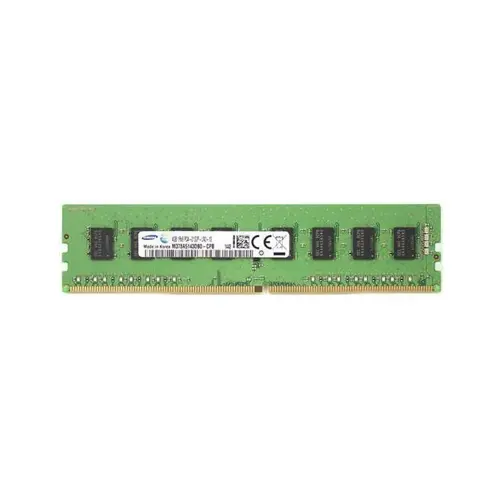
This 4GB DDR4-2133 non-ECC UDIMM is tailored for mainstream desktop platforms, delivering reliable performance for office productivity, content creation, and light gaming workloads. The single-rank x8 design and CL15 latency reduce electrical loading on the memory controller, improving signal integrity and enabling stable operation at the module’s native 1.2V standard voltage.
1. DDR4 technology doubles internal bank groups versus older DDR3, enabling smoother multitasking so content creators can render video, edit photos, and browse assets simultaneously without perceptible lag.
2. 2133 MHz speed delivers consistent baseline bandwidth that keeps frame times tight in esports titles, preventing micro-stuttering during competitive gameplay.
3. CL15 latency provides a responsive data access window, accelerating application launch times and file-switching snappiness for productivity workloads.
4. 1.2V operation generates less heat inside the case, helping sustain stable boost clocks and quieter fan curves during prolonged gaming or rendering sessions.
5. Single Rank x8 construction minimizes electrical loading on the CPU’s memory controller, expanding overclocking tolerance and plug-and-play compatibility across diverse desktop platforms.
As a standard desktop UDIMM, the M378A5143DB0-CPB is engineered for responsive, no-compromise computing. Its non-ECC, unbuffered architecture means the memory controller talks directly to the DRAM chips without any registering buffer, slashing signal turnaround time. For a gamer locked in a fast-paced AAA title, this translates to immediate command execution—every frame drawn and every texture streamed benefits from the bare-metal low latency. The tightly timed CL15 at 2133MHz ensures that data starts flowing after just 15 clock cycles, so in-memory game states and physics calculations never become a bottleneck.
Creative professionals face a different pain point: sustained throughput under heavy workloads. Here, the single-rank x8 organization shines by placing all memory chips on one side of the module, reducing electrical loading and improving signal integrity. During a lengthy 4K video render, this design keeps the memory subsystem stable and cool, preventing data corruption during the massive temporary file writes that video editors rely on. The 1.2V operating voltage further reinforces stability by minimizing heat buildup inside the case—crucial when both the CPU and GPU are fully stressed for hours. In effect, you get the consistent, stutter-free performance that turns a frustrating wait into a smooth creative session.
Desktop UDIMM Capacity Planning: DDR4-2133 4GB Non-ECC UDIMM
This module is a standard 288-pin DDR4-2133 UDIMM with a 4GB capacity, CL15 latency, and 1.2V operating voltage—ideal for mainstream desktops. Below are capacity planning guidelines for typical desktop workloads.
Gaming Build
For dual-channel performance, install two identical 4GB modules in the correct motherboard slots to achieve 8GB total. Many modern games benefit from 16GB; if your board has four DIMM slots, populate all four with these 4GB modules to reach 16GB while maintaining dual-channel symmetry. Avoid single-module configurations, which can starve frame rates in memory-sensitive titles.
Content Creation
Video editing, 3D rendering, and large photo composites thrive on ample RAM. A 4GB DIMM is too small—four populated slots yield only 16GB, which bottlenecks 4K timelines and complex scenes. For smooth 64GB workflows, replace these modules with higher-capacity 16GB or 32GB UDIMMs. Use the 4GB sticks only as a temporary stopgap while planning a capacity upgrade.
General Productivity
For office multitasking, web browsing, and media playback, 8GB is the sweet spot. A pair of these 4GB modules in dual-channel mode offers responsive performance at a budget-friendly price. A single 4GB module can suffice for extremely basic tasks, but dual-channel 8GB markedly improves system responsiveness when juggling multiple browser tabs and productivity applications.
Rigorously tested DDR4 UDIMM, compatible with desktops like Dell OptiPlex 7040, HP EliteDesk 800 G2, Lenovo ThinkCentre M700.
Q: Can I mix this M378A5143DB0-CPB with other memory modules of different brands or speeds?
A: Mixing is possible but not recommended. For stability, use modules with identical specifications—DDR4 2133MHz, CL15, 1.2V, single-rank—to avoid timing conflicts or system instability.
Q: Is this memory compatible with my desktop motherboard?
A: It is a standard 288-pin DDR4 UDIMM. It supports Intel 100/200/300 series and AMD AM4 platforms. Please verify your motherboard QVL or chipset compatibility for DDR4-2133.
Q: What is the recommended DIMM population order for optimal performance on my desktop?
A: For dual-channel performance, install modules in the same-color slots, typically DIMM A2 and B2 on 4-slot boards. Always consult your motherboard manual for the correct slot sequence.
Q: Does this module support overclocking or XMP profiles?
A: No, it adheres to JEDEC standard DDR4-2133 specifications. It does not feature XMP profiles and is not designed for overclocking, ensuring reliable operation at its rated speed.
Q: What warranty and typical failure rate can I expect?
A: This Samsung module includes a 1-year limited warranty. It meets Samsung’s high quality standards, resulting in a very low annualized failure rate under normal desktop operating conditions.