











 Secure payments
Standard refund policy
Trade Assurance
Secure payments
Standard refund policy
Trade Assurance
| Product Type | Memory Module |
|---|---|
| Compliance Standards | CE,WEEE,RoHS |
| Memory Capacity | 4 GB |
| Memory Technology | DDR4 |
| Product Voltage | 1.2V |
| RAM Speed | 2133MHz |
| RAM Standard | DDR4-2133/PC4-17000 |
| Error Identifying | Non-ECC |
| Signal Type | Unbuffered |
| Column Access Strobe (CAS) | CL15 |
| Rank | Single Rank x8 |
| Quantity of Pins | 288-pin |
| RAM Genre | UDIMM |
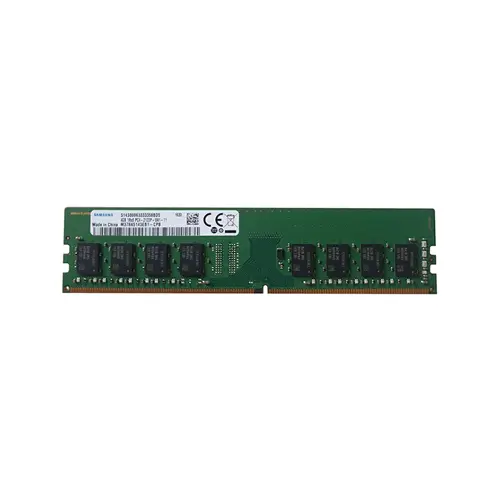
This DDR4 UDIMM module is tailored for desktop platforms, delivering reliable everyday productivity and responsiveness with its unbuffered design and efficient single-rank x8 configuration. The CL15 latency at 2133MHz ensures snappy command-to-data response for office workloads and light content creation, while the standard 1.2V operation maintains thermal headroom and energy efficiency across compatible systems.
1. DDR4 architecture delivers higher bandwidth headroom, enabling fluid multitasking and faster rendering for content creation workloads on modern desktop platforms.
2. Mainstream transfer rate ensures responsive application launches and consistent frame delivery in competitive online gaming without micro-stutter.
3. Entry-level capacity provides a cost-effective baseline for office productivity, keeping web browsing, document editing, and video conferencing smooth under light multitasking.
4. Tight CAS latency shortens the gap between data requests and execution, giving gamers quicker reaction feedback and a tangible edge in fast-paced titles.
5. Low voltage operation reduces thermal output inside the chassis, preserving stable boost clocks and leaving safer electrical headroom for performance tuning.
As a desktop memory module, the M378A5143EB1-CPB’s unbuffered, non-ECC architecture cuts out the buffer chip, allowing the memory controller to communicate directly with the DRAM particles. This matters acutely when you’re deep into a AAA game or rendering a 4K video timeline: every nanosecond of round-trip latency saved translates into smoother frame pacing and faster scrubbing through complex edits, because the CPU isn’t waiting on an intermediary layer. The CL15 column access strobe latency keeps initial data retrieval tight, so in CPU-bound gaming scenarios—like sprawling open-world titles—texture streaming feels instantaneous rather than stutter-prone. Operating at a low 1.2V, the module generates substantially less heat than legacy 1.5V DDR3, which is critical during sustained rendering jobs that push the system for hours; lower thermals mean consistent signal integrity and zero throttling of your work. Its single-rank x8 organization presents a light electrical load, making it broadly compatible with mainstream desktop chipsets and leaving room for future dual-channel expansion without overwhelming the memory controller. Whether you’re upgrading a compact creative workstation or chasing competitive response times, this module delivers the predictable, low-overhead performance that turns hardware potential into real-world productivity and immersion.
Based on the specifications—Non-ECC, Unbuffered, 288‑pin UDIMM—this is standard desktop DDR4 memory. The capacity planning recommendations below address typical consumer workloads.
Gaming Build
Dual-channel is essential for modern gaming to maximize memory bandwidth. A kit of two matched 8 GB modules (16 GB total) running at 3200 MHz or higher delivers smooth frame rates in current titles. For enthusiasts who stream or use heavily modded games, a 2 × 16 GB (32 GB) kit provides ample headroom and future-proofing.
Content Creation
Video editing, 3D rendering, and large-layer graphic design thrive on abundant RAM. Populate two slots with 32 GB modules for a 64 GB dual-channel configuration; this keeps 4K timelines and complex scenes entirely in memory, eliminating swap-file slowdowns. Alternatively, four identical 16 GB modules can reach 64 GB while maintaining symmetrical dual‑channel operation.
General Productivity
For web browsing, office suites, and light multitasking, a cost‑effective 2 × 4 GB (8 GB) dual‑channel kit offers responsive everyday performance. Users expanding from a single 4 GB module can simply add an identical stick to double capacity and enable dual‑channel, which also improves integrated graphics. An 8 GB single‑module solution is acceptable when planning a future upgrade path.
Rigorously tested desktop memory. Compatible with Intel 100/200, AMD AM4, and similar DDR4 UDIMM platforms.
Q: Can I mix this M378A5143EB1-CPB with other memory modules of different brands or speeds?
A: Mixing is possible but not recommended. The system will downclock all modules to the slowest common speed and may face compatibility issues. For optimal stability, use identical modules.
Q: Is this memory compatible with my system?
A: It is a standard 288-pin UDIMM for desktop platforms. Please check if your motherboard supports DDR4 non-ECC unbuffered memory, e.g., Intel 100/200/300 series or AMD 300/400 series chipsets.
Q: What is the recommended DIMM population order for optimal performance?
A: For a single module, use the DIMM_A2 slot (check manual). On dual-channel boards, install matched pairs in the same-colored slots, typically A2 and B2, to enable dual-channel mode.
Q: Does this module support overclocking or XMP profiles?
A: No. This module follows the JEDEC standard with a fixed 2133MHz CL15 profile. It does not support XMP profiles or overclocking; it runs at its native speed only.
Q: What warranty and typical failure rate can I expect?
A: We provide a 1-year warranty. The module uses high-quality Samsung chips with an extremely low AFR, typically below 0.5%. Quick replacement is offered for any defects.